
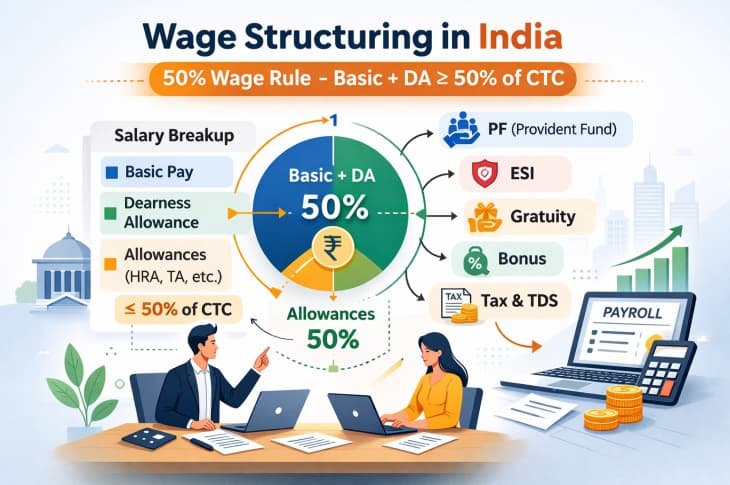
The landscape of wage structuring in India has undergone a significant transformation with the enactment of the four Labour Codes: the Code on Wages, 2019, the Industrial Relations Code, 2020, the Code on Social Security, 2020, and the Occupational Safety, Health and Working Conditions Code, 2020. These codes consolidate multiple fragmented labour laws into a unified framework, aiming to simplify compliance, enhance employee protection, and standardise the calculation of wages and benefits. While these Codes are primarily labour welfare statutes, they carry far-reaching implications for payroll structuring, statutory contributions, and income tax management.
Understanding the Shift: From Fragmented Laws to Unified Labour Codes
Previously, India’s labour laws were scattered across multiple statutes, each with its own definition of wages, contribution obligations, and exemptions. Employers often structured salaries with tax efficiency in mind, differentiating between “basic pay,” “allowances,” and “perquisites” to minimise statutory contributions.
The new Labour Codes aim to simplify and standardise the regulatory framework. Key objectives include:
- Consolidating wage-related laws to remove interpretational inconsistencies.
- Introducing a uniform statutory definition of wages, applicable across all Codes.
- Limiting the proportion of allowances and excluded components in salary calculation.
- Enhancing employee protection in social security contributions, gratuity, and other benefits.
This shift has direct consequences on payroll structuring, statutory contributions, and tax obligations, affecting both employers and employees.
The Uniform Definition of “Wages” and the 50% Threshold
1. Statutory Composition of Wages
The Code on Wages, 2019 and the Code on Social Security, 2020 define wages to provide uniformity and reduce disputes arising from differing interpretations under older laws. According to the Codes, “wages” comprise:
- Basic pay
- Dearness allowance (DA)
- Retaining allowance, where applicable
Components expressly excluded from wages include:
- House Rent Allowance (HRA)
- Overtime wages
- Statutory or incentive bonus
- Commission
- Employer’s contribution to provident fund
- Gratuity
- Conveyance allowance and travel reimbursements
- Other amenity-based payments
2. The 50% Rule
A critical feature of the Codes is the 50% threshold. Under Section 2(y), the total value of excluded components cannot exceed 50% of an employee’s total remuneration or Cost to Company (CTC). If the excluded components exceed this limit, the excess (except gratuity and retrenchment compensation) automatically becomes part of the statutory “wages.”
This rule ensures that artificial salary bifurcation, previously used to reduce statutory contributions, is no longer legally valid. Regardless of contractual labels, allowances exceeding 50% of CTC are deemed wages, increasing the wage base for social security contributions and statutory obligations.
Judicial Alignment
The Codes codify principles established in judicial precedents, notably:
Regional Provident Fund Commissioner (II) v. Vivekananda Vidyamandir & Ors. (2019) – The Supreme Court held that uniform allowances not linked to performance, output, or special skills must be included in “basic wages” for provident fund computation. Artificial segregation to reduce statutory contributions was disallowed.
By formalising these principles, the Codes reduce ambiguity and provide a predictable framework for wage calculation.
Implications Under the Income Tax Act, 1961
While the Labour Codes do not directly alter the Income Tax Act, 1961, they have significant indirect consequences.
1. Interaction Between Labour Codes and Income Tax
- Taxation of salary continues under Sections 15, 16, and 17 of the Income Tax Act.
- The Codes impact payroll composition, which changes the base figures for taxable salary, exemptions, and deductions.
- Employers may witness increased taxable salary and altered TDS obligations, even though the legal definition of “salary” under tax law remains unchanged.
2. Key Tax Implications
- Higher wage base: More components may be classified as “wages,” increasing taxable salary.
- Reduced exemption efficiency: Components like HRA may yield lower tax benefits when basic pay rises.
- Adjusted TDS obligations: Employers must recalculate monthly TDS to align with revised salary structures.
Provident Fund (PF) Considerations
1. Increased Contributions
Under the Codes, basic pay + DA must constitute at least 50% of CTC. This increases the base for provident fund contributions, leading to higher:
- Employee contributions
- Employer contributions
2. Employee Contribution and Section 80C
Employee contributions to the recognised provident fund (PF) remain eligible for deduction under Section 80C (up to ₹1.5 lakh annually). However:
- Many employees already exhaust the 80C limit through PF, ELSS, insurance, and housing loan principal repayments.
- Incremental PF contributions from wage restructuring may not provide additional tax benefit, impacting disposable income.
3. Employer Contribution and Perquisite Taxation
Employer contributions to PF and NPS are deductible within statutory limits:
- Old tax regime: Deduction up to 10% of salary (basic + DA)
- New tax regime: Deduction up to 14% of salary
Contributions exceeding the aggregate annual ceiling of ₹7.5 lakh become taxable under Section 17(2). Employers must monitor cumulative contributions to avoid under-reporting and tax non-compliance.
Employee State Insurance (ESI) Implications
The Code on Social Security, 2020 extends ESI coverage nationwide, replacing area-specific restrictions. Key points:
- Eligibility now depends on redefined “wages” rather than gross salary.
- More employees may be covered, increasing compliance costs for employers.
- Contribution rates may vary, often calculated on a narrower wage base, potentially lowering per-employee contributions.
TDS Implications for Employers
Employers deduct TDS under Section 192 based on estimated salary. Wage restructuring impacts:
- Taxable salary
- Eligible exemptions (HRA, LTA)
- Deductions (PF, NPS)
To ensure compliance:
- Monthly TDS calculations must reflect revised payroll structures.
- Failure to adjust may result in interest liability and penalties under the Income Tax Act.
Gratuity Under Labour Codes
1. Expansion of Gratuity Liability
The Code on Social Security, 2020:
- Extends gratuity eligibility to fixed-term employees after one year.
- For regular employees, the five-year continuous service rule remains.
- Gratuity is calculated on last drawn wages, so an increase in basic + DA inflates the liability.
2. Tax Treatment
- Exemption under Section 10(10) remains capped at ₹20 lakh for non-government employees.
- Higher wages may accelerate gratuity accrual, leading to earlier exhaustion of exemption.
- Any amount exceeding the limit is taxable as salary income.
Employers must accurately reflect gratuity in Form 16 to ensure tax compliance.
Bonus Implications
The Code on Wages retains the Payment of Bonus Act, 1965 framework:
- Minimum bonus: 8.33% of wages
- Maximum bonus: 20% (subject to allocable surplus)
Tax implications:
- Bonus is salary income under Section 15.
- Higher wages from restructuring may increase bonus quantum, impacting TDS.
- Employers must ensure accurate reporting to avoid compliance risks.
House Rent Allowance (HRA)
1. Statutory Framework
HRA exemptions under Section 10(13A) of the Income Tax Act are limited to:
- Actual HRA received
- Excess of rent paid over 10% of salary (basic + DA)
- 50% of salary for metro cities, 40% for non-metros
2. Impact of Wage Restructuring
- Increasing basic pay + DA raises the 10% of salary threshold.
- Exempt portion of HRA may decrease, reducing take-home pay.
- Employees must reassess HRA declarations to optimise tax benefits.
Other Allowances and Tax Character
Allowances like:
- Special allowance
- Conveyance allowance
- Meal allowance
- Leave travel allowance
remain taxable if exemption conditions are unmet. While the 50% add-back rule applies for labour law, it does not change the tax character of these allowances. However, higher basic pay indirectly increases overall taxable salary.
Old vs New Tax Regime Implications
1. Old Tax Regime
- Exemptions (HRA, LTA) and deductions (Sections 80C, 80D, housing loan interest) can offset higher wages.
- Provides flexibility to absorb increased taxable salary due to labour law compliance.
2. New Tax Regime
- Lower slab rates, but most exemptions and deductions are disallowed.
- Higher basic pay directly increases taxable income.
- Choice of regime becomes critical for employees impacted by wage restructuring.
Employers must:
- Obtain employee declarations on tax regime choice
- Align TDS calculations accordingly
- Follow CBDT Circular No. 03/2025 on salary TDS
Strategic Considerations for Employers
Given the far-reaching implications, employers must:
- Reevaluate salary structures: Align CTC components to comply with the 50% rule.
- Update payroll systems: Reflect revised wage composition for PF, gratuity, ESIC, and TDS calculations.
- Assess tax impact: Determine changes in taxable salary, exemptions, and deductions under both tax regimes.
- Communicate with employees: Ensure awareness of the changes, impacts on take-home salary, and retirement benefits.
- Monitor compliance: Regular audits to avoid penalties under labour and tax laws.
Practical Examples
Example 1: PF Impact
Employee CTC: ₹12 lakh
Old structure: Basic + DA = ₹4 lakh; Allowances = ₹8 lakh
- PF calculated on ₹4 lakh
New structure (50% rule): Basic + DA = ₹6 lakh; Allowances = ₹6 lakh
- PF calculated on ₹6 lakh → higher contribution from employee and employer
Example 2: HRA Impact
Basic + DA before restructuring: ₹3 lakh → HRA exemption calculation
After restructuring: ₹6 lakh → 10% threshold rises, reducing exempt portion
Example 3: Gratuity Impact
- Gratuity = 4.81 × Last drawn wages × Years of service
- Higher basic + DA → increased gratuity liability
Conclusion
The introduction of the Labour Codes has fundamentally reshaped wage structuring in India. By prescribing a uniform definition of wages and imposing the 50% threshold on exclusions:
- Employers must revise payroll and CTC structures
- Provident fund contributions, gratuity, bonuses, and HRA calculations are directly affected
- Tax implications under both old and new regimes need careful planning
Wage restructuring now requires a holistic approach, integrating labour law compliance with income tax considerations, payroll accuracy, and clear communication with employees. Failure to adopt such a strategy may result in regulatory risk, tax non-compliance, and employee dissatisfaction, potentially leading to disputes and litigation.
In this new era, understanding and navigating the Labour Codes is no longer optional—it is essential for employers who wish to remain compliant, optimise tax outcomes, and maintain workforce satisfaction.
கருத்துகள்
இவ்வாறு கருத்துத் தெரிவிக்கிறீர்கள் விருந்தினர்