


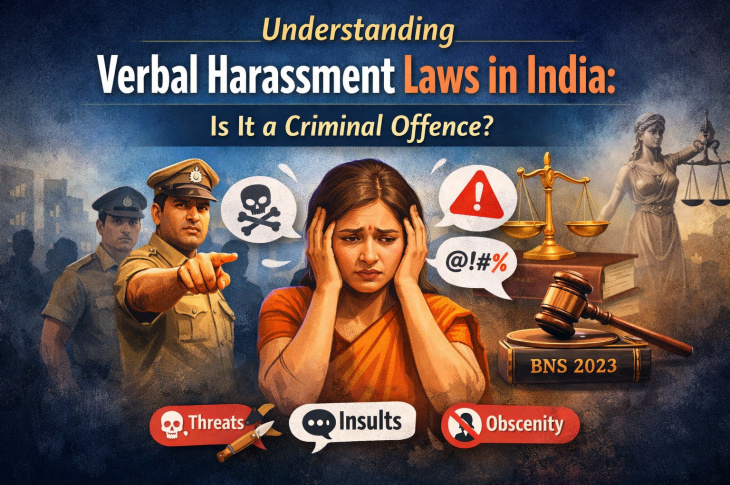


Understanding Verbal Harassment Laws in India: Is It a Criminal Offence?


Verbal harassment is often underestimated in Indian society. Many people believe that unless there is physical violence, abusive words do not amount to a serious legal issue. However, modern Indian criminal law recognises that words can deeply wound dignity, mental peace, reputation, and a person’s sense of safety. Insults, threats, humiliating remarks, and abusive language can cause lasting psychological harm and disturb public order.
With the enforcement of India’s new criminal laws in July 2024, verbal harassment continues to be punishable primarily under the Bharatiya Nyaya Sanhita, 2023 (BNS), which has replaced the Indian Penal Code, 1860 (IPC). While the law does not define “verbal harassment” as a single standalone offence, multiple provisions criminalise abusive, threatening, obscene, and dignity-violating speech.
Whether verbal harassment becomes a criminal offence depends on its nature, intention, context, location, and impact. This guide explains in detail how Indian law treats verbal harassment, when it becomes punishable, and what remedies are available to victims.
Also Read: Section 354 IPC: A Comprehensive Guide to Combating Physical Harassment
Meaning and Scope of Verbal Harassment
Verbal harassment refers to the use of spoken words, sounds, expressions, or gestures intended to insult, intimidate, humiliate, threaten, or mentally distress another person. It may occur as a single incident or as repeated behaviour and can take place in various environments such as:
-
Public places
-
Private interactions
-
Workplaces
-
Domestic settings
-
Educational institutions
-
Online and digital platforms
Verbal harassment is not the same as ordinary disagreement, criticism, or casual rudeness. It goes beyond momentary anger or social friction and usually involves an abuse of power, dominance, or intent to harm another person emotionally or psychologically.
Common forms of verbal harassment include:
-
Persistent insults or name-calling
-
Threats to life, safety, reputation, or property
-
Sexually inappropriate or lewd remarks
-
Public humiliation or ridicule
-
Caste-based, gender-based, or identity-based abuse
-
Verbal intimidation meant to silence or control
Indian criminal law focuses not merely on the words spoken, but on their intent and consequences.
Also Read: How to Handle Harassment from Loan Recovery Agents: Know Your Legal Options
Is Verbal Harassment a Crime in India?
Yes, verbal harassment can be a criminal offence in India, but not every unpleasant or offensive remark attracts criminal liability.
Indian law draws a clear distinction between:
-
Socially undesirable or rude behaviour, and
-
Criminal conduct that violates dignity, safety, or public order
Under the Bharatiya Nyaya Sanhita, 2023, verbal harassment becomes punishable when it crosses legally recognised thresholds, such as:
-
Creating fear or alarm
-
Intentionally insulting dignity
-
Provoking violence or breach of peace
-
Using obscene or sexually explicit language in public
-
Threatening life, reputation, or property
-
Insulting the dignity or modesty of women
Thus, the criminality of verbal harassment depends on intent, setting, seriousness, and social impact.
Verbal Harassment Under the Bharatiya Nyaya Sanhita, 2023
Obscene Acts and Words in Public Places (Earlier Section 294 IPC)
The Bharatiya Nyaya Sanhita penalises obscene acts, songs, or words used in public places that cause annoyance to others.
Verbal harassment may fall under this provision when it involves:
-
Vulgar or sexually explicit language
-
Lewd comments spoken loudly in public
-
Obscene songs or verbal expressions
-
Conduct causing public annoyance
Key legal elements include:
-
Use of obscene words or expressions
-
Occurrence in a public place
-
Annoyance caused to others
The punishment may include simple imprisonment, fine, or both. The law does not criminalise all offensive speech, but targets obscenity that affects public morality and peace.
Criminal Intimidation – Sections 351 and 352, BNS
(Earlier Sections 503 and 506 IPC)
Criminal intimidation is one of the most serious forms of verbal harassment recognised under Indian law.
Section 351 defines criminal intimidation as threatening a person with injury to:
-
Life
-
Body
-
Reputation
-
Property
The threat must be intended to cause alarm or to compel the victim to do or avoid doing something.
Section 352 prescribes punishment depending on the gravity of the threat.
Verbal harassment becomes criminal intimidation when it includes:
-
Threats to kill or cause physical harm
-
Threats to defame or damage reputation
-
Threats intended to instil fear or force compliance
Even if the threat is purely verbal, criminal liability arises if intention and alarm are established. Actual harm need not occur.
Intentional Insult Intended to Provoke Breach of Peace – Section 356, BNS
(Earlier Section 504 IPC)
This provision criminalises intentional insults made with the knowledge that such conduct is likely to provoke violence or disturb public peace.
Verbal harassment falls under this section when:
-
Abusive or insulting words are used deliberately
-
The speaker knows such words may provoke retaliation
-
There is a real likelihood of violence or disturbance
The law focuses not on emotional hurt alone, but on the risk to social order. Mere harsh language is not enough; the insult must be intentional and provocative.
Public Nuisance – Section 270, BNS
(Earlier Section 268 IPC)
Public nuisance refers to acts or omissions that cause common annoyance, danger, or inconvenience to the public.
Verbal harassment may amount to public nuisance when it involves:
-
Repeated shouting or abusive speech in public areas
-
Disturbance to neighbourhood peace
-
Loud verbal abuse affecting public comfort
The emphasis is on community impact, not just personal offence.
Word, Gesture or Act Intended to Insult the Modesty of a Woman – Section 79, BNS
(Earlier Section 509 IPC)
This is a crucial provision protecting women from verbal harassment.
Any word, sound, gesture, or act intended to insult the modesty of a woman is punishable.
Courts have consistently interpreted “modesty” as encompassing:
-
Dignity
-
Self-respect
-
Bodily autonomy
-
Personal integrity
Verbal harassment under this section includes:
-
Sexual remarks
-
Lewd comments
-
Gender-based humiliation
-
Derogatory references to body or character
This provision applies irrespective of whether the act occurs in public or private.
Also Read: What to Do If Your Landlord Is Harassing You: A Complete Legal Guide for Tenants
Verbal Harassment Under Special Laws
Protection of Women from Domestic Violence Act, 2005
Indian law recognises that verbal abuse within domestic relationships can be as damaging as physical violence.
The Act explicitly includes verbal and emotional abuse within the definition of domestic violence. This includes:
-
Persistent insults
-
Humiliation
-
Ridicule
-
Verbal degradation
An aggrieved woman can seek civil remedies such as:
-
Protection orders
-
Residence orders
-
Monetary relief
The focus is on protection and rehabilitation rather than punishment alone.
Sexual Harassment of Women at Workplace Act, 2013
Verbal harassment at the workplace involving sexually coloured remarks or verbal conduct of sexual nature is prohibited.
Employers are legally obligated to:
-
Prevent harassment
-
Establish Internal Complaints Committees
-
Provide safe working environments
The law treats verbal harassment as a violation of equality, dignity, and fundamental workplace rights.
Also Read: Know About Sexual Harassment At Workplace
Verbal Harassment in the Digital Space
With increasing online communication, verbal harassment frequently occurs through:
-
Social media comments
-
Emails and messages
-
Online forums and chats
The Bharatiya Nyaya Sanhita applies irrespective of the medium. Additionally, the Information Technology Act, 2000 addresses:
-
Obscene electronic content
-
Offensive messages
-
Online intimidation
Digital verbal harassment often causes amplified harm due to anonymity, permanence, and wide reach.
Evidentiary Challenges in Verbal Harassment Cases
One of the biggest challenges in prosecuting verbal harassment is proof.
Courts rely on:
-
Witness testimony
-
Audio or video recordings
-
Electronic records
-
Context and surrounding circumstances
Indian courts follow a balanced approach, protecting victims while preventing misuse of criminal law.
Not Every Verbal Act Is a Crime
Indian criminal law consciously avoids criminalising:
-
Ordinary arguments
-
Emotional outbursts
-
Isolated rude remarks
Verbal conduct becomes criminal only when it:
-
Is deliberate and malicious
-
Causes fear or humiliation
-
Violates legally protected dignity
-
Disturbs public peace
This balance protects free expression while addressing genuine harm.
Procedural Support Under the New Criminal Laws
The Bharatiya Nagarik Suraksha Sanhita, 2023 introduces several victim-friendly reforms, including:
-
Zero FIR, regardless of jurisdiction
-
Online complaint registration
-
Strengthened procedural safeguards
These measures improve access to justice for victims of verbal harassment.
Conclusion
Verbal harassment is not a trivial issue under Indian law. When it manifests as obscenity, intimidation, intentional insult, public nuisance, or dignity-based abuse, it is clearly punishable.
Under the Bharatiya Nyaya Sanhita, 2023, the protections earlier available under the IPC continue with clearer structure and improved procedural support. While not every unpleasant word invites criminal liability, verbal harassment that undermines dignity, creates fear, or disrupts social order is firmly recognised as a criminal offence.
Addressing verbal harassment through law is essential to protect mental safety, dignity, equality, and social harmony in modern India.
Frequently asked questions
Is verbal harassment punishable under Indian law?
Is verbal harassment punishable under Indian law?
Yes. Verbal harassment is punishable when it involves threats, intimidation, obscenity, public disturbance, or insult to dignity under the Bharatiya Nyaya Sanhita, 2023.
Can someone be arrested for verbal abuse alone?
Can someone be arrested for verbal abuse alone?
Yes, if the verbal abuse amounts to criminal intimidation, intentional insult provoking breach of peace, or obscene speech in public. Arrest depends on facts, intent, and severity.
Is verbal harassment against women treated differently?
Is verbal harassment against women treated differently?
Yes. Section 79 of the BNS specifically criminalises words, gestures, or acts intended to insult the dignity or modesty of a woman.
Can verbal abuse in a family setting be reported?
Can verbal abuse in a family setting be reported?
Yes. Under the Domestic Violence Act, verbal and emotional abuse by family members is recognised and victims can seek protection and relief.
What proof is required in verbal harassment cases?
What proof is required in verbal harassment cases?
Courts rely on witness statements, audio/video recordings, electronic messages, and surrounding circumstances.
Can I file a complaint online for verbal harassment?
Can I file a complaint online for verbal harassment?
Yes. Under the new criminal procedure laws, online complaints and Zero FIRs are allowed irrespective of jurisdiction.
Is shouting or abusing someone in public a crime?
Is shouting or abusing someone in public a crime?
It can be. Repeated or obscene verbal abuse in public places may attract punishment for public nuisance or obscene acts under the BNS.
Is verbal harassment at the workplace illegal?
Is verbal harassment at the workplace illegal?
Absolutely. Sexually coloured remarks or verbal misconduct at work violate the Sexual Harassment of Women at Workplace Act, 2013.
Does online verbal harassment count as a crime?
Does online verbal harassment count as a crime?
Yes. Online abuse, threats, or obscene messages are punishable under BNS provisions and the Information Technology Act, 2000.
Is every insult or argument a criminal offence?
Is every insult or argument a criminal offence?
No. Ordinary arguments, emotional exchanges, or casual rudeness are not crimes unless they cross legal thresholds like intimidation, humiliation, or public disorder.

Online Consultation


Online Consultations


Trending
Frequently asked questions
Is verbal harassment punishable under Indian law?
Is verbal harassment punishable under Indian law?
Yes. Verbal harassment is punishable when it involves threats, intimidation, obscenity, public disturbance, or insult to dignity under the Bharatiya Nyaya Sanhita, 2023.
Can someone be arrested for verbal abuse alone?
Can someone be arrested for verbal abuse alone?
Yes, if the verbal abuse amounts to criminal intimidation, intentional insult provoking breach of peace, or obscene speech in public. Arrest depends on facts, intent, and severity.
Is verbal harassment against women treated differently?
Is verbal harassment against women treated differently?
Yes. Section 79 of the BNS specifically criminalises words, gestures, or acts intended to insult the dignity or modesty of a woman.
Can verbal abuse in a family setting be reported?
Can verbal abuse in a family setting be reported?
Yes. Under the Domestic Violence Act, verbal and emotional abuse by family members is recognised and victims can seek protection and relief.
What proof is required in verbal harassment cases?
What proof is required in verbal harassment cases?
Courts rely on witness statements, audio/video recordings, electronic messages, and surrounding circumstances.
Can I file a complaint online for verbal harassment?
Can I file a complaint online for verbal harassment?
Yes. Under the new criminal procedure laws, online complaints and Zero FIRs are allowed irrespective of jurisdiction.
Is shouting or abusing someone in public a crime?
Is shouting or abusing someone in public a crime?
It can be. Repeated or obscene verbal abuse in public places may attract punishment for public nuisance or obscene acts under the BNS.
Is verbal harassment at the workplace illegal?
Is verbal harassment at the workplace illegal?
Absolutely. Sexually coloured remarks or verbal misconduct at work violate the Sexual Harassment of Women at Workplace Act, 2013.
Does online verbal harassment count as a crime?
Does online verbal harassment count as a crime?
Yes. Online abuse, threats, or obscene messages are punishable under BNS provisions and the Information Technology Act, 2000.
Is every insult or argument a criminal offence?
Is every insult or argument a criminal offence?
No. Ordinary arguments, emotional exchanges, or casual rudeness are not crimes unless they cross legal thresholds like intimidation, humiliation, or public disorder.
Online Consultations


Ask a Lawyer