


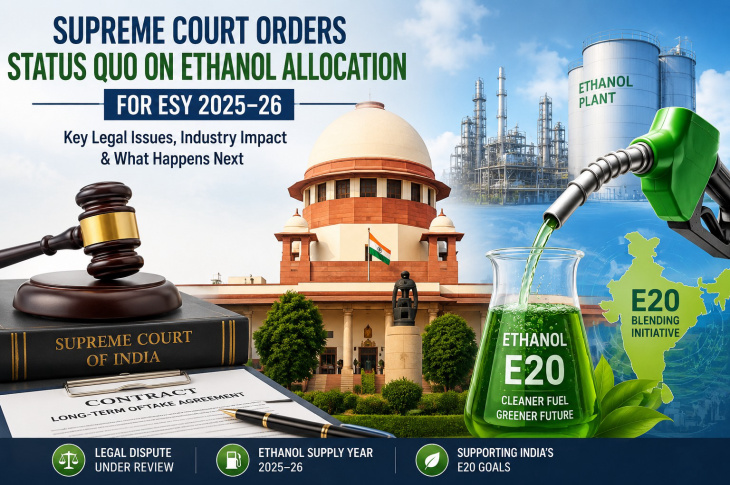


Supreme Court Directs Status Quo on Ethanol Allocation for ESY 2025–26: Understanding the Legal Dispute and Its Impact


India's ambitious ethanol blending programme has become one of the country's most significant energy transition initiatives. While the policy aims to reduce dependence on imported crude oil and promote cleaner fuels, disputes over ethanol procurement and allocation continue to test the legal framework governing the sector.
In a significant development, the Supreme Court has directed that the existing ethanol allocation for the Ethanol Supply Year (ESY) 2025–26 should remain unchanged while it examines a challenge filed by Bharat Petroleum Corporation Limited (BPCL) against a Karnataka High Court decision.
The dispute raises important questions regarding government policy, contractual obligations, legitimate expectation, and judicial intervention in large-scale public procurement.
Background of the Dispute
The case originates from an ethanol manufacturing company operating a dedicated ethanol production facility established specifically to supply ethanol to India's Oil Marketing Companies (OMCs).
For ESY 2025–26, the company offered to supply a significantly larger quantity of ethanol than what was ultimately allocated during the nationwide procurement process.
Believing that its dedicated status and contractual arrangement entitled it to preferential consideration, the company approached the Karnataka High Court after receiving a substantially lower allocation than its offered production capacity.
The High Court ruled in favour of reconsidering the company's representation under the relevant contractual provisions, leading BPCL to challenge the decision before the Supreme Court.
What is Ethanol Supply Year (ESY)?
The Ethanol Supply Year (ESY) is the annual procurement cycle during which Oil Marketing Companies purchase ethanol from approved suppliers for blending with petrol.
The procurement process involves:
| Stage | Description |
|---|---|
| Supplier Registration | Ethanol producers participate in procurement |
| Offer Submission | Suppliers indicate available production capacity |
| Allocation | OMCs distribute procurement quantities among suppliers |
| Agreement Execution | Contracts are finalized |
| Supply Period | Ethanol is delivered throughout the ESY |
The allocation process balances multiple policy objectives, including:
-
Ensuring nationwide fuel availability
-
Diversifying supplier participation
-
Maintaining competitive procurement
-
Achieving ethanol blending targets
-
Supporting domestic ethanol production
Why Was the Karnataka High Court Approached?
The manufacturer argued that it had established its plant exclusively to supply ethanol to Oil Marketing Companies under long-term contractual arrangements.
According to the company:
-
the plant was created based on government policy;
-
it was contractually restricted from selling ethanol elsewhere;
-
previous allocation practices recognized dedicated ethanol producers;
-
sudden reduction in allocation adversely affected business viability.
The company therefore sought reconsideration of its allocation in accordance with the contractual provisions governing preferential treatment.
Karnataka High Court's Observations
The High Court considered both the contractual framework and the historical relationship between the parties.
The Court observed that dedicated ethanol facilities, established under government policy and operating exclusively for OMCs, could legitimately expect consistent application of the procurement framework.
Rather than directly increasing the allocation, the Court directed the concerned Oil Marketing Companies to reconsider the company's request under the relevant clause of the Long-Term Offtake Agreement.
This distinction is important because the High Court did not itself redistribute ethanol quantities but required the authorities to revisit the representation within the contractual framework.
Why Did BPCL Challenge the High Court Order?
BPCL argued before the Supreme Court that altering allocations after completion of the nationwide procurement exercise could create significant administrative and policy complications.
According to the company, the procurement process for ESY 2025–26 had already reached an advanced stage, with contracts executed and substantial quantities of ethanol already supplied.
BPCL contended that:
-
reopening allocations for one supplier may affect allocations of others;
-
similar claims from additional suppliers could follow;
-
nationwide procurement planning could be disrupted;
-
implementation of India's E20 blending programme might be adversely impacted.
The appeal therefore focused not merely on one supplier's allocation but on preserving stability in the overall procurement mechanism.
Supreme Court's Interim Order
While issuing notice on BPCL's appeal, the Supreme Court directed that the parties maintain status quo regarding ethanol allocation.
An order of status quo generally means that existing arrangements should continue until the Court decides otherwise.
The interim direction ensures that:
-
current allocations remain unchanged;
-
no immediate redistribution occurs;
-
contractual implementation continues without disruption;
-
the Court has sufficient time to examine the legal questions involved.
Importantly, the interim order does not determine which party is ultimately correct.
Major Legal Questions Before the Supreme Court
The case raises several important legal issues.
1. Can Contractual Preference Create an Enforceable Right?
One central issue is whether contractual clauses providing preferential consideration create a legally enforceable entitlement to receive allocation matching production capacity.
The answer may influence future procurement disputes involving public contracts.
2. Scope of Legitimate Expectation
The doctrine of legitimate expectation often applies where government authorities consistently follow a particular policy or practice.
The Court may examine whether previous procurement practices created a reasonable expectation that dedicated ethanol plants would continue receiving preferential allocation.
3. Judicial Review of Public Procurement Decisions
Courts generally avoid interfering with commercial procurement decisions unless they are:
-
arbitrary;
-
discriminatory;
-
unreasonable;
-
contrary to statutory provisions;
-
violative of contractual obligations.
The Supreme Court may clarify the extent to which procurement allocations under national policy are open to judicial review.
4. Balancing Individual Rights and National Policy
The dispute illustrates the broader challenge of balancing:
| Individual Supplier Interests | National Policy Objectives |
|---|---|
| Fair contractual treatment | Stable procurement |
| Commercial viability | Uniform implementation |
| Legitimate expectation | E20 blending targets |
| Contract enforcement | Public interest |
Why This Case Matters for India's Ethanol Industry
The outcome could influence multiple stakeholders.
Dedicated Ethanol Manufacturers
Manufacturers operating exclusive ethanol facilities may receive greater clarity regarding:
-
allocation expectations;
-
contractual rights;
-
future procurement certainty.
Oil Marketing Companies
The judgment could establish clearer standards governing:
-
allocation methodology;
-
contractual interpretation;
-
handling supplier representations;
-
procurement flexibility.
Government Policy
India's ethanol blending programme depends upon predictable procurement mechanisms.
A clear judicial ruling could reduce future litigation while improving confidence among investors in ethanol infrastructure.
Possible Industry Implications
Depending on the Supreme Court's final decision, the judgment could:
-
clarify interpretation of Long-Term Offtake Agreements;
-
define limits of preferential allocation;
-
strengthen procurement transparency;
-
influence future ethanol policy revisions;
-
establish precedent for government procurement disputes.
Timeline of Events
| Event | Development |
|---|---|
| ESY 2025–26 Procurement | Ethanol allocation finalized |
| Supplier Representation | Request for enhanced allocation submitted |
| Karnataka High Court | Directed reconsideration under contractual clause |
| BPCL Appeal | Supreme Court challenged High Court order |
| Supreme Court | Ordered maintenance of status quo |
Conclusion
The Supreme Court's interim direction maintaining status quo reflects the need to preserve stability while important legal questions are examined. At the heart of the dispute lies a broader issue that extends beyond one supplier—the balance between contractual expectations and the practical realities of implementing a nationwide public procurement policy.
The Court's eventual ruling is likely to shape how dedicated ethanol producers, Oil Marketing Companies, and government agencies approach procurement under India's expanding biofuel programme. It may also provide valuable judicial guidance on contractual interpretation, legitimate expectation, and the limits of judicial intervention in large-scale policy implementation.
As India continues pursuing its clean energy objectives, the decision will be closely watched by stakeholders across the energy, legal, and manufacturing sectors.
Frequently asked questions
What does the Supreme Court's status quo order mean?
What does the Supreme Court's status quo order mean?
It means that the existing ethanol allocation arrangement will continue until the Court hears and decides the matter.
Does the order increase the supplier's allocation?
Does the order increase the supplier's allocation?
No. The Supreme Court has not granted any increase. It has only directed that the present position be maintained.
Why is the dispute significant?
Why is the dispute significant?
The case concerns the balance between contractual rights of dedicated ethanol suppliers and the government's nationwide ethanol procurement policy.
What is the E20 blending programme?
What is the E20 blending programme?
The E20 programme aims to blend 20% ethanol with petrol to reduce fossil fuel dependence, lower emissions, and support domestic biofuel production.
Can this judgment affect other suppliers?
Can this judgment affect other suppliers?
Potentially yes. The Supreme Court's interpretation of procurement contracts and allocation principles could influence future disputes involving similarly situated suppliers.

Online Consultation


Online Consultations


Trending
Frequently asked questions
What does the Supreme Court's status quo order mean?
What does the Supreme Court's status quo order mean?
It means that the existing ethanol allocation arrangement will continue until the Court hears and decides the matter.
Does the order increase the supplier's allocation?
Does the order increase the supplier's allocation?
No. The Supreme Court has not granted any increase. It has only directed that the present position be maintained.
Why is the dispute significant?
Why is the dispute significant?
The case concerns the balance between contractual rights of dedicated ethanol suppliers and the government's nationwide ethanol procurement policy.
What is the E20 blending programme?
What is the E20 blending programme?
The E20 programme aims to blend 20% ethanol with petrol to reduce fossil fuel dependence, lower emissions, and support domestic biofuel production.
Can this judgment affect other suppliers?
Can this judgment affect other suppliers?
Potentially yes. The Supreme Court's interpretation of procurement contracts and allocation principles could influence future disputes involving similarly situated suppliers.
Online Consultations


Ask a Lawyer