


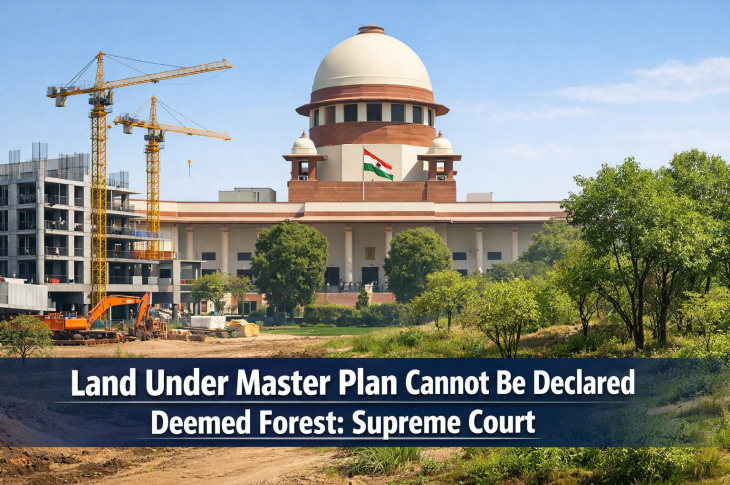


Supreme Court Rules Land Under Master Plan Cannot Be Declared ‘Deemed Forest’ Due to Later Vegetation Growth


The Supreme Court of India has delivered an important judgment clarifying how land earmarked for development under a legally approved Master Plan should be treated when vegetation or trees grow on that land over time. In a significant ruling, the Court held that land designated for development under a notified Master Plan cannot automatically be classified as a “deemed forest” simply because vegetation or tree cover appears later.
This decision provides much-needed clarity for urban development authorities, infrastructure agencies, environmental regulators, landowners, and developers across India. It reinforces the legal authority of Master Plans and ensures that development projects are not unnecessarily delayed due to changing vegetation patterns that were not present when the land use plan was approved.
The ruling came in the case of:
-
Naveen Solanki and Another v. Rail Land Development Authority and Others
-
Neutral Citation: 2026 INSC 270
-
Civil Appeal No. 10656 of 2024
The judgment was delivered by a Division Bench comprising Justice Dipankar Datta and Justice Augustine George Masih.
Background of the Case: Bijwasan Railway Station Development Dispute
The case arose from a redevelopment project near Bijwasan Railway Station in Delhi, where a statutory railway authority issued a Request for Proposal (RFP) for mixed-use development of railway land.
The project was part of an urban development plan designed to modernize infrastructure and utilize railway land efficiently.
However, the project faced legal opposition.
The Objection Raised
An applicant approached the National Green Tribunal (NGT) claiming:
-
The land contained a large number of trees
-
The land should be treated as forest land
-
Development could not proceed without prior approval from the Central Government under the Forest (Conservation) Act, 1980
The applicant argued that the presence of vegetation meant the land qualified as a “deemed forest.”
What Is a “Deemed Forest”?
Understanding this concept is essential to grasp the significance of the judgment.
Definition of Deemed Forest
A deemed forest is land that:
-
Is not officially notified as a forest
-
But functions like a forest in reality
-
Has dense vegetation or ecological characteristics similar to a forest
The concept was established by the Supreme Court in the landmark case:
T.N. Godavarman Thirumulkpad v. Union of India
In that case, the Court held:
The term “forest” should be understood in its dictionary meaning and not limited only to officially notified forests.
This expanded the definition of forest land to include:
-
Recorded forest land
-
Areas functioning as forests
-
Land with significant tree cover
However, the Court also clarified that classification must consider:
-
Historical land use
-
Government records
-
Ecological characteristics
Why the Case Reached the Supreme Court
After the National Green Tribunal dismissed the initial application, third parties filed an appeal claiming public interest.
Arguments Made by the Appellants
The appellants argued:
The land should be treated as a deemed forest because:
-
Survey reports showed significant tree density
-
Vegetation had grown on the land
-
Environmental protection laws should apply
They claimed that:
Development without forest clearance would violate environmental laws.
Arguments Made by the Respondents
The respondents—government authorities and development agencies—presented the following points:
-
The land was historically agricultural
-
It was never recorded as forest land
-
It was included in a legally approved Master Plan
-
Any necessary permissions for tree removal would be obtained
They emphasized that:
Vegetation growth after the Master Plan approval cannot change the legal status of land.
Supreme Court’s Key Legal Question
The central legal issue before the Court was:
Can land designated for development under a Master Plan become a “deemed forest” simply because vegetation or trees grow on it later?
The Supreme Court answered:
No.
Supreme Court’s Landmark Ruling
The Supreme Court held that:
Land earmarked for development under a duly approved and notified Master Plan cannot be declared a deemed forest solely due to later vegetation growth.
This ruling reinforces the legal authority of urban planning frameworks and prevents uncertainty in development projects.
Legal Status of a Master Plan: Not Just a Policy Document
One of the most important parts of the judgment is the Court’s clarification regarding the nature of a Master Plan.
What the Supreme Court Said
The Court observed that:
A Master Plan is:
-
A statutory planning instrument
-
Prepared by a competent authority
-
Legally binding on all stakeholders
It is not:
-
A temporary policy
-
A suggestion
-
A flexible guideline
Why This Matters
This means:
Once a Master Plan is approved:
-
It becomes legally enforceable
-
It governs land use
-
It guides urban development
-
It cannot be ignored without formal modification
Vegetation Growth Does Not Automatically Create a Forest
The Supreme Court clearly rejected the argument that:
Tree growth alone can transform land into a forest.
Key Legal Principle
The Court stated that:
The determination of forest status must consider:
-
Historical land character
-
Government land records
-
Planning documents
-
Ecological conditions
Not just:
Vegetation density.
Native vs. Invasive Vegetation: A Crucial Distinction
Another significant aspect of the judgment is the distinction between:
-
Native vegetation
-
Invasive species
Native Vegetation
Native vegetation includes:
Plants that:
-
Evolved naturally in a region
-
Support biodiversity
-
Maintain ecological balance
These plants:
-
Sustain wildlife
-
Support pollinators
-
Protect soil systems
Invasive Species
Invasive species are:
Plants introduced from outside their natural habitat.
They:
-
Spread aggressively
-
Displace native plants
-
Disturb ecosystems
The Court noted:
Many trees found on the disputed land were invasive species.
Legal Impact
The Court held:
The presence of invasive vegetation does not automatically indicate the existence of a natural forest ecosystem.
This clarification is extremely important for:
-
Urban planning
-
Infrastructure development
-
Environmental regulation
Importance of Historical Land Classification
The Supreme Court emphasized that:
Land classification must be based on historical records.
Key Factors Considered
The Court examined:
-
Revenue records
-
Land use history
-
Urban planning documents
-
Master Plan classification
These records showed:
The land was not classified as forest when the Master Plan was created.
Master Plan Has Primacy Over Later Changes
One of the strongest legal principles established in this judgment is:
The Master Plan prevails over later changes in vegetation.
Supreme Court Observation
The Court stated:
If land remains unused or changes naturally over time, those changes do not affect the legal status of the land unless the Master Plan is officially modified.
Simple Example
Suppose:
A plot of land is designated for residential development.
If trees grow on that land over time:
-
That does not automatically turn it into forest land.
-
Only a legal change to the Master Plan can alter its classification.
No Central Government Approval Required Under Forest Conservation Act
The Supreme Court clarified another critical issue.
Section 2 of the Forest (Conservation) Act, 1980
This law requires:
Central Government approval before:
-
Using forest land for non-forest purposes
-
Starting development projects on forest land
Court’s Conclusion
The Court held:
-
Since the land was not forest land:
-
Central Government approval was not required.
Environmental Protection Still Required
Although the Court allowed development to proceed, it emphasized:
Environmental safeguards must still be followed.
Mandatory Measures Ordered by the Court
Authorities must:
-
Transplant native trees wherever possible
-
Protect existing vegetation
-
Carry out compensatory afforestation
-
Obtain necessary environmental permissions
What Is Compensatory Afforestation?
Compensatory afforestation means planting new trees to replace those removed during development.
Purpose
It helps:
-
Maintain ecological balance
-
Reduce environmental damage
-
Protect biodiversity
Role of the National Green Tribunal
The National Green Tribunal (NGT) played an important role in this case.
What the NGT Did
The NGT:
-
Examined evidence
-
Reviewed land records
-
Evaluated environmental claims
It concluded:
-
There was no proof that the land was forest.
-
The Supreme Court upheld this decision.
Impact of the Judgment on Urban Development
This ruling has major implications for infrastructure and city planning across India.
Key Benefits
The judgment:
-
Provides legal clarity
-
Reduces project delays
-
Prevents misuse of environmental claims
-
Strengthens urban planning systems
Sectors Affected
The decision will impact:
-
Railway development
-
Metro projects
-
Housing development
-
Commercial real estate
-
Public infrastructure
Impact on Landowners and Developers
The ruling offers significant legal certainty for property owners and developers.
What It Means for Developers
Developers can:
-
Proceed with projects under approved Master Plans
-
Avoid unnecessary forest clearance procedures
-
Rely on official land classification
What It Means for Landowners
Landowners gain:
-
Protection from sudden land reclassification
-
Clear development rights
-
Legal certainty in property use
Impact on Environmental Regulation
The judgment also protects environmental law from misuse.
Balanced Approach
The Court maintained a balance between:
-
Environmental protection
-
Urban development
Why This Matters
Without this clarification:
-
Projects could be delayed indefinitely
-
Urban planning could become unpredictable
-
Investment could decline
Legal Principles Established by the Supreme Court
This judgment establishes several important legal principles.
Principle 1: Master Plan Has Statutory Force
A Master Plan is legally binding.
Principle 2: Vegetation Growth Does Not Change Land Status
Trees alone do not create a forest.
Principle 3: Historical Land Use Matters
Land classification depends on official records.
Principle 4: Environmental Protection Must Continue
Development must follow environmental safeguards.
Practical Implications for Government Authorities
Government agencies must:
-
Follow Master Plans
-
Protect environmental resources
-
Obtain necessary permissions
Responsibilities of Authorities
Authorities must ensure:
-
Legal compliance
-
Environmental protection
-
Transparent decision-making
Why This Judgment Matters for India’s Urban Future
-
India is rapidly urbanizing.
-
Cities are expanding.
-
Infrastructure demand is growing.
This judgment provides a clear legal framework for managing that growth responsibly.
Real-World Example of the Judgment’s Application
Consider this scenario:
A city designates land for:
Commercial development.
Over time:
Trees grow on the land.
Under this ruling:
The land remains commercial land.
Unless:
The Master Plan is legally changed.
Key Takeaways From the Supreme Court Judgment
The Supreme Court has clarified that:
Land under a Master Plan cannot become a deemed forest due to later vegetation growth.
This principle:
Protects urban planning
Supports infrastructure development
Ensures legal certainty
Maintains environmental safeguards
Conclusion
The Supreme Court’s decision in Naveen Solanki v. Rail Land Development Authority (2026) is a landmark judgment in the field of urban planning and environmental law.
It establishes a clear and practical rule:
The legal status of land depends on official planning records and historical classification—not on vegetation that appears later.
By reaffirming the statutory authority of Master Plans while ensuring environmental safeguards, the Court has created a balanced framework that supports both:
-
Development
-
Environmental protection
This ruling will guide:
-
Developers
-
Government agencies
-
Courts
-
Landowners
-
Urban planners
for years to come.
Frequently asked questions
Can land become a forest just because trees grow on it?
Can land become a forest just because trees grow on it?
No.
The Supreme Court has clarified that:
Tree growth alone does not make land a forest.
What is a Master Plan?
What is a Master Plan?
A Master Plan is:
A legally approved document that defines how land in a city will be used.
Does this judgment weaken environmental protection?
Does this judgment weaken environmental protection?
No.
The Court required:
Tree protection
Afforestation
Environmental compliance
Can development proceed without forest clearance?
Can development proceed without forest clearance?
Yes, if:
The land is not classified as forest.
Who decides whether land is forest?
Who decides whether land is forest?
Authorities determine this based on:
Government records
Land history
Environmental characteristics

Online Consultation


Online Consultations


Trending
Frequently asked questions
Can land become a forest just because trees grow on it?
Can land become a forest just because trees grow on it?
No.
The Supreme Court has clarified that:
Tree growth alone does not make land a forest.
What is a Master Plan?
What is a Master Plan?
A Master Plan is:
A legally approved document that defines how land in a city will be used.
Does this judgment weaken environmental protection?
Does this judgment weaken environmental protection?
No.
The Court required:
Tree protection
Afforestation
Environmental compliance
Can development proceed without forest clearance?
Can development proceed without forest clearance?
Yes, if:
The land is not classified as forest.
Who decides whether land is forest?
Who decides whether land is forest?
Authorities determine this based on:
Government records
Land history
Environmental characteristics
Online Consultations


Ask a Lawyer