


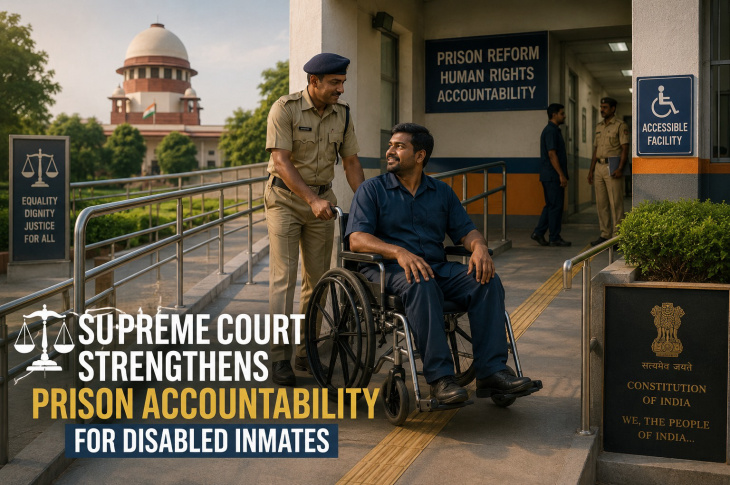


Supreme Court Strengthens Prison Accountability with Expanded Oversight for Disabled Inmates


Introduction
The Indian justice system is founded on the principle that every individual deserves dignity, equality, and protection under the law. These rights do not disappear when a person enters a prison. In a significant development, the Supreme Court of India has reinforced this principle by issuing important directions aimed at improving the treatment and protection of prisoners with disabilities.
The Court's decision comes as a major step toward making prisons more humane, inclusive, and accountable. By expanding the role of an existing prison reforms oversight committee, the Supreme Court has sought to ensure that inmates with disabilities receive proper care, accessibility, medical support, and equal treatment during their incarceration.
This judgment is not merely about prison administration. It reflects a broader commitment to human rights, constitutional values, disability inclusion, and institutional accountability. It also sends a strong message that vulnerable groups, including persons with disabilities, cannot be ignored simply because they are behind bars.
Understanding the Supreme Court's Recent Intervention
The Supreme Court's latest directions focus on ensuring that prisons across India adequately protect the rights of persons with disabilities.
The Court recognized a troubling reality: while India has strong laws protecting disabled persons, implementation inside prisons remains inconsistent and often inadequate. Many prisons lack accessible infrastructure, specialized medical support, assistive devices, and trained personnel.
To address these concerns, the Court expanded the responsibilities of an existing high-level prison reforms committee. The committee will now actively monitor whether prisons are complying with disability rights standards and constitutional obligations.
The objective is clear:
-
Ensure dignity and equality for disabled inmates.
-
Improve accessibility within prison facilities.
-
Strengthen accountability among prison authorities.
-
Monitor implementation of disability-related laws.
-
Recommend corrective measures wherever violations occur.
This move reflects a shift from policy discussions to practical enforcement.
Why Disabled Prisoners Need Special Protection
Double Vulnerability in Custody
Persons with disabilities often face challenges even in ordinary social environments. Inside prisons, those challenges can become significantly worse.
A disabled inmate may face:
-
Physical barriers in moving around prison premises.
-
Difficulty accessing toilets and bathing facilities.
-
Limited access to healthcare.
-
Communication barriers.
-
Dependence on other inmates for daily activities.
-
Increased risk of neglect or abuse.
As a result, disabled prisoners occupy one of the most vulnerable positions within the criminal justice system.
Example
Consider a wheelchair-bound prisoner lodged in a prison without ramps or accessible toilets. Even routine activities such as eating, bathing, attending court hearings, or accessing medical services become difficult.
Similarly, a hearing-impaired inmate may struggle to understand prison instructions or communicate effectively without appropriate support systems.
The Supreme Court recognized these realities and emphasized the need for institutional safeguards.
Constitutional Rights Continue Behind Prison Walls
One of the most important principles of Indian constitutional law is that imprisonment does not extinguish fundamental rights.
Article 21: Right to Life and Dignity
Article 21 of the Constitution guarantees every person the right to life and personal liberty.
Over the years, courts have interpreted this provision broadly to include:
-
Right to live with dignity.
-
Right to health.
-
Right to humane treatment.
-
Right to protection against cruel treatment.
Prisoners remain entitled to these rights.
The Supreme Court has repeatedly held that incarceration limits only those freedoms that are necessarily restricted by law. Human dignity remains intact.
Article 14: Equality Before Law
Article 14 guarantees equality before the law and equal protection of laws.
For disabled prisoners, equality does not mean treating everyone identically.
Instead, equality often requires:
-
Reasonable accommodation.
-
Special facilities.
-
Accessibility measures.
-
Additional support systems.
Without such measures, disabled inmates may be placed at a significant disadvantage compared to other prisoners.
Article 15 and Social Justice Principles
India's constitutional framework supports the protection of vulnerable and marginalized groups.
Providing disability-friendly prison facilities is consistent with the broader constitutional vision of social justice and inclusive governance.
Rights of Persons with Disabilities Act, 2016 and Prisons
What is the RPwD Act?
The Rights of Persons with Disabilities Act, 2016 (RPwD Act) is India's primary legislation protecting the rights of persons with disabilities.
The law recognizes multiple categories of disabilities and seeks to eliminate discrimination in various sectors.
Key principles include:
-
Equality and non-discrimination.
-
Accessibility.
-
Inclusion.
-
Respect for dignity.
-
Reasonable accommodation.
Applicability to Prison Systems
Although prisons are not commonly discussed in disability rights conversations, the RPwD Act applies to public institutions, including correctional facilities.
This means prison authorities have a responsibility to:
-
Create accessible infrastructure.
-
Provide necessary support services.
-
Avoid discriminatory practices.
-
Ensure equal access to prison facilities.
However, implementation has often lagged behind legal requirements.
Major Challenges Faced by Disabled Inmates in India
Despite legal protections, several practical barriers continue to exist.
1. Inaccessible Infrastructure
Many prisons were built decades ago without considering accessibility requirements.
Common issues include:
-
Absence of ramps.
-
Narrow doorways.
-
Inaccessible toilets.
-
Multi-story buildings without elevators.
-
Uneven pathways.
These conditions can severely restrict mobility.
2. Lack of Assistive Devices
Many disabled inmates depend on devices such as:
-
Wheelchairs.
-
Hearing aids.
-
Crutches.
-
Prosthetic limbs.
-
Visual aids.
Delays in providing these devices can significantly affect their quality of life.
3. Limited Medical Care
Disability-related healthcare often requires specialized attention.
However, prisons frequently face:
-
Staff shortages.
-
Limited specialists.
-
Delayed medical assessments.
-
Inadequate rehabilitation services.
As a result, inmates may suffer avoidable physical and psychological hardships.
4. Communication Barriers
Prison systems are largely designed around verbal communication.
This creates challenges for:
-
Deaf inmates.
-
Hearing-impaired prisoners.
-
Persons with speech disabilities.
-
Individuals with intellectual disabilities.
Without proper communication support, misunderstandings and rights violations can occur.
5. Lack of Staff Training
Many prison officials have not received specialized disability awareness training.
This can result in:
-
Unintentional discrimination.
-
Failure to identify needs.
-
Inadequate support.
-
Delayed assistance.
Training is therefore a critical component of meaningful reform.
Expanded Oversight: What Changes Now?
The Supreme Court's decision significantly strengthens accountability mechanisms.
Active Monitoring Role
The prison reforms committee will no longer function merely as a policy advisor.
Its responsibilities now include:
-
Monitoring prison conditions.
-
Reviewing disability-related facilities.
-
Evaluating compliance levels.
-
Identifying deficiencies.
This proactive approach increases transparency.
Accessibility Audits
Prisons may now be subject to more rigorous accessibility assessments.
These evaluations can examine:
-
Building design.
-
Living conditions.
-
Mobility support.
-
Emergency evacuation systems.
-
Sanitation facilities.
Regular audits can help identify and correct shortcomings.
Corrective Recommendations
The committee can recommend:
-
Infrastructure improvements.
-
Staff training programs.
-
Medical interventions.
-
Compliance timelines.
This creates a structured framework for reform rather than ad-hoc responses.
Greater Accountability for Authorities
Prison administrations may face increased scrutiny regarding:
-
Treatment of disabled inmates.
-
Accessibility compliance.
-
Medical care standards.
-
Implementation of recommendations.
Such oversight encourages better governance.
Healthcare and Rehabilitation: A Key Focus Area
Why Healthcare Matters
Disability and healthcare are closely connected.
Without proper treatment, existing disabilities can worsen during incarceration.
The Supreme Court's emphasis on healthcare recognizes that prisons must not become environments where health deteriorates due to neglect.
Regular Medical Assessments
Disabled inmates may require periodic evaluations to monitor:
-
Physical health.
-
Mental health.
-
Functional limitations.
-
Assistive device needs.
Regular assessments help ensure timely interventions.
Rehabilitation Services
Effective rehabilitation may include:
-
Physiotherapy.
-
Occupational therapy.
-
Counseling.
-
Mental health support.
Such services help inmates maintain independence and dignity.
Timely Access to Specialists
Certain disabilities require specialist care.
Prison authorities may need systems that facilitate:
-
Specialist consultations.
-
Hospital referrals.
-
Follow-up treatment.
Delays can have serious consequences.
Access to Justice for Disabled Prisoners
Beyond Physical Accessibility
True justice requires more than accessible buildings.
Disabled prisoners must also be able to participate effectively in legal proceedings.
Legal Communication Support
Necessary measures may include:
-
Sign language interpretation.
-
Accessible legal documents.
-
Simplified communication methods.
-
Support for persons with intellectual disabilities.
These accommodations ensure meaningful participation.
Fair Trial Rights
Every accused person has the right to:
-
Understand legal proceedings.
-
Consult legal counsel.
-
Present their defense.
Disability-related barriers should never prevent these rights from being exercised.
Importance of Data Collection and Monitoring
One recurring problem in prison administration is the absence of reliable data.
Without accurate information, policymakers cannot identify problems effectively.
Important areas for data collection include:
-
Number of disabled inmates.
-
Type of disabilities.
-
Accessibility status of prisons.
-
Availability of assistive devices.
-
Medical support provided.
Improved data collection can help create evidence-based reforms.
Role of State Governments
Shared Responsibility
Prisons fall under the jurisdiction of state governments.
Therefore, successful implementation of the Supreme Court's directions will require active participation from states.
State authorities must:
-
Allocate resources.
-
Upgrade infrastructure.
-
Conduct inspections.
-
Implement recommendations.
Reducing Regional Disparities
Prison conditions vary significantly across India.
Some states have made notable progress, while others continue to struggle with overcrowding and resource shortages.
The expanded oversight mechanism can help create more uniform standards nationwide.
International Human Rights Perspective
India's obligations extend beyond domestic law.
United Nations Convention on the Rights of Persons with Disabilities (UNCRPD)
India is a signatory to the UNCRPD.
The Convention emphasizes:
-
Equality.
-
Accessibility.
-
Inclusion.
-
Non-discrimination.
-
Equal recognition before the law.
The Supreme Court's directions align closely with these principles.
Global Trend Toward Inclusive Corrections
Many countries are moving toward disability-inclusive prison systems.
Common reforms include:
-
Accessible prison design.
-
Disability-sensitive staff training.
-
Specialized healthcare.
-
Independent monitoring mechanisms.
India's recent developments reflect this global movement toward inclusive justice.
How Civil Society Can Contribute
Government action alone cannot guarantee success.
Civil society organizations play an important role in monitoring and advocacy.
Their contributions may include:
-
Conducting prison studies.
-
Reporting rights violations.
-
Providing legal aid.
-
Supporting rehabilitation efforts.
-
Promoting awareness.
Independent oversight often strengthens accountability.
Practical Impact of the Supreme Court's Decision
If implemented effectively, the ruling could produce several positive outcomes.
Improved Living Conditions
Disabled inmates may gain better access to:
-
Housing facilities.
-
Healthcare.
-
Mobility support.
-
Daily services.
Reduced Human Rights Violations
Enhanced monitoring can help identify and address:
-
Neglect.
-
Discrimination.
-
Accessibility failures.
-
Medical deficiencies.
Stronger Institutional Accountability
Prison authorities may become more responsive due to increased oversight and evaluation.
Better Rehabilitation Outcomes
Supportive prison environments can contribute to:
-
Physical well-being.
-
Mental health.
-
Social reintegration.
This benefits both inmates and society.
Challenges That Still Remain
While the judgment is a major step forward, implementation challenges remain.
These include:
-
Funding constraints.
-
Aging prison infrastructure.
-
Overcrowding.
-
Staff shortages.
-
Lack of technical expertise.
Success will depend on sustained commitment from governments and prison authorities.
The Supreme Court's directions create a framework, but meaningful reform requires continuous effort and monitoring.
What This Means for the Future of Prison Reform in India
The ruling represents a broader shift in prison jurisprudence.
Historically, prison reforms focused on issues such as:
-
Overcrowding.
-
Sanitation.
-
Healthcare.
-
Violence prevention.
The latest intervention expands the conversation to include disability inclusion and accessibility.
This reflects a modern understanding of human rights—one that recognizes the unique needs of vulnerable populations and seeks to address systemic barriers.
Future reforms may increasingly focus on:
-
Inclusive prison design.
-
Mental health support.
-
Gender-sensitive facilities.
-
Technology-enabled accessibility.
-
Human rights-based prison management.
Conclusion
The Supreme Court's decision to strengthen prison accountability through expanded oversight for disabled inmates is a landmark development in India's human rights and prison reform journey.
By emphasizing accessibility, healthcare, dignity, equality, and institutional responsibility, the Court has reaffirmed that prisoners remain rights-bearing individuals entitled to constitutional protection.
The judgment highlights a crucial reality: disability rights cannot stop at prison gates. Whether a person is free or incarcerated, their dignity must be respected, their needs addressed, and their rights protected.
If implemented effectively, the expanded oversight mechanism has the potential to transform prison administration across India. It can help bridge the gap between legal guarantees and real-world conditions, ensuring that correctional facilities become more humane, inclusive, and accountable.
Ultimately, the ruling strengthens not only the rights of disabled prisoners but also the integrity of India's constitutional democracy. A justice system is judged not merely by how it punishes wrongdoing, but by how it treats the most vulnerable individuals under its care. In that respect, this decision marks an important step toward a more compassionate and rights-based prison system.
Frequently asked questions
What did the Supreme Court decide regarding disabled inmates in Indian prisons?
What did the Supreme Court decide regarding disabled inmates in Indian prisons?
The Supreme Court directed enhanced oversight of prison conditions for persons with disabilities by expanding the role of an existing prison reforms committee. The committee will monitor accessibility, healthcare, rehabilitation services, and compliance with disability rights laws to ensure that disabled inmates are treated with dignity and equality.
What rights do prisoners with disabilities have in India?
What rights do prisoners with disabilities have in India?
Prisoners with disabilities are entitled to the same fundamental rights guaranteed under the Constitution, including the right to life, dignity, equality, and healthcare. They are also protected under the Rights of Persons with Disabilities Act, 2016, which requires public institutions, including prisons, to provide accessibility and reasonable accommodation.
Why is the Supreme Court's ruling important for prison reform?
Why is the Supreme Court's ruling important for prison reform?
The ruling addresses long-standing gaps between disability rights laws and their implementation in prisons. By strengthening accountability and monitoring mechanisms, the decision aims to improve living conditions, healthcare access, accessibility, and protection from discrimination for disabled inmates across India.
What challenges do disabled prisoners commonly face in Indian prisons?
What challenges do disabled prisoners commonly face in Indian prisons?
Many disabled inmates face inaccessible infrastructure, lack of assistive devices, inadequate medical care, communication barriers, and limited support services. These challenges can make daily activities and access to justice significantly more difficult during incarceration.
How will the expanded prison oversight mechanism benefit disabled inmates?
How will the expanded prison oversight mechanism benefit disabled inmates?
The enhanced oversight framework will help ensure regular inspections, accessibility audits, improved healthcare services, timely provision of assistive devices, staff sensitization, and better compliance with disability rights laws. This can lead to safer, more inclusive, and humane prison environments for disabled prisoners.

Online Consultation


Online Consultations


Trending
Frequently asked questions
What did the Supreme Court decide regarding disabled inmates in Indian prisons?
What did the Supreme Court decide regarding disabled inmates in Indian prisons?
The Supreme Court directed enhanced oversight of prison conditions for persons with disabilities by expanding the role of an existing prison reforms committee. The committee will monitor accessibility, healthcare, rehabilitation services, and compliance with disability rights laws to ensure that disabled inmates are treated with dignity and equality.
What rights do prisoners with disabilities have in India?
What rights do prisoners with disabilities have in India?
Prisoners with disabilities are entitled to the same fundamental rights guaranteed under the Constitution, including the right to life, dignity, equality, and healthcare. They are also protected under the Rights of Persons with Disabilities Act, 2016, which requires public institutions, including prisons, to provide accessibility and reasonable accommodation.
Why is the Supreme Court's ruling important for prison reform?
Why is the Supreme Court's ruling important for prison reform?
The ruling addresses long-standing gaps between disability rights laws and their implementation in prisons. By strengthening accountability and monitoring mechanisms, the decision aims to improve living conditions, healthcare access, accessibility, and protection from discrimination for disabled inmates across India.
What challenges do disabled prisoners commonly face in Indian prisons?
What challenges do disabled prisoners commonly face in Indian prisons?
Many disabled inmates face inaccessible infrastructure, lack of assistive devices, inadequate medical care, communication barriers, and limited support services. These challenges can make daily activities and access to justice significantly more difficult during incarceration.
How will the expanded prison oversight mechanism benefit disabled inmates?
How will the expanded prison oversight mechanism benefit disabled inmates?
The enhanced oversight framework will help ensure regular inspections, accessibility audits, improved healthcare services, timely provision of assistive devices, staff sensitization, and better compliance with disability rights laws. This can lead to safer, more inclusive, and humane prison environments for disabled prisoners.
Online Consultations


Ask a Lawyer