


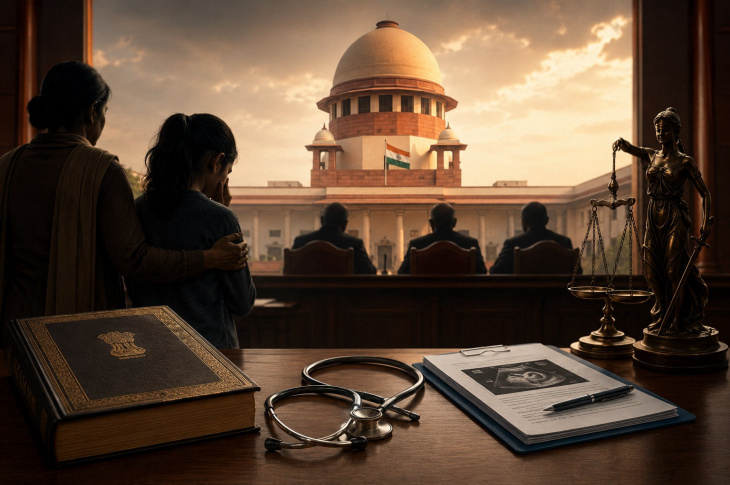


Supreme Court of India Draws a Hard Line on Minor Girl’s Abortion Rights


Introduction
The recent intervention by the Supreme Court of India in a case involving a 15-year-old rape survivor seeking termination of a pregnancy beyond 28 weeks has once again brought India’s abortion laws, constitutional rights, and judicial accountability into national focus. The Court’s strong warning to the Union government over alleged non-compliance with its order has triggered an important legal and social conversation about reproductive autonomy, bodily integrity, and the urgency of protecting vulnerable survivors.
At the heart of the matter lies a difficult question: when a minor rape survivor seeks medical termination of pregnancy after crossing the statutory limit, should rigid procedural barriers prevail over dignity, trauma, and constitutional rights?
The Supreme Court answered this question firmly by reiterating that judicial orders must be implemented without delay, especially when fundamental rights and time-sensitive medical procedures are involved.
This case is not merely about abortion laws. It is about constitutional morality, state accountability, the rights of survivors of sexual violence, and the evolving understanding of reproductive freedom in India.
Understanding the Legal Background of Abortion in India
What Is the Medical Termination of Pregnancy Act?
India regulates abortion primarily through the Medical Termination of Pregnancy Act, 1971, commonly known as the MTP Act.
The law was originally enacted to permit safe and legal abortions under specified circumstances. Over time, amendments were introduced to expand access and recognize women’s reproductive rights more progressively.
Under the current legal framework:
-
Abortions up to 20 weeks are generally permitted under certain medical conditions.
-
Abortions between 20 and 24 weeks are allowed for specific categories of women, including rape survivors, minors, and differently-abled women.
-
Beyond 24 weeks, termination is usually allowed only in exceptional circumstances, often through court intervention or where substantial foetal abnormalities are detected.
The law requires medical opinions from registered practitioners and, in many late-stage cases, evaluation by medical boards.
However, courts in India have increasingly recognized that strict statutory interpretation cannot override constitutional rights under Article 21.
Why This Case Became So Significant
The Facts in Brief
The case involved a minor girl from Delhi who became pregnant allegedly due to rape. By the time the matter reached the Court, the pregnancy had crossed 28 weeks.
Since the pregnancy exceeded the ordinary statutory limit under the MTP Act, judicial permission became necessary.
Recognizing:
-
the girl’s age,
-
the trauma of sexual assault,
-
her mental health condition,
-
and the irreversible consequences of forced continuation of pregnancy,
the Supreme Court permitted termination at All India Institute of Medical Sciences.
However, controversy arose when concerns regarding implementation and medical hesitation reportedly delayed compliance with the Court’s order. The bench strongly reminded authorities that judicial directives cannot be ignored or selectively implemented.
The Court reportedly warned that failure to comply could attract contempt proceedings.
This transformed the matter from a medical dispute into a constitutional accountability issue.
Why the Supreme Court Took a Strong Position
Judicial Orders Are Not Optional
One of the strongest messages emerging from this case is that executive authorities cannot dilute or delay implementation of court orders merely because they disagree with them.
The judiciary functions as the constitutional guardian of fundamental rights. Once a competent court passes an order, authorities are expected to act promptly and in good faith.
In time-sensitive medical matters, delay itself can become injustice.
For a pregnant minor survivor:
-
every passing day increases medical complications,
-
emotional trauma deepens,
-
and legal relief may become meaningless if implementation is delayed.
The Supreme Court’s warning effectively reinforced the principle that constitutional rights must be practical and enforceable, not symbolic.
Reproductive Rights Under Article 21
How the Constitution Protects Bodily Autonomy
Indian courts have increasingly interpreted Article 21 of the Constitution broadly.
Article 21 guarantees:
“Right to life and personal liberty.”
Over decades, the Supreme Court has expanded this protection to include:
-
privacy,
-
dignity,
-
bodily integrity,
-
reproductive choice,
-
mental health,
-
and decisional autonomy.
In abortion-related cases, the Court has repeatedly recognized that a woman’s choice regarding pregnancy is deeply personal and constitutionally protected.
This becomes even more critical when:
-
the pregnancy results from rape,
-
the pregnant person is a minor,
-
or continuation causes severe mental anguish.
The judiciary has acknowledged that forcing a rape survivor to continue an unwanted pregnancy may amount to cruel, inhuman, and dignity-violating treatment.
Why Minor Survivors Need Special Protection
Psychological and Physical Impact
Minor girls face significantly higher risks during pregnancy.
These risks include:
-
complications during childbirth,
-
maternal health dangers,
-
severe emotional trauma,
-
social stigma,
-
interrupted education,
-
and long-term psychological consequences.
For rape survivors, pregnancy often becomes a continuing reminder of abuse.
Courts have increasingly accepted that continuation of such pregnancies may severely damage:
-
mental health,
-
emotional stability,
-
and future rehabilitation prospects.
The Supreme Court’s approach reflects a trauma-informed understanding of justice.
Instead of focusing only on technical statutory limits, the Court considered:
-
human dignity,
-
constitutional compassion,
-
and the real-life impact on the survivor.
The Growing Importance of Reproductive Autonomy in India
What Is Reproductive Autonomy?
Reproductive autonomy means the right of a person to make decisions about:
-
pregnancy,
-
childbirth,
-
contraception,
-
and reproductive health without coercion.
Indian constitutional jurisprudence now treats reproductive choice as an integral part of personal liberty.
The Supreme Court has repeatedly observed that women are not merely passive subjects of state regulation. They are rights-bearing individuals entitled to bodily agency.
This evolution became especially visible after landmark privacy and dignity judgments.
The judiciary has increasingly moved away from paternalistic approaches and toward rights-based reasoning.
Landmark Judgments That Changed India’s Abortion Jurisprudence
X v. Principal Secretary, Health and Family Welfare Department
In this important ruling, the Supreme Court emphasized that reproductive choice belongs to all women, including unmarried women.
The Court recognized:
-
decisional autonomy,
-
bodily integrity,
-
and access to safe abortion as constitutional values.
The judgment broadened interpretation of the MTP Act and strengthened access to reproductive healthcare.
Justice K.S. Puttaswamy v. Union of India
This landmark privacy judgment transformed constitutional interpretation in India.
The Court recognized privacy as a fundamental right and linked it directly with:
-
bodily autonomy,
-
decisional freedom,
-
and dignity.
Abortion rights discussions now frequently rely on privacy jurisprudence developed in this case.
Suchita Srivastava v. Chandigarh Administration
This judgment clearly recognized reproductive choice as part of personal liberty under Article 21.
The Court held that a woman’s right to make reproductive decisions is a dimension of personal freedom and dignity.
Medical Boards and Judicial Oversight
Are Medical Opinions Final?
In many late-term abortion cases, courts rely on medical boards for expert evaluation.
Medical boards generally assess:
-
health risks,
-
foetal viability,
-
feasibility of termination,
-
and possible complications.
However, medical opinions are advisory, not automatically binding.
The final constitutional balancing often remains with the judiciary.
The Supreme Court has repeatedly clarified that:
-
medical caution cannot entirely override constitutional rights,
-
and doctors cannot become the final arbiters of personal liberty.
This balance is delicate.
Courts must protect:
-
medical ethics,
-
patient safety,
-
and constitutional freedoms simultaneously.
Why Delays in Abortion Cases Are Dangerous
Time Sensitivity in Medical Justice
Unlike ordinary litigation, abortion matters are highly time-sensitive.
Even a delay of:
-
a few days,
-
administrative paperwork,
-
or procedural confusion
can make termination medically riskier or legally impossible.
This is why courts often conduct urgent hearings in such matters.
When authorities delay compliance:
-
the survivor’s suffering increases,
-
medical risks rise,
-
and judicial relief may lose meaning.
The Supreme Court’s strong language in this case reflects recognition of this urgency.
Contempt of Court: Why the Supreme Court Mentioned It
Understanding Contempt Jurisdiction
The Supreme Court has constitutional powers to punish for contempt under:
-
Article 129,
-
and related legal provisions.
Contempt proceedings may arise when:
-
court orders are intentionally disobeyed,
-
judicial authority is undermined,
-
or compliance is obstructed.
In this case, the Court’s warning served multiple purposes:
-
ensuring immediate implementation,
-
protecting institutional authority,
-
and preventing dangerous precedents.
The Court essentially conveyed that constitutional rights cannot be frustrated through bureaucratic hesitation.
The Ethical Debate Around Late-Term Abortions
Competing Concerns
Late-term abortions involve complex ethical debates.
These debates usually involve:
-
foetal viability,
-
maternal rights,
-
medical ethics,
-
religious beliefs,
-
and state interests.
- However, Indian courts increasingly prioritize:
-
the survivor’s dignity,
-
trauma,
-
mental health,
-
and bodily autonomy.
This is especially true in rape-related pregnancies involving minors.
The judiciary recognizes that forcing childbirth upon a child survivor may itself become a form of institutional cruelty.
Challenges Faced by Rape Survivors Seeking Abortion in India
Ground-Level Reality
Despite legal protections, survivors often face enormous practical obstacles.
1. Delay in Reporting Sexual Assault
Many minors report abuse late because of:
-
fear,
-
stigma,
-
family pressure,
-
or lack of awareness.
By the time legal proceedings begin, pregnancies may already be advanced.
2. Lack of Medical Access
Rural and semi-urban areas often lack:
-
trained specialists,
-
approved facilities,
-
and functioning medical boards.
3. Bureaucratic Delays
Multiple approvals, paperwork, and institutional hesitation frequently delay procedures.
4. Social Stigma
Survivors often face judgment and emotional isolation instead of support.
5. Inconsistent Judicial Approaches
Different courts sometimes adopt varying interpretations regarding late-term termination.
This creates uncertainty for survivors and families.
The Role of AIIMS and Major Government Hospitals
Institutions like All India Institute of Medical Sciences often become central in complex abortion litigation.
These hospitals:
-
conduct medical evaluations,
-
form expert boards,
-
assess viability,
-
and carry out sensitive procedures under court supervision.
However, tensions sometimes arise between:
-
medical caution,
-
administrative concerns,
-
and constitutional directives.
The Supreme Court’s intervention in this case signals that hospitals and authorities must act within constitutional obligations once judicial approval is granted.
How Indian Courts Are Expanding Women’s Rights
A Shift Toward Constitutional Compassion
India’s abortion jurisprudence has evolved significantly over the last decade.
Earlier approaches focused heavily on:
-
statutory limits,
-
procedural compliance,
-
and medical conservatism.
Modern judgments increasingly prioritize:
-
dignity,
-
autonomy,
-
mental health,
-
equality,
-
and real-world hardships.
This reflects a broader constitutional shift toward empathetic justice.
Courts are acknowledging that law cannot ignore lived experiences.
International Human Rights Perspective
Globally, reproductive rights are increasingly viewed as human rights.
International human rights bodies emphasize:
-
access to safe abortion,
-
bodily autonomy,
-
freedom from cruel treatment,
-
and healthcare equality.
India’s constitutional interpretation is gradually aligning with these evolving standards.
The Supreme Court’s recent approach demonstrates growing recognition that reproductive freedom is linked with:
-
dignity,
-
privacy,
-
equality,
-
and liberty.
What This Judgment Means for Future Cases
Important Legal Implications
Stronger Protection for Survivors
Minor rape survivors may receive greater judicial sensitivity in future abortion petitions.
Faster Compliance Expectations
Authorities may now face stricter scrutiny regarding implementation delays.
Expanded Article 21 Interpretation
Courts are likely to continue strengthening reproductive autonomy under constitutional law.
Reduced Bureaucratic Resistance
The contempt warning sends a clear signal that administrative hesitation has limits.
Greater Focus on Mental Health
Psychological trauma is becoming a central legal consideration in abortion matters.
Important Legal Questions Still Remaining
Despite progressive judicial developments, several unresolved concerns remain.
Should India Remove Gestational Limits in Exceptional Cases?
Many experts argue that rigid week-based limits fail to account for:
-
delayed discovery of pregnancy,
-
trauma,
-
abuse,
-
and systemic barriers.
Should Fast-Track Medical Boards Be Created?
Specialized emergency medical boards could help avoid delays in urgent cases.
Can Access Be Improved in Rural India?
Legal rights remain ineffective without healthcare infrastructure.
Should Survivor-Centric Procedures Be Standardized?
Uniform national guidelines may reduce inconsistent treatment across states.
Practical Guidance for Families and Survivors
What Should Be Done in Similar Situations?
Seek Immediate Medical Assistance
Early medical consultation improves legal and healthcare options.
File Complaints Promptly
In rape-related cases involving minors, reporting helps trigger legal protections under:
-
Protection of Children from Sexual Offences Act,
-
criminal law provisions,
-
and medical support mechanisms.
Approach High Courts or Supreme Court Quickly
Late-term termination cases often require urgent constitutional remedies.
Preserve Medical Records
Medical documentation becomes extremely important during court proceedings.
Seek Psychological Support
Mental health care is essential for survivors and families navigating traumatic situations.
The Broader Debate on Abortion Rights in India
India’s abortion law is often considered more progressive than many countries in the region. However, implementation gaps remain substantial.
Legal access does not always translate into practical access.
The real challenge lies in:
-
awareness,
-
affordability,
-
healthcare infrastructure,
-
institutional sensitivity,
-
and timely execution.
This case highlights the need for a survivor-centric reproductive healthcare system where dignity and urgency are prioritized over procedural rigidity.
Conclusion
The Supreme Court of India’s strong stand in the case involving a minor rape survivor seeking termination of a 28-week pregnancy marks a significant moment in India’s constitutional and reproductive rights journey.
The Court’s message was clear:
-
judicial orders must be respected,
-
reproductive autonomy is part of fundamental rights,
-
and vulnerable survivors cannot be trapped in bureaucratic indecision.
More importantly, the case reflects the judiciary’s growing commitment to constitutional compassion. The Court recognized that behind every legal file is a human being facing trauma, fear, and irreversible consequences.
As India continues to evolve its approach toward abortion rights, this judgment may serve as an important precedent reinforcing:
-
dignity over delay,
-
rights over rigidity,
-
and justice over procedural hesitation.
For survivors, families, lawyers, medical professionals, and policymakers, the case is a powerful reminder that constitutional rights are meaningful only when implemented swiftly, sensitively, and effectively.
Frequently asked questions
Can a minor girl get abortion permission after 24 weeks in India?
Can a minor girl get abortion permission after 24 weeks in India?
Yes, Indian courts may allow abortion beyond 24 weeks in exceptional cases, especially involving rape survivors, minors, or serious health risks.
What is the legal abortion limit in India?
What is the legal abortion limit in India?
Under the MTP Act, abortion is generally permitted up to 20 weeks, and up to 24 weeks for certain categories such as rape survivors and minors.
Is reproductive autonomy a fundamental right in India?
Is reproductive autonomy a fundamental right in India?
Yes, the Supreme Court has recognized reproductive autonomy and bodily integrity as part of Article 21 of the Constitution.
What happens if authorities do not follow Supreme Court orders?
What happens if authorities do not follow Supreme Court orders?
Failure to comply with Supreme Court orders may lead to contempt proceedings and legal consequences.
Can courts allow late-term abortions in India?
Can courts allow late-term abortions in India?
Yes, High Courts and the Supreme Court can permit late-term abortions in exceptional and humanitarian circumstances.

Online Consultation


Online Consultations


Trending
Frequently asked questions
Can a minor girl get abortion permission after 24 weeks in India?
Can a minor girl get abortion permission after 24 weeks in India?
Yes, Indian courts may allow abortion beyond 24 weeks in exceptional cases, especially involving rape survivors, minors, or serious health risks.
What is the legal abortion limit in India?
What is the legal abortion limit in India?
Under the MTP Act, abortion is generally permitted up to 20 weeks, and up to 24 weeks for certain categories such as rape survivors and minors.
Is reproductive autonomy a fundamental right in India?
Is reproductive autonomy a fundamental right in India?
Yes, the Supreme Court has recognized reproductive autonomy and bodily integrity as part of Article 21 of the Constitution.
What happens if authorities do not follow Supreme Court orders?
What happens if authorities do not follow Supreme Court orders?
Failure to comply with Supreme Court orders may lead to contempt proceedings and legal consequences.
Can courts allow late-term abortions in India?
Can courts allow late-term abortions in India?
Yes, High Courts and the Supreme Court can permit late-term abortions in exceptional and humanitarian circumstances.
Online Consultations


Ask a Lawyer