


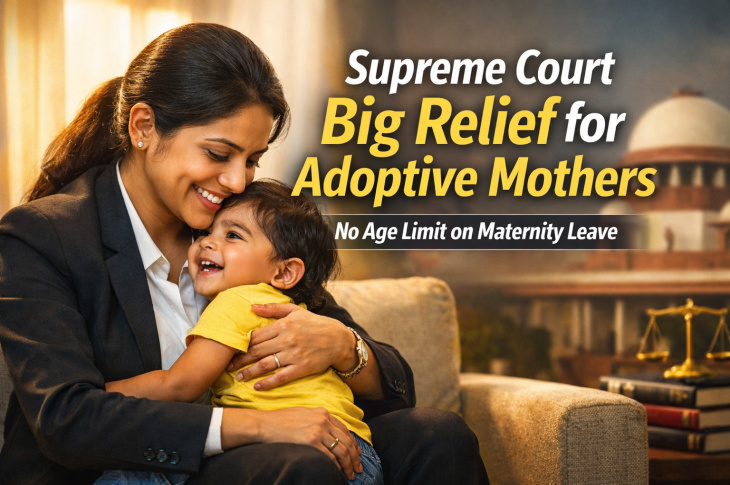


Supreme Court Gives Big Relief to Adoptive Mothers, Removes Age Limit on Maternity Benefits


The Supreme Court of India has ruled that adoptive mothers are entitled to 12 weeks of maternity leave regardless of the child’s age (up to 18 years). The Court struck down the earlier 3-month age restriction as unconstitutional, calling it arbitrary and violative of fundamental rights.
Also Read: Complete Guide to Adopting a Child in India: Procedure, Laws, and Eligibility
Why This Judgment Matters Right Now
In a progressive and long-awaited decision, the Supreme Court has reshaped maternity benefit laws in India. The ruling ensures that adoptive mothers receive equal rights, dignity, and workplace protection—just like biological mothers.
This judgment is expected to:
-
Encourage adoption in India
-
Promote gender equality at workplaces
-
Strengthen child welfare and bonding
Also Read: Empowering Working Mothers: Understanding Your Legal Rights in India
Case That Changed Everything
The ruling came in Hamsaanandini Nanduri v. Union of India & Ors., decided by:
-
Justice J.B. Pardiwala
-
Justice R. Mahadevan
The Court examined whether restricting maternity benefits based on the child’s age was constitutional—and answered with a clear NO.
What Was the Old Rule?
Under:
-
Maternity Benefit Act, 1961
-
Code on Social Security, 2020
Adoptive mothers could only claim maternity leave if:
- The adopted child was below 3 months old
The Problem
-
Adoption procedures take time
-
Most children are older than 3 months by the time adoption is finalized
-
Result: The benefit was almost useless in practice
What the Supreme Court Changed
The Court removed the age restriction and clarified:
-
All adoptive mothers are entitled to 12 weeks of maternity leave
-
Applicable for children up to 18 years of age
-
Leave starts from the date the child is handed over
Supreme Court’s Key Observations (Simplified)
1. Motherhood Is Not Limited to Childbirth
“Maternity benefit is about motherhood, not just childbirth.”
The Court recognized that:
-
Emotional bonding
-
Caregiving
-
Child development
are equally important for adoptive mothers.
2. Age-Based Classification Is Unconstitutional
The restriction violated:
-
Article 14 of the Constitution of India
-
Article 21 of the Constitution of India
Because:
-
There is no real difference between adoptive mothers based on the child’s age
3. Adoption Is Part of Reproductive Rights
The Court expanded the scope of rights by stating:
-
Reproductive autonomy includes adoption choices
-
Parenthood is not limited to biological processes
4. Focus on Child’s Best Interests
The Court emphasized:
-
Children need time to adjust
-
Bonding is essential for emotional development
This applies to all children, not just infants
5. Law Must Be Practical, Not Just Theoretical
The Court criticized the old law as:
-
Illogical
-
Impractical
-
Ineffective
A beneficial law must be usable in real life.
Before vs After the Judgment
| Factor | Before | After |
|---|---|---|
| Eligibility | Only if child < 3 months | Any child below 18 years |
| Accessibility | Rarely usable | Fully accessible |
| Legal Validity | Discriminatory | Constitutionally valid |
| Focus | Limited | Child + Mother welfare |
Big Impact on Working Women
This judgment:
-
Ensures equal maternity rights
-
Improves work-life balance
-
Encourages women to adopt without fear
-
Strengthens gender-inclusive workplaces
Boost for Adoption in India
Earlier: Women avoided adopting older children
Now:
-
Adoption becomes more practical and supported
-
More children may find homes
Supreme Court Pushes for Paternity Leave
The Court also made an important recommendation:
Introduce paternity leave as a social security benefit
This reflects:
-
Shared parenting responsibilities
-
Modern family dynamics
Key Takeaways (Quick Read)
-
No age limit for adopted child in maternity benefits
-
12 weeks maternity leave for adoptive mothers
-
Applies to children up to 18 years
-
Strengthens equality and dignity
-
Encourages adoption and child welfare
Download the Judgment Here:
Supreme Court JudgmentFrequently asked questions
Is there still a 3-month age limit for adoption maternity benefits?
Is there still a 3-month age limit for adoption maternity benefits?
No, the Court has removed the 3-month restriction completely.
What did the Supreme Court say about adoptive mothers’ maternity leave?
What did the Supreme Court say about adoptive mothers’ maternity leave?
The Supreme Court of India ruled that adoptive mothers are entitled to 12 weeks of maternity leave regardless of the child’s age.
How many weeks of maternity leave do adoptive mothers get?
How many weeks of maternity leave do adoptive mothers get?
Adoptive mothers are entitled to 12 weeks of paid maternity leave.
Does this apply to all adoptive mothers in India?
Does this apply to all adoptive mothers in India?
Yes, it applies to all adoptive mothers adopting a child below 18 years.

Online Consultation


Online Consultations


Trending
Frequently asked questions
Is there still a 3-month age limit for adoption maternity benefits?
Is there still a 3-month age limit for adoption maternity benefits?
No, the Court has removed the 3-month restriction completely.
What did the Supreme Court say about adoptive mothers’ maternity leave?
What did the Supreme Court say about adoptive mothers’ maternity leave?
The Supreme Court of India ruled that adoptive mothers are entitled to 12 weeks of maternity leave regardless of the child’s age.
How many weeks of maternity leave do adoptive mothers get?
How many weeks of maternity leave do adoptive mothers get?
Adoptive mothers are entitled to 12 weeks of paid maternity leave.
Does this apply to all adoptive mothers in India?
Does this apply to all adoptive mothers in India?
Yes, it applies to all adoptive mothers adopting a child below 18 years.
Online Consultations


Ask a Lawyer