


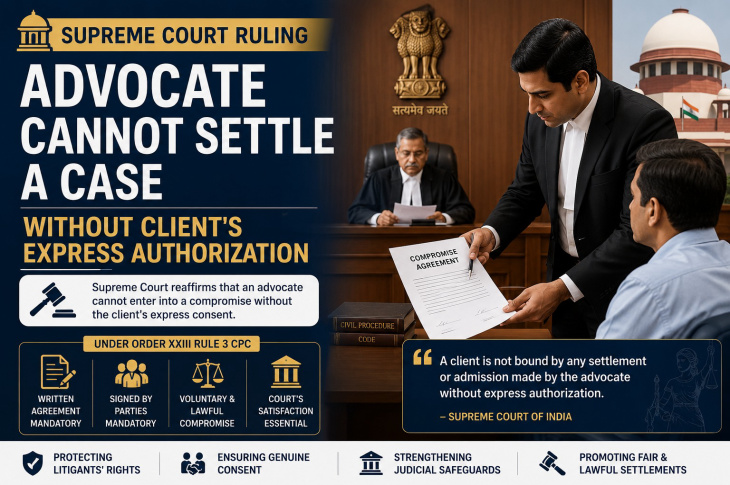


Supreme Court Clarifies: Lawyers Cannot Enter Into a Settlement Without the Client's Express Authorization


In a significant ruling reinforcing the rights of litigants, the Supreme Court has held that an advocate cannot bind a client to a legal settlement unless there is clear and express authorization from the client. The judgment reiterates that a compromise affecting valuable legal rights must strictly comply with the requirements of Order XXIII Rule 3 of the Code of Civil Procedure, 1908 (CPC).
The Court emphasized that a compromise decree cannot be sustained merely because a lawyer signed or presented a settlement before the court. Unless the client has expressly authorized the advocate—or exceptional circumstances justify immediate action—the compromise may be declared legally invalid.
The decision strengthens procedural fairness, protects litigants from unauthorized settlements, and highlights the responsibility of courts to verify that compromise decrees are lawful.
Why This Judgment Matters
Compromise decrees are common in civil disputes because they help parties avoid lengthy litigation. However, a settlement also involves surrendering or modifying legal rights.
The Supreme Court has now made it clear that:
-
An advocate cannot independently decide to settle a client's dispute.
-
The client's informed and express consent is essential.
-
Courts must examine whether the compromise satisfies legal requirements before recording it.
-
Property and civil rights cannot be defeated through unauthorized settlements.
This judgment has wide implications for partition suits, property disputes, family settlements, commercial litigation, and other civil proceedings.
Background of the Case
The dispute arose from a partition suit concerning ancestral property.
During the pendency of the case, a compromise petition was filed before the trial court. Based on the compromise, the court passed a compromise decree and later prepared a final decree.
Years later, the legal heirs of one defendant challenged the compromise, alleging that:
-
the defendant never signed the compromise;
-
he never authorized his advocate to settle the dispute;
-
the signatures were allegedly fabricated; and
-
they discovered the decree only when attempts were made to dispossess them from the property.
The opposing parties argued that the defendant had knowledge of the proceedings and that the compromise had been validly entered into.
The Supreme Court ultimately upheld the setting aside of the compromise decree and directed that the partition dispute should proceed through a complete trial.
What Does Order XXIII Rule 3 CPC Require?
Order XXIII Rule 3 governs compromise of civil suits.
For a compromise to be legally enforceable, it must satisfy certain mandatory conditions.
Essential Requirements
| Requirement | Legal Position |
|---|---|
| Written agreement | Mandatory |
| Signature of parties | Mandatory |
| Lawful settlement | Mandatory |
| Voluntary consent | Mandatory |
| Court's satisfaction | Mandatory before recording compromise |
These safeguards exist to prevent fraudulent settlements and protect parties from unauthorized agreements.
Can an Advocate Settle a Case Without the Client?
The Supreme Court answered this question in clear terms:
No—unless the client has expressly authorized the advocate.
An advocate represents a client in court, but representation does not automatically include authority to surrender substantive legal rights.
The Court observed that:
-
Express authorization is the general rule.
-
Implied authority is insufficient where valuable legal rights are being compromised.
-
Only exceptional situations may justify immediate action without prior approval.
This reinforces the principle that the client—not the lawyer—controls major litigation decisions.
Why Express Authorization Is So Important
Express authorization ensures that:
-
clients remain in control of their legal rights;
-
settlements reflect genuine consent;
-
fraud and misuse are prevented;
-
disputes over unauthorized compromises are minimized; and
-
confidence in the judicial system is maintained.
A compromise decree has significant legal consequences, making voluntary consent indispensable.
The Court's Duty Before Recording a Compromise
The judgment also highlights an important responsibility of courts.
A court cannot simply approve every settlement placed before it.
Instead, it must determine whether:
-
the compromise is genuine;
-
the agreement is lawful;
-
the parties voluntarily consented;
-
statutory requirements are fulfilled; and
-
the compromise is not contrary to public policy or law.
The court acts as a judicial authority—not merely a recording office.
What Happens If a Compromise Is Unauthorized?
If it is established that:
-
the client never consented;
-
signatures were forged;
-
authority was absent; or
-
mandatory legal requirements were ignored,
the compromise decree may be recalled or set aside.
Once the decree is invalidated, the underlying suit generally continues and is decided on its merits.
Can a Compromise Decree Be Challenged?
Yes—but the legal remedy is limited.
The Supreme Court reiterated that a party alleging an unlawful compromise should ordinarily seek:
-
recall of the compromise decree before the same court; or
-
appropriate relief available under law.
A separate fresh suit challenging the compromise is generally not maintainable, and an appeal against a valid compromise decree is also restricted under the CPC.
Delay Alone Does Not Defeat Justice
An important aspect of the ruling concerns delay.
Although the compromise had remained in existence for many years, the Supreme Court observed that limitation principles cannot automatically defeat substantive rights where allegations of fraud or lack of consent exist.
Where valuable property rights are involved and foundational facts remain disputed, courts must carefully examine the evidence before refusing relief merely because considerable time has elapsed.
Key Legal Principles Reaffirmed
The judgment reinforces several settled principles of civil law:
1. Client Consent Is Fundamental
An advocate cannot compromise a client's substantive rights without express approval.
2. Written Compromise Is Mandatory
After the 1976 amendment to the CPC, compromises must be in writing and signed by the parties.
3. Voluntary Acceptance Is Essential
Consent obtained without authority or genuine approval cannot support a valid compromise decree.
4. Courts Must Apply Judicial Mind
Judges must independently verify that statutory requirements are fulfilled before recording a compromise.
5. Property Rights Receive Strong Judicial Protection
Courts will closely scrutinize settlements affecting ownership and inheritance rights.
Practical Lessons for Litigants
If you are involved in a civil case:
-
Never assume your lawyer may settle without your approval.
-
Read every compromise document carefully.
-
Sign only after fully understanding the terms.
-
Keep written records of any authorization given to your advocate.
-
Immediately challenge any compromise that you believe was entered into without your consent.
Guidance for Advocates
The judgment also serves as an important reminder for legal professionals.
Advocates should:
-
obtain clear written instructions before settling disputes;
-
preserve documentary proof of client authorization;
-
explain the consequences of settlement to clients;
-
avoid making admissions that extinguish legal rights without approval; and
-
ensure ethical compliance throughout negotiations.
Doing so protects both the client and the advocate from future disputes.
Impact of This Judgment
This decision is expected to influence a broad range of civil litigation, including:
-
partition suits;
-
family property disputes;
-
inheritance claims;
-
commercial settlements;
-
contract disputes;
-
land ownership litigation; and
-
other cases resolved through compromise.
The ruling reinforces procedural safeguards and ensures that settlements genuinely reflect the will of the parties rather than assumptions made by their representatives.
Conclusion
The Supreme Court's decision reinforces one of the most important principles governing the lawyer-client relationship: the authority to compromise a dispute belongs to the client, not the advocate.
By insisting on express authorization, written consent, and careful judicial scrutiny, the Court has strengthened procedural fairness and safeguarded litigants against unauthorized settlements. The ruling serves as an important reminder that compromise decrees are not mere procedural formalities—they involve the voluntary relinquishment of valuable legal rights and therefore demand strict compliance with the law.
If you are involved in a civil dispute or believe a compromise decree has been passed without your valid consent, seek legal advice promptly to understand the remedies available under the Code of Civil Procedure.
Download the Judgment Here:
Supreme Court JudgmentFrequently asked questions
Can a lawyer settle a case without informing the client?
Can a lawyer settle a case without informing the client?
Generally, no. A lawyer cannot compromise a client's substantive legal rights without express authorization except in rare and exceptional circumstances recognized by law.
What is a compromise decree?
What is a compromise decree?
A compromise decree is a court order passed after parties voluntarily settle their dispute and the court records the lawful settlement under Order XXIII Rule 3 CPC.
Is the signature of every party necessary?
Is the signature of every party necessary?
Yes. A lawful compromise ordinarily requires a written agreement signed by the parties or by a duly authorized representative acting with express authority.
What if the compromise was obtained through fraud?
What if the compromise was obtained through fraud?
The affected party may seek recall or setting aside of the compromise decree before the competent court.
Does delay automatically prevent challenging an unauthorized compromise?
Does delay automatically prevent challenging an unauthorized compromise?
No. The Supreme Court has clarified that delay alone cannot defeat substantive rights where allegations of fraud, lack of consent, or unauthorized compromise require judicial examination.

Online Consultation


Online Consultations


Trending
Frequently asked questions
Can a lawyer settle a case without informing the client?
Can a lawyer settle a case without informing the client?
Generally, no. A lawyer cannot compromise a client's substantive legal rights without express authorization except in rare and exceptional circumstances recognized by law.
What is a compromise decree?
What is a compromise decree?
A compromise decree is a court order passed after parties voluntarily settle their dispute and the court records the lawful settlement under Order XXIII Rule 3 CPC.
Is the signature of every party necessary?
Is the signature of every party necessary?
Yes. A lawful compromise ordinarily requires a written agreement signed by the parties or by a duly authorized representative acting with express authority.
What if the compromise was obtained through fraud?
What if the compromise was obtained through fraud?
The affected party may seek recall or setting aside of the compromise decree before the competent court.
Does delay automatically prevent challenging an unauthorized compromise?
Does delay automatically prevent challenging an unauthorized compromise?
No. The Supreme Court has clarified that delay alone cannot defeat substantive rights where allegations of fraud, lack of consent, or unauthorized compromise require judicial examination.
Online Consultations


Ask a Lawyer