


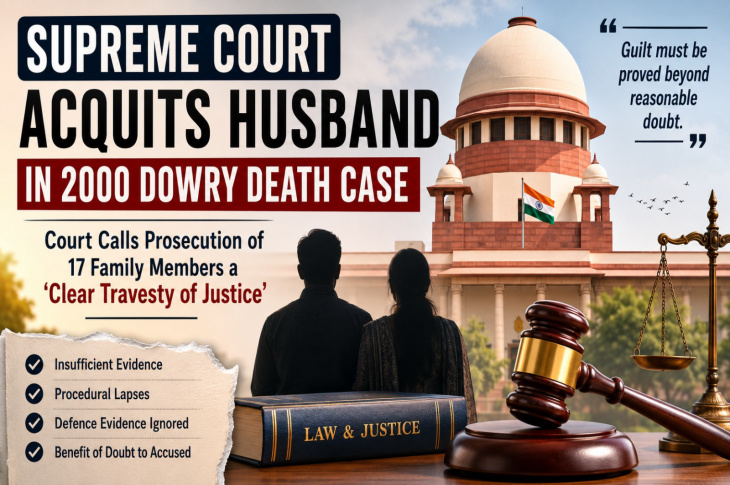


Supreme Court Acquits Husband in 2000 Dowry Death Case: What the Landmark Judgment Means for Criminal Justice


Dowry death cases demand careful judicial scrutiny because they involve two equally important objectives—protecting women from cruelty and ensuring that innocent individuals are not convicted without reliable evidence.
In a significant judgment, the Supreme Court acquitted a husband who had been convicted in connection with his wife's death from burn injuries in 2000. The Court concluded that the prosecution failed to establish guilt beyond reasonable doubt and criticized the prosecution of 17 members of the matrimonial family as a "clear travesty of justice."
Beyond granting relief to the accused, the judgment reinforces several fundamental principles of criminal law, including the importance of fair investigation, proper appreciation of defence evidence, procedural fairness, and the prosecution's burden of proof.
Case Overview
| Particular | Details |
|---|---|
| Case | Brajesh Kumar @ Birjesh Kumar Singh v. State of Bihar |
| Court | Supreme Court of India |
| Neutral Citation | 2026 INSC 695 |
| Bench | Justice Sanjay Kumar and Justice K. Vinod Chandran |
| Decision | Husband acquitted |
| Primary Allegations | Dowry death, cruelty, dowry demand |
| Incident Year | 2000 |
Background of the Case
The case arose after a married woman suffered severe burn injuries at her matrimonial home in Mirzapur on April 13, 2000. She was initially treated at a district hospital before being shifted to a hospital in Allahabad, where she later died.
Following her death, her father alleged that:
-
The husband and his family had continuously demanded ₹50,000 as dowry.
-
The deceased had been subjected to cruelty.
-
The burn injuries were not accidental but linked to dowry harassment.
An FIR was registered naming:
-
Husband
-
Parents-in-law
-
Brothers-in-law
-
Sisters-in-law
-
Several other relatives
In total, 17 members of the matrimonial family were prosecuted.
How the Investigation Progressed
One of the unusual aspects of the case was the manner in which the investigation unfolded.
Initially:
-
The police filed a report against the parents-in-law.
-
Investigation continued against the remaining family members.
Subsequently:
-
Investigators reported that no additional evidence had emerged against the remaining accused.
-
Separate criminal proceedings nevertheless continued.
Eventually:
-
Parents-in-law and several relatives were acquitted.
-
The husband alone was convicted.
The Supreme Court closely examined this procedural history while deciding the appeal.
Why the Supreme Court Acquitted the Husband
The Court found multiple shortcomings that collectively created reasonable doubt regarding the prosecution's version.
1. Prosecution Failed to Prove Dowry Harassment
The Court observed that the allegations of dowry demand largely came from close family members of the deceased.
However:
-
The testimonies lacked independent corroboration.
-
Witnesses repeated similar allegations without providing convincing supporting circumstances.
-
The evidence did not establish sustained cruelty or harassment linked to dowry.
Since criminal convictions require proof beyond reasonable doubt, the Court held that these allegations alone were insufficient.
2. Medical Evidence Was Incomplete
The judgment highlighted several deficiencies in the investigation.
These included:
-
No post-mortem examination
-
Missing wound certificate
-
Incomplete hospital records
-
Failure to produce important treatment documents
-
Limited investigation into events immediately after the incident
The Court observed that these omissions weakened the prosecution's ability to prove that the burns resulted from a criminal act rather than an accident.
3. Dying Declaration Suggested an Accidental Fire
One of the most significant pieces of evidence was the deceased's own statement.
According to the dying declaration:
-
She was boiling milk.
-
The gas stove pipe became disconnected.
-
The fire spread accidentally.
-
Family members, including her husband, attempted to extinguish the flames.
The declaration had been recorded by an Executive Magistrate after a doctor certified that the woman was medically fit to make a statement.
Although the Court did not treat the declaration as the sole basis for acquittal, it held that it created substantial doubt when viewed alongside other evidence.
4. Defence Evidence Was Ignored
The Supreme Court emphasized that criminal courts must evaluate defence evidence with the same seriousness as prosecution evidence.
The defence produced:
-
Hospital treatment records
-
Investment certificates
-
Insurance documents
-
Medical evidence
-
Records showing the husband himself suffered burn injuries while attempting to save his wife
The Court criticized the lower courts for failing to adequately consider these materials.
5. Conviction Cannot Rest on Suspicion
A recurring theme throughout the judgment was that suspicion, regardless of its strength, cannot replace legal proof.
The Court reiterated that:
-
The accused is presumed innocent.
-
The prosecution bears the burden of proving guilt.
-
Any reasonable doubt must benefit the accused.
This principle remains one of the cornerstones of Indian criminal jurisprudence.
Procedural Lapses Identified by the Supreme Court
Apart from evaluating the evidence, the Court also examined procedural irregularities.
Key concerns included:
Separate Trials on the Same FIR
The Court noted that multiple proceedings arose from the same FIR despite later investigations finding insufficient evidence against several accused.
This unusual procedural course required closer judicial scrutiny.
Investigation Concerns
The Bench questioned:
-
The manner in which further investigation was directed
-
Whether proper investigative procedures had been followed
-
The authority exercised during the investigation
The Court stressed that investigative agencies must operate strictly within the framework of criminal procedure.
Why the Court Called It a "Travesty of Justice"
One of the strongest observations in the judgment concerned the prosecution of the extended family.
The Court found that:
-
Seventeen family members were placed on trial.
-
Many appeared to have been implicated largely because of their relationship with the deceased.
-
Independent evidence connecting several accused to the alleged offence was lacking.
The Bench described this as a clear travesty of justice, emphasizing that criminal liability cannot arise merely from familial association.
Supreme Court's View on Fair Criminal Trials
The judgment reinforces several important legal safeguards that apply in every criminal prosecution.
Burden of Proof
The prosecution must establish guilt beyond reasonable doubt.
The accused has no obligation to prove innocence.
Importance of Defence Evidence
Courts must impartially evaluate:
-
Defence witnesses
-
Medical evidence
-
Documentary records
-
Alternative explanations supported by evidence
Ignoring defence evidence undermines a fair trial.
Independent Judicial Assessment
The Court reiterated that:
-
Investigating officers form an opinion after investigation.
-
Magistrates independently decide whether sufficient material exists for prosecution.
-
Courts are not bound by investigative conclusions alone.
Broader Impact of This Judgment
This ruling is likely to influence future criminal trials involving allegations of dowry death and matrimonial cruelty.
Its broader implications include:
Stronger Scrutiny of Evidence
Courts may place greater emphasis on:
-
Medical documentation
-
Independent witnesses
-
Objective evidence
-
Scientific investigation
Protection Against Mechanical Prosecution
The judgment discourages indiscriminate prosecution of extended family members solely because they belong to the matrimonial household.
Each accused person's role must be supported by specific evidence.
Better Appreciation of Defence Material
Trial courts may increasingly ensure that defence evidence receives equal consideration alongside prosecution evidence.
This promotes fairness without weakening legal protections available to genuine victims.
Important Legal Principles Reaffirmed
The judgment reinforces several well-established criminal law principles:
-
Guilt must be proved beyond reasonable doubt.
-
Suspicion cannot substitute legal proof.
-
Defence evidence deserves equal judicial consideration.
-
Fair investigation is essential to a valid prosecution.
-
Criminal liability must be based on individual acts, not family relationships.
-
Procedural fairness is fundamental to criminal justice.
Timeline of the Case
| Year | Development |
|---|---|
| 2000 | Woman suffers burn injuries at matrimonial home |
| 2000 | FIR registered alleging dowry harassment |
| Investigation | Multiple family members prosecuted |
| Trial | Husband convicted; several relatives acquitted |
| High Court | Matter remanded |
| 2026 | Supreme Court acquits husband and criticizes prosecution |
Conclusion
The Supreme Court's decision serves as an important reminder that criminal justice must balance the protection of victims with the constitutional rights of the accused. While dowry-related offences remain a serious social concern, convictions cannot be sustained unless supported by credible, comprehensive, and legally admissible evidence.
By highlighting investigative shortcomings, stressing the importance of defence evidence, and rejecting guilt based solely on family association, the judgment strengthens the principles of fairness and due process that underpin India's criminal justice system.
For legal professionals, law students, and anyone following developments in criminal law, this ruling underscores that every prosecution must ultimately satisfy one enduring standard: guilt must be proved beyond reasonable doubt.
Download the Judgment Here:
Supreme Court JudgmentFrequently asked questions
Why did the Supreme Court acquit the husband?
Why did the Supreme Court acquit the husband?
The Court held that the prosecution failed to prove guilt beyond reasonable doubt. Medical deficiencies, lack of convincing evidence of dowry harassment, defence evidence, and the deceased's statement indicating an accidental fire collectively created reasonable doubt.
What was the significance of the dying declaration?
What was the significance of the dying declaration?
The deceased reportedly stated that the burns resulted from an accidental gas stove incident and that her family attempted to rescue her. The Court considered this an important circumstance supporting the defence.
Did the judgment weaken laws against dowry deaths?
Did the judgment weaken laws against dowry deaths?
No. The judgment does not dilute protections under dowry laws. Instead, it reiterates that convictions must rest on reliable evidence and that every accused is entitled to a fair trial.
Why did the Court criticize the prosecution of 17 family members?
Why did the Court criticize the prosecution of 17 family members?
The Court found that many relatives appeared to have been prosecuted primarily because of their relationship with the deceased, without sufficient individual evidence linking them to the alleged offences.
What message does this judgment send to trial courts?
What message does this judgment send to trial courts?
The decision emphasizes the need for impartial evaluation of both prosecution and defence evidence, thorough investigations, and adherence to procedural fairness before recording convictions.

Online Consultation


Online Consultations


Trending
Frequently asked questions
Why did the Supreme Court acquit the husband?
Why did the Supreme Court acquit the husband?
The Court held that the prosecution failed to prove guilt beyond reasonable doubt. Medical deficiencies, lack of convincing evidence of dowry harassment, defence evidence, and the deceased's statement indicating an accidental fire collectively created reasonable doubt.
What was the significance of the dying declaration?
What was the significance of the dying declaration?
The deceased reportedly stated that the burns resulted from an accidental gas stove incident and that her family attempted to rescue her. The Court considered this an important circumstance supporting the defence.
Did the judgment weaken laws against dowry deaths?
Did the judgment weaken laws against dowry deaths?
No. The judgment does not dilute protections under dowry laws. Instead, it reiterates that convictions must rest on reliable evidence and that every accused is entitled to a fair trial.
Why did the Court criticize the prosecution of 17 family members?
Why did the Court criticize the prosecution of 17 family members?
The Court found that many relatives appeared to have been prosecuted primarily because of their relationship with the deceased, without sufficient individual evidence linking them to the alleged offences.
What message does this judgment send to trial courts?
What message does this judgment send to trial courts?
The decision emphasizes the need for impartial evaluation of both prosecution and defence evidence, thorough investigations, and adherence to procedural fairness before recording convictions.
Online Consultations


Ask a Lawyer