




Stay Order Explained: Meaning, Legal Effect & How to Get One from Court in India


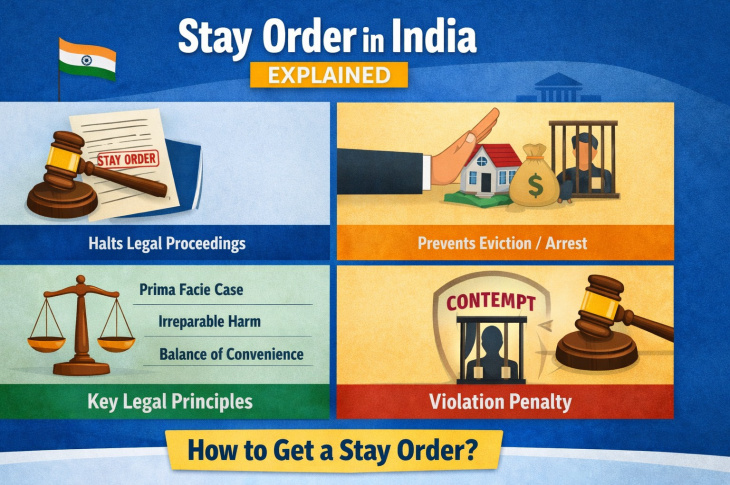
A stay order is one of the most powerful interim protections available under Indian law. It can temporarily stop court proceedings, prevent arrest, halt eviction, suspend recovery of money, or freeze government action—often protecting a person from irreversible harm until the court finally decides the case.
In India, stay orders are frequently sought in property disputes, civil suits, criminal cases, writ petitions, appeals, and administrative challenges. However, a stay order is not automatic. Courts grant it only when strict legal conditions are satisfied.
What Is a Stay Order?
A stay order is a judicial direction issued by a court to temporarily suspend legal proceedings or stop the execution of an order, decree, or administrative action.
The word “stay” literally means to stop or pause. In legal terms, a stay order ensures that the existing situation (status quo) is preserved until the court examines the dispute in detail.
A stay order may be granted:
-
During investigation
-
During trial
-
At the appellate or revision stage
-
During execution of a decree
-
While challenging a government or administrative action
The purpose is not to decide the case, but to prevent injustice, irreparable harm, or misuse of power while the case is pending.
Why Do Courts Grant Stay Orders?
Courts grant stay orders as a protective mechanism. If an order is implemented immediately and later found to be illegal, the damage caused may be irreversible.
Key Objectives of a Stay Order
-
Prevent irreparable loss or injury
-
Preserve property, liberty, or rights
-
Maintain status quo
-
Avoid multiplicity of proceedings
-
Ensure fairness and judicial balance
-
Give appellate courts time to examine legality
A stay order ensures that justice is not defeated by haste.
How Does a Stay Order Work in Practice?
The effect of a stay order depends on its scope and wording. Courts may grant a limited stay or a complete stay.
1. Stay of Proceedings
When proceedings are stayed:
-
The trial or hearing is paused
-
No further evidence or arguments take place
-
The lower court cannot pass further orders
This is common when jurisdiction or legality itself is under challenge.
2. Stay on Execution of an Order
This stops enforcement of a decree or order, such as:
-
Eviction from property
-
Recovery of money
-
Demolition of construction
-
Arrest or imprisonment
3. Temporary Nature
Stay orders are interim in nature.
They continue:
-
For a fixed period, or
-
Until “further orders” of the court
Courts regularly review stay orders to prevent abuse.
4. Binding Effect
Once passed, a stay order is binding on all parties, authorities, and courts concerned.
Legal Principles Applied Before Granting a Stay Order
Indian courts consistently apply three settled principles before granting a stay:
1. Prima Facie Case
The applicant must show that:
-
The case raises serious legal questions
-
The claim is not frivolous or vexatious
-
There is a reasonable chance of success
A weak or baseless case will not qualify.
2. Irreparable Injury
The applicant must prove that:
-
Harm caused cannot be undone later
-
Monetary compensation will not be sufficient
-
Rights or property may be permanently affected
3. Balance of Convenience
The court compares hardship:
-
Which party will suffer more if the stay is granted or refused?
-
A stay is granted only if the balance tilts in favour of the applicant
All three conditions generally need to be satisfied.
Types of Stay Orders in India
Stay orders vary depending on the nature of the dispute.
1. Stay of Execution
Suspends enforcement of a decree or judgment, especially in civil appeals.
2. Stay of Proceedings
Halts trial or hearings to avoid parallel proceedings or jurisdictional conflict.
3. Stay of Arrest
Granted in criminal matters to protect liberty while:
-
Bail application
-
Quashing petition
-
Anticipatory bail is pending
4. Stay on Government or Administrative Action
Stops implementation of:
-
Government notifications
-
Demolition orders
-
Cancellation of licenses
-
Tax recovery proceedings
5. Stay under Writ Jurisdiction
High Courts and the Supreme Court may stay:
-
Proceedings of tribunals
-
Orders passed without jurisdiction
-
Actions violating fundamental rights
Stay Orders in Property and Land Disputes
Property litigation commonly involves stay orders.
Courts may restrain parties from:
-
Selling or transferring property
-
Creating third-party interests
-
Demolishing structures
-
Changing nature or possession of land
Temporary Injunctions
These are granted under Order 39 of the Code of Civil Procedure, 1908 to preserve property until final adjudication.
Legal Provisions Governing Stay Orders in India
Code of Civil Procedure, 1908 (CPC)
Important provisions include:
-
Section 10 – Stay of suit where same matter is pending
-
Section 94 & Section 151 – Inherent powers to grant interim relief
-
Order 21 Rule 29 – Stay of execution of decree
-
Order 39 Rules 1 & 2 – Temporary injunctions
Bharatiya Nagarik Suraksha Sanhita, 2023 (BNSS)
Key areas where stay applies:
-
Suspension of sentence during appeal
-
Revisional jurisdiction to stay proceedings
-
Inherent powers of High Courts to prevent abuse of process
How to Get a Stay Order from Court in India
Step-by-Step Procedure
-
File the main case
-
Suit, appeal, revision, or writ petition
-
-
File a separate stay application
-
Clearly mention urgency and relief sought
-
-
Attach supporting documents
-
Orders challenged, property papers, evidence of harm
-
-
Court hearing
-
Both sides are heard (unless urgent)
-
-
Court passes a reasoned order
-
Stay granted or refused with conditions
-
Ex-Parte Stay Orders
In urgent cases, courts may grant temporary stay without hearing the opposite party, subject to later hearing.
Documents Required for a Stay Order
Typically required documents include:
-
Identity proof
-
Case pleadings or appeal papers
-
Certified copy of order sought to be stayed
-
Property documents (if applicable)
-
Affidavit explaining urgency
-
Proof of irreparable harm
Documents vary based on the nature of the case.
Which Court Can Grant a Stay Order?
Stay orders may be granted by:
-
District Courts
-
Sessions Courts
-
High Courts
-
Supreme Court of India
Higher courts can stay proceedings or orders of lower courts.
Time Required to Obtain a Stay Order
Time depends on:
-
Urgency of the matter
-
Nature of relief
-
Court workload
-
Urgent cases: Interim stay may be granted the same day or within a few days
-
Routine matters: May take several hearings
Cost of Obtaining a Stay Order
Costs vary depending on:
-
Court fees
-
Documentation
-
Nature of case
-
Complexity of arguments
Some cases may also require:
-
Security deposit
-
Undertakings to the court
There is no fixed cost applicable universally.
Duration and Extension of Stay Orders
Stay orders are temporary.
Courts may:
-
Fix a time limit
-
Direct periodic review
-
Vacate stay if misused
Extension is not automatic and must be justified.
Recent judicial trends emphasise that stay orders should not delay final adjudication indefinitely.
What Happens If a Stay Order Is Violated?
Violation of a stay order has serious consequences.
Legal Consequences
-
Contempt of court proceedings
-
Fines or civil detention
-
Attachment of property
-
Adverse inference against violator
-
Acts done in violation may be declared void
Courts treat violation of stay orders very seriously.
Advantages and Limitations of Stay Orders
Advantages
-
Prevents irreversible damage
-
Protects liberty and property
-
Ensures fairness
-
Allows proper judicial review
Limitations
-
Can delay proceedings
-
Risk of misuse
-
Requires strict supervision
Courts remain cautious to ensure stay orders are not used as tools for obstruction.
Conclusion
A stay order is a crucial judicial safeguard in the Indian legal system. It protects individuals from irreversible harm while courts examine the legality and correctness of actions taken against them.
However, a stay order is not a right—it is a discretionary relief granted only when legal conditions are satisfied. Courts balance urgency, fairness, and justice before granting such protection.
When used responsibly, stay orders strengthen the justice delivery system by preserving rights without compromising final adjudication.
Frequently asked questions
Is a stay order permanent?
Is a stay order permanent?
No. A stay order is always temporary and remains in force only for a specific period or until further orders of the court.
Can a stay order be vacated or cancelled?
Can a stay order be vacated or cancelled?
Yes. A stay order can be vacated if:
-
Conditions are violated
-
Facts were concealed
-
Delay or misuse is proved
-
The court finds no continuing necessity
How long does it take to get a stay order in India?
How long does it take to get a stay order in India?
In urgent cases, an interim stay may be granted within a day or two. In regular cases, it may take a few hearings depending on court workload.
What happens if someone violates a stay order?
What happens if someone violates a stay order?
Violation can lead to contempt proceedings, fines, attachment of property, civil detention, and adverse orders against the violator.
What does a stay order mean in Indian law?
What does a stay order mean in Indian law?
A stay order is a temporary direction issued by a court to stop legal proceedings or suspend the execution of an order until the matter is finally decided.
Is a stay order automatic when an appeal is filed?
Is a stay order automatic when an appeal is filed?
No. Filing an appeal does not automatically grant a stay. A separate stay application must be filed and justified.
Can government actions be stayed by courts?
Can government actions be stayed by courts?
Yes. Courts can stay demolitions, recovery notices, cancellations, and other administrative actions if found prima facie illegal.
Can a lower court ignore a stay order?
Can a lower court ignore a stay order?
No. Once a stay order is passed, all lower courts and authorities are legally bound to comply. Ignoring it may amount to contempt of court.
Can a stay order stop arrest in criminal cases?
Can a stay order stop arrest in criminal cases?
Yes. Courts may grant a stay of arrest to protect liberty while bail, quashing, or appeal proceedings are pending.

Online Consultation


Online Consultations


Trending
Frequently asked questions
Is a stay order permanent?
Is a stay order permanent?
No. A stay order is always temporary and remains in force only for a specific period or until further orders of the court.
Can a stay order be vacated or cancelled?
Can a stay order be vacated or cancelled?
Yes. A stay order can be vacated if:
-
Conditions are violated
-
Facts were concealed
-
Delay or misuse is proved
-
The court finds no continuing necessity
How long does it take to get a stay order in India?
How long does it take to get a stay order in India?
In urgent cases, an interim stay may be granted within a day or two. In regular cases, it may take a few hearings depending on court workload.
What happens if someone violates a stay order?
What happens if someone violates a stay order?
Violation can lead to contempt proceedings, fines, attachment of property, civil detention, and adverse orders against the violator.
What does a stay order mean in Indian law?
What does a stay order mean in Indian law?
A stay order is a temporary direction issued by a court to stop legal proceedings or suspend the execution of an order until the matter is finally decided.
Is a stay order automatic when an appeal is filed?
Is a stay order automatic when an appeal is filed?
No. Filing an appeal does not automatically grant a stay. A separate stay application must be filed and justified.
Can government actions be stayed by courts?
Can government actions be stayed by courts?
Yes. Courts can stay demolitions, recovery notices, cancellations, and other administrative actions if found prima facie illegal.
Can a lower court ignore a stay order?
Can a lower court ignore a stay order?
No. Once a stay order is passed, all lower courts and authorities are legally bound to comply. Ignoring it may amount to contempt of court.
Can a stay order stop arrest in criminal cases?
Can a stay order stop arrest in criminal cases?
Yes. Courts may grant a stay of arrest to protect liberty while bail, quashing, or appeal proceedings are pending.
Online Consultations


Ask a Lawyer