


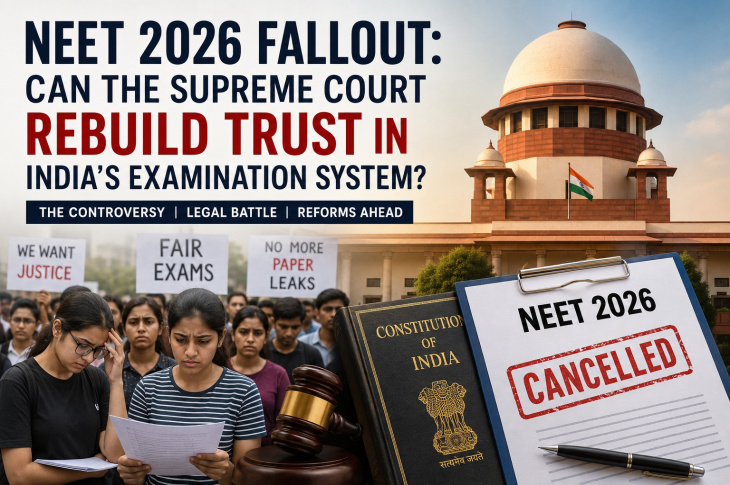


NEET 2026 Controversy Explained: Can Supreme Court Reforms Restore Trust in India's Examination System?


India's education system has long relied on competitive entrance examinations to determine admission into prestigious institutions. Among these, the National Eligibility cum Entrance Test (NEET) is one of the country's most significant examinations, deciding the future of millions of medical aspirants every year.
The cancellation of NEET-UG 2026 following allegations of a large-scale paper leak has triggered one of the biggest debates on examination integrity in recent years. Beyond the immediate impact on students, the controversy has sparked nationwide discussions about institutional accountability, constitutional rights, technological reforms, and the future of competitive examinations in India.
As the matter reaches the Supreme Court, the outcome could influence not only NEET but also the broader framework governing entrance examinations across the country.
Why NEET Matters in India
NEET serves as the common entrance examination for undergraduate medical courses across India. Every year, millions of candidates compete for a limited number of MBBS, BDS, AYUSH, veterinary, and other healthcare-related seats.
Because admission depends almost entirely on merit, the examination must maintain the highest standards of fairness, confidentiality, and transparency.
Any compromise in the examination process affects:
-
Students' careers
-
Parents' investments
-
Medical education standards
-
Public trust in government institutions
This explains why allegations of examination fraud often become matters of national importance.
Also Read: Supreme Court to Decide: Will Law Degrees in India Become Shorter and More Affordable?
What Led to the NEET 2026 Crisis?
Following the conduct of NEET-UG 2026, allegations emerged regarding organized malpractice involving question paper leaks and irregularities at examination centres.
Investigative agencies reportedly began examining evidence suggesting that confidential examination material may have been accessed before the examination by unauthorized individuals.
The controversy rapidly escalated as:
-
Multiple petitions were filed before the Supreme Court.
-
Questions were raised regarding examination security.
-
Students demanded transparency.
-
Calls for institutional reforms gained momentum.
-
Investigative agencies initiated criminal inquiries.
Eventually, the examination was cancelled, affecting lakhs of candidates who had spent years preparing.
Also Read: Child Denied School Admission in India? Know Your Legal Rights and What Parents Should Do
Why the Supreme Court's Role Is So Important
The Supreme Court is not deciding whether students studied hard or not.
Instead, it is examining whether constitutional principles governing fairness, equality, and administrative accountability were adequately protected.
The Court's observations may shape how future national examinations are conducted.
Constitutional Principles Involved
Several constitutional values become relevant whenever public examinations are compromised.
1. Equality Before Law (Article 14)
Article 14 guarantees equality before law and prohibits arbitrary state action.
When an examination is unfair because some candidates gain an illegal advantage through leaked papers, deserving students may lose equal opportunity.
The Court may examine whether authorities exercised sufficient care in protecting examination integrity.
2. Right to Fair Opportunity
Although the Constitution does not specifically mention competitive examinations, courts have consistently emphasized that admission processes must be transparent, objective, and non-arbitrary.
A flawed examination can affect students' legitimate expectation of competing on equal terms.
3. Administrative Accountability
Public institutions responsible for national examinations are expected to maintain high standards of governance.
Questions before the Court may include:
-
Were adequate security protocols implemented?
-
Were vulnerabilities ignored?
-
Could preventive measures have avoided the alleged leak?
-
Should stronger oversight mechanisms be introduced?
4. Public Confidence in Merit-Based Selection
Competitive examinations function effectively only when society believes that success depends upon merit.
Repeated allegations of paper leaks risk damaging confidence in the entire educational ecosystem.
Also Read: BCI Freezes Approval of New Law Colleges for 3 Years: What It Means for Legal Education in India
Understanding the National Testing Agency (NTA)
The National Testing Agency (NTA) conducts several major entrance examinations, including:
| Examination | Purpose |
|---|---|
| NEET | Medical admissions |
| JEE Main | Engineering admissions |
| CUET | Central university admissions |
| UGC NET | Eligibility for Assistant Professor and JRF |
The agency was established to create a standardized, transparent, and technology-driven examination process.
However, repeated controversies over recent years have led many stakeholders to question whether additional institutional safeguards are necessary.
What Reforms Are Being Demanded?
The ongoing legal proceedings have revived discussions on comprehensive examination reforms.
Some of the widely discussed proposals include:
Better Question Paper Security
Possible improvements include:
-
End-to-end encryption
-
Digital authentication
-
Multi-layer authorization
-
Time-controlled access systems
-
Real-time monitoring
Independent Security Audits
Experts have suggested periodic audits conducted by independent agencies to identify vulnerabilities before examinations are conducted.
Regular assessments could strengthen public confidence.
Greater Transparency
Many education experts recommend:
-
Transparent investigation mechanisms
-
Public disclosure of security improvements
-
Standard operating procedures for emergencies
-
Better communication with students
Stronger Accountability
Reforms may also include:
-
Clearly defined responsibilities
-
Internal compliance systems
-
Faster disciplinary action
-
Criminal prosecution where appropriate
Should NEET Become a Computer-Based Test?
One of the most debated proposals is shifting NEET entirely to Computer-Based Testing (CBT).
While this may reduce certain security risks, the issue is more complex than it appears.
Potential Benefits
Computer-based examinations may offer:
-
Reduced transportation of physical question papers
-
Better encryption
-
Automated access control
-
Centralized monitoring
-
Faster evaluation
Possible Challenges
India's educational diversity creates practical concerns.
Many candidates come from:
-
Rural regions
-
Remote districts
-
Economically weaker backgrounds
-
Schools with limited computer infrastructure
A sudden transition may unintentionally disadvantage students unfamiliar with digital examination environments.
Cybersecurity Risks
Digital examinations introduce different challenges, including:
-
Hacking attempts
-
Malware attacks
-
Server failures
-
Internet disruptions
-
Data breaches
Therefore, technology alone cannot guarantee fairness.
Strong cybersecurity measures would be equally important.
How Investigation Agencies Influence the Case
Criminal investigations play a crucial role in determining the extent of alleged malpractice.
Their findings may answer important questions:
-
Was the leak isolated?
-
Was it organized?
-
Were examination officials involved?
-
Were multiple states affected?
-
Was there systemic failure?
The answers could influence future judicial directions regarding institutional reforms.
Impact on Students
The cancellation of a national examination creates significant consequences.
Academic Impact
Students may experience:
-
Delay in admissions
-
Additional preparation burden
-
Revised counselling schedules
-
Extended uncertainty
Emotional Impact
Months or years of preparation can result in:
-
Stress
-
Anxiety
-
Mental fatigue
-
Loss of confidence
Supporting students through transparent communication becomes equally important during such crises.
Lessons India Can Learn from Global Examination Systems
Many countries have adopted layered security mechanisms for high-stakes examinations.
Some commonly used practices include:
| Security Measure | Purpose |
| Multi-stage encryption | Protect question papers |
| Biometric verification | Prevent impersonation |
| AI-assisted monitoring | Detect suspicious activity |
| Independent audit teams | Improve accountability |
| Secure digital delivery | Minimize unauthorized access |
No system is completely immune from malpractice, but combining technology with accountability significantly reduces risks.
Could New Laws Be Needed?
The controversy has also renewed discussions about strengthening legal protections for public examinations.
Potential policy measures could include:
-
Stronger penalties for organized paper leak networks
-
Faster investigation procedures
-
Mandatory cybersecurity standards
-
Independent regulatory oversight
-
Whistleblower protection
-
Periodic institutional reviews
Legislative reforms, combined with administrative improvements, could create a more resilient examination framework.
Why This Case Extends Beyond NEET
The implications go far beyond one entrance examination.
Future reforms may influence:
-
Government recruitment exams
-
University admissions
-
Public service commission examinations
-
Professional licensing tests
-
National eligibility examinations
The Supreme Court's observations may therefore shape educational governance across multiple sectors.
Balancing Fairness and Student Hardship
One of the most difficult legal questions is determining the appropriate response when widespread irregularities are alleged.
Authorities must balance two competing concerns:
| Protect Examination Integrity | Protect Honest Students |
| Prevent unfair advantage | Avoid unnecessary hardship |
| Maintain public trust | Minimize delays |
| Punish organized malpractice | Preserve academic careers |
| Ensure equal opportunity | Reduce psychological burden |
Finding this balance is likely to remain central to judicial decision-making.
The Future of India's Examination System
The NEET 2026 controversy has highlighted that examination reforms require more than stronger technology.
A sustainable system should include:
-
Institutional transparency
-
Continuous security upgrades
-
Independent oversight
-
Regular audits
-
Modern cybersecurity practices
-
Student-centric communication
-
Swift investigation of irregularities
Ultimately, public confidence depends on the credibility of both the examination process and the institutions responsible for conducting it.
Conclusion
The NEET 2026 controversy represents more than an examination dispute—it has become a defining moment for India's education governance. As the Supreme Court examines issues relating to fairness, accountability, and institutional responsibility, the decisions emerging from this litigation may influence the future design of competitive examinations across the country.
Restoring public trust will require coordinated action from policymakers, educational institutions, investigative agencies, technology experts, and examination authorities. Transparent governance, modern security systems, and effective legal safeguards are essential to preserving merit-based education.
For millions of students whose futures depend on competitive examinations, credibility is not merely an administrative objective—it is the foundation of equal opportunity. The reforms initiated today may determine whether India's examination system continues to command confidence for generations to come.
Frequently asked questions
Why was NEET 2026 cancelled?
Why was NEET 2026 cancelled?
The examination was cancelled following allegations of widespread irregularities, including an alleged paper leak. Investigations and judicial proceedings are examining the circumstances surrounding the controversy.
What role is the Supreme Court playing?
What role is the Supreme Court playing?
The Supreme Court is considering petitions concerning examination fairness, institutional accountability, and possible reforms to improve the integrity of national entrance examinations.
Can the Court replace the National Testing Agency?
Can the Court replace the National Testing Agency?
Institutional restructuring generally falls within the executive's powers. However, courts may issue directions requiring reforms, monitoring, transparency measures, or improved safeguards if constitutional concerns are established.
Is Computer-Based Testing the complete solution?
Is Computer-Based Testing the complete solution?
No. While digital examinations may reduce certain risks, they also introduce cybersecurity and accessibility challenges. Any transition would require careful planning and robust infrastructure.
Why is Article 14 relevant?
Why is Article 14 relevant?
Article 14 guarantees equality before law. If an examination process unfairly benefits certain candidates due to systemic failures, questions regarding equal opportunity may arise.
How can future examination fraud be prevented?
How can future examination fraud be prevented?
A combination of technological safeguards, institutional accountability, independent audits, stronger cybersecurity, transparent investigations, and effective legal enforcement can significantly improve examination security.

Online Consultation


Online Consultations


Trending
Frequently asked questions
Why was NEET 2026 cancelled?
Why was NEET 2026 cancelled?
The examination was cancelled following allegations of widespread irregularities, including an alleged paper leak. Investigations and judicial proceedings are examining the circumstances surrounding the controversy.
What role is the Supreme Court playing?
What role is the Supreme Court playing?
The Supreme Court is considering petitions concerning examination fairness, institutional accountability, and possible reforms to improve the integrity of national entrance examinations.
Can the Court replace the National Testing Agency?
Can the Court replace the National Testing Agency?
Institutional restructuring generally falls within the executive's powers. However, courts may issue directions requiring reforms, monitoring, transparency measures, or improved safeguards if constitutional concerns are established.
Is Computer-Based Testing the complete solution?
Is Computer-Based Testing the complete solution?
No. While digital examinations may reduce certain risks, they also introduce cybersecurity and accessibility challenges. Any transition would require careful planning and robust infrastructure.
Why is Article 14 relevant?
Why is Article 14 relevant?
Article 14 guarantees equality before law. If an examination process unfairly benefits certain candidates due to systemic failures, questions regarding equal opportunity may arise.
How can future examination fraud be prevented?
How can future examination fraud be prevented?
A combination of technological safeguards, institutional accountability, independent audits, stronger cybersecurity, transparent investigations, and effective legal enforcement can significantly improve examination security.
Online Consultations


Ask a Lawyer