


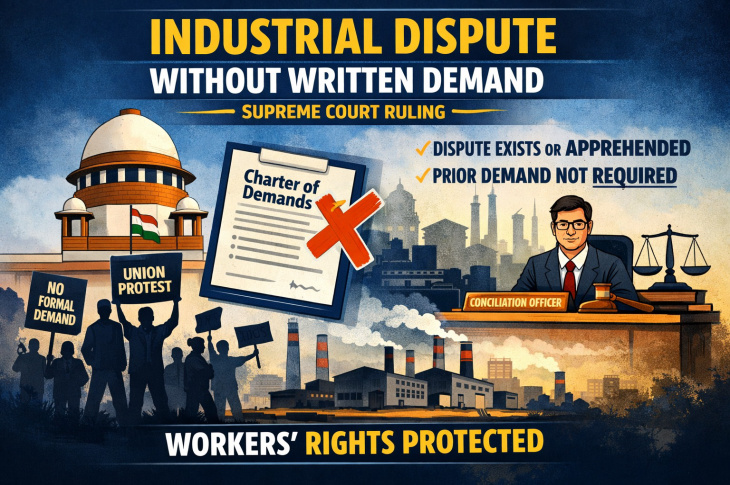


Industrial Dispute Need Not Await Prior Written Demand: Supreme Court Clarifies


Introduction
In a significant and worker‑friendly interpretation of labour law, the Supreme Court of India has clarified that an industrial dispute under the Industrial Disputes Act, 1947 (ID Act) does not require a prior written or formal charter of demands to be raised by workmen or their trade union before invoking the statutory machinery of conciliation. This landmark clarification reinforces the preventive and remedial purpose of labour legislation and strengthens access to justice for workers, particularly contract labourers who often operate in vulnerable employment arrangements.
The ruling came in M/s Premium Transmission Private Limited v. State of Maharashtra & Others (Neutral Citation: 2026 INSC 87), decided by a Division Bench comprising Justice Pankaj Mithal and Justice S.V.N. Bhatti. The Court dismissed the employer’s challenge to conciliation proceedings, a government reference, and interim reliefs granted by the Industrial Court, firmly holding that the absence of a prior written demand does not negate the existence of an industrial dispute.
This judgment has far‑reaching implications for industrial relations in India. It clarifies long‑standing ambiguities, curbs dilatory tactics by employers, and re‑emphasises that labour laws must be interpreted in a manner that furthers industrial peace rather than procedural technicalities.
Background of the Case
The dispute arose from a group of contract workers, represented through a trade union, who alleged that the contractual arrangement under which they were engaged was sham and nominal. According to the workmen, although they were shown as employees of a contractor, the real control, supervision, and nature of work indicated that the management was the principal employer.
Instead of first serving a formal charter of demands on the management, the union directly approached the Conciliation Officer under the ID Act. The conciliation proceedings ultimately failed, resulting in a failure report under Section 12 of the Act. Based on this report, the appropriate Government referred the dispute to the Industrial Court under Section 10.
The management challenged this reference before the High Court, arguing that:
-
No industrial dispute existed in law.
-
No prior written demand or charter of demands had been served.
-
The Conciliation Officer lacked jurisdiction in the absence of such demand.
While the reference was pending, the workmen also filed a complaint under Section 33‑A of the ID Act, alleging illegal alteration of service conditions and cessation of work during the pendency of proceedings. Interim relief granted by the Industrial Court was affirmed by the High Court.
Aggrieved, the management approached the Supreme Court challenging both the government reference and the interim relief orders.
Core Legal Issue Before the Supreme Court
The principal question before the Supreme Court was:
Is a prior formal or written demand by workmen a mandatory precondition for the existence of an industrial dispute and for invoking conciliation and reference proceedings under the Industrial Disputes Act, 1947?
Closely connected to this were related issues, such as:
-
Whether an industrial dispute can be said to exist or be apprehended without a formal demand.
-
Whether the appropriate Government exceeded its jurisdiction by referring the dispute.
-
Whether disputes concerning sham contract labour arrangements can be entertained without prior employer‑workman negotiation.
Understanding the Concept of “Industrial Dispute”
Statutory Definition
Section 2(k) of the Industrial Disputes Act defines an industrial dispute as:
“Any dispute or difference between employers and employers, or between employers and workmen, or between workmen and workmen, which is connected with the employment or non‑employment or the terms of employment or with the conditions of labour, of any person.”
The definition is deliberately broad and inclusive. It does not prescribe any rigid or formalistic method by which a dispute must arise.
No Prescribed Mode of Raising a Dispute
The Supreme Court reiterated that the ID Act:
-
Does not mandate a written demand as a condition precedent.
-
Does not require that the dispute must first be raised directly with the employer.
-
Focuses instead on the existence or apprehension of a dispute.
This interpretation aligns with the welfare‑oriented nature of labour legislation.
Supreme Court’s Analysis and Reasoning
Reliance on Established Precedent
The Bench relied heavily on earlier authoritative decisions, particularly Shambu Nath Goyal v. Bank of Baroda (1978), where the Supreme Court held that:
-
The appropriate Government has the power to refer not only existing disputes but also apprehended disputes.
-
Any interpretation that nullifies the word “apprehended” in Section 10(1) would be legally impermissible.
The Court observed that the management’s argument effectively sought to read additional words into the statute, which is not allowed in statutory interpretation.
Formal Demand Is Not a Sine Qua Non
The Court unequivocally held:
-
A formal written demand is not a sine qua non for an industrial dispute.
-
What matters is whether there is a real dispute or difference relating to employment conditions.
The only statutory exception is in the case of public utility services, where Section 22 of the ID Act requires prior notice before strikes. Outside this limited exception, no such requirement exists.
Preventive and Remedial Nature of the ID Act
A key highlight of the judgment is the Court’s emphasis on the preventive function of the ID Act. The Court cautioned that:
-
Insisting on prior demands would delay intervention.
-
In many cases, raising demands with the employer may expose workers to victimisation or loss of employment.
The Court observed that allowing preliminary objections at the threshold would:
“Negate the preventive intent of the statute, converting a mechanism of immediate relief into an engine of delay.”
Role of the Conciliation Officer Explained
The Supreme Court clarified the limited yet crucial role of the Conciliation Officer:
-
The Conciliation Officer is not required to adjudicate disputed facts.
-
His role is to attempt settlement once a dispute exists or is apprehended.
-
Questions such as whether a contract is sham or whether the management is the principal employer fall within the domain of the Industrial or Labour Court, not the Conciliation Officer.
Thus, objections relating to the merits of the dispute cannot be used to block conciliation or reference proceedings.
Tripartite Relationship: Management, Contractor, and Workmen
Denial of Status as a Dispute
In contract labour cases, employers often deny any direct relationship with the workers. The Court held that:
-
Denial of employer‑employee relationship itself can constitute an industrial dispute.
-
Allegations that a contract is sham or camouflage necessarily involve factual examination.
Adjudication by Industrial Court
Recognising this, the Supreme Court directed the Industrial Court to frame and decide two specific issues:
-
Whether the contract labour arrangements were sham and nominal.
-
Whether, considering the nature of work, the management was the principal employer.
This approach ensures that substantive justice is delivered after proper adjudication rather than being defeated at the threshold.
Section 33‑A Complaint and Interim Relief
The Court also addressed the complaint filed under Section 33‑A, which allows workmen to directly approach the Labour or Industrial Court when service conditions are altered during pending proceedings.
The management argued that interim relief should not have been granted. Rejecting this contention, the Supreme Court held that:
-
Interim protection is essential to prevent fait accompli situations.
-
Workers cannot be left remediless while legal proceedings are pending.
The affirmation of interim relief underscores the Court’s commitment to maintaining a balance of power during industrial adjudication.
Government’s Power of Reference Under Section 10
The Supreme Court reaffirmed that:
-
The appropriate Government’s role at the stage of reference is administrative, not adjudicatory.
-
The Government need only be satisfied that a dispute exists or is apprehended.
-
Detailed examination of evidence is neither required nor permissible at this stage.
Any attempt by employers to convert reference proceedings into mini‑trials was firmly discouraged.
Why This Judgment Is a Landmark
Strengthens Workers’ Access to Justice
By removing the insistence on prior written demands, the judgment:
-
Makes labour remedies more accessible.
-
Protects vulnerable workers from procedural traps.
Prevents Abuse of Process
The ruling curbs the tendency of employers to raise technical objections to delay adjudication.
Reinforces Welfare Interpretation
The decision aligns with the settled principle that labour laws must receive a liberal and purposive interpretation.
Clarifies Law on Contract Labour Disputes
It reaffirms that disputes over sham contracts are legitimate industrial disputes requiring adjudication.
Practical Implications for Employers and Workers
For Employers
-
Procedural objections will not easily stall industrial adjudication.
-
Greater emphasis must be placed on compliance and fair labour practices.
For Workers and Trade Unions
-
Direct access to conciliation machinery is reinforced.
-
Fear of retaliation for raising demands is reduced.
For Labour Administration
-
Conciliation Officers and Governments can act decisively to preserve industrial peace.
Conclusion
The Supreme Court’s ruling in M/s Premium Transmission Private Limited v. State of Maharashtra & Others marks a decisive step in reaffirming the spirit and purpose of the Industrial Disputes Act, 1947. By holding that an industrial dispute need not await a prior written demand, the Court has ensured that labour law remains a tool of social justice rather than a maze of procedural hurdles.
The judgment strengthens preventive mechanisms, empowers workers, and reinforces the idea that industrial peace is best achieved through timely intervention and fair adjudication. In doing so, it sets a robust precedent that will guide industrial relations in India for years to come.
Case Details
-
Case Title: M/s Premium Transmission Private Limited v. State of Maharashtra & Others
-
Neutral Citation: 2026 INSC 87
-
Bench: Justice Pankaj Mithal, Justice S.V.N. Bhatti
-
Decision: Civil Appeal dismissed; reference and interim relief upheld
Download the Judgment Here:
Supreme Court JudgmentFrequently asked questions
Is a prior written demand mandatory to raise an industrial dispute under the Industrial Disputes Act?
Is a prior written demand mandatory to raise an industrial dispute under the Industrial Disputes Act?
No. The Supreme Court has clarified that a prior written or formal charter of demands is not mandatory to raise an industrial dispute. An industrial dispute can exist or even be apprehended without such a demand, and the conciliation machinery can be invoked directly.
Can a trade union approach the Conciliation Officer without first negotiating with the employer?
Can a trade union approach the Conciliation Officer without first negotiating with the employer?
Yes. A trade union or workmen can directly approach the Conciliation Officer if an industrial dispute exists or is apprehended. The Industrial Disputes Act does not require prior negotiations or a written demand before initiating conciliation proceedings.
Does the absence of a written demand mean no industrial dispute exists?
Does the absence of a written demand mean no industrial dispute exists?
No. The Supreme Court has held that the existence of an industrial dispute does not depend on a written demand. Any dispute or difference relating to employment, non-employment, or service conditions can qualify as an industrial dispute, even without a formal demand.
What is the role of the Government while referring an industrial dispute under Section 10 of the ID Act?
What is the role of the Government while referring an industrial dispute under Section 10 of the ID Act?
The role of the appropriate Government is administrative, not judicial. It only needs to be satisfied that an industrial dispute exists or is apprehended. The Government is not required to examine evidence or decide the merits of the dispute before making a reference.
Can disputes about sham contract labour arrangements be treated as industrial disputes?
Can disputes about sham contract labour arrangements be treated as industrial disputes?
Yes. The Court clarified that disputes alleging that a contract labour arrangement is sham or nominal are valid industrial disputes. Whether the management is the principal employer is a question of fact that must be decided by the Industrial or Labour Court, not at the conciliation stage.

Online Consultation


Online Consultations


Trending
Frequently asked questions
Is a prior written demand mandatory to raise an industrial dispute under the Industrial Disputes Act?
Is a prior written demand mandatory to raise an industrial dispute under the Industrial Disputes Act?
No. The Supreme Court has clarified that a prior written or formal charter of demands is not mandatory to raise an industrial dispute. An industrial dispute can exist or even be apprehended without such a demand, and the conciliation machinery can be invoked directly.
Can a trade union approach the Conciliation Officer without first negotiating with the employer?
Can a trade union approach the Conciliation Officer without first negotiating with the employer?
Yes. A trade union or workmen can directly approach the Conciliation Officer if an industrial dispute exists or is apprehended. The Industrial Disputes Act does not require prior negotiations or a written demand before initiating conciliation proceedings.
Does the absence of a written demand mean no industrial dispute exists?
Does the absence of a written demand mean no industrial dispute exists?
No. The Supreme Court has held that the existence of an industrial dispute does not depend on a written demand. Any dispute or difference relating to employment, non-employment, or service conditions can qualify as an industrial dispute, even without a formal demand.
What is the role of the Government while referring an industrial dispute under Section 10 of the ID Act?
What is the role of the Government while referring an industrial dispute under Section 10 of the ID Act?
The role of the appropriate Government is administrative, not judicial. It only needs to be satisfied that an industrial dispute exists or is apprehended. The Government is not required to examine evidence or decide the merits of the dispute before making a reference.
Can disputes about sham contract labour arrangements be treated as industrial disputes?
Can disputes about sham contract labour arrangements be treated as industrial disputes?
Yes. The Court clarified that disputes alleging that a contract labour arrangement is sham or nominal are valid industrial disputes. Whether the management is the principal employer is a question of fact that must be decided by the Industrial or Labour Court, not at the conciliation stage.
Online Consultations


Ask a Lawyer