




India’s New Online Gaming Law 2026: Everything About Rules, Liability and Compliance


India’s digital gaming industry has entered a completely new legal era with the introduction of the Promotion and Regulation of Online Gaming Act, 2025 and the Online Gaming Rules, 2026. Together, these reforms have reshaped how online games are classified, operated, marketed, and regulated in India.
For gamers, startups, payment companies, advertisers, and influencers, this is not just another regulatory update—it is a full structural overhaul of the online gaming ecosystem. The law introduces strict controls on “online money games,” expands liability across the entire value chain, and establishes a dedicated regulator.
1. The Legal Status of India’s Online Gaming Law in 2026
The legal framework governing online gaming in India is now fully operational.
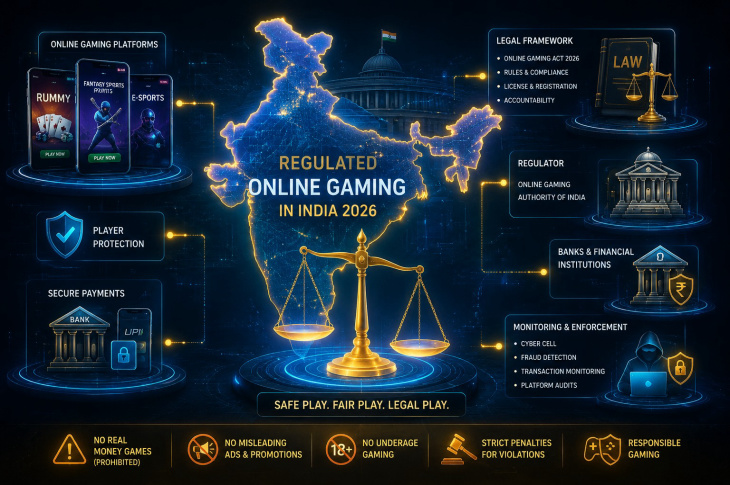
The Promotion and Regulation of Online Gaming Act, 2025 received Presidential assent in 2025 and was officially brought into force on 1 May 2026. Along with it, the Online Gaming Rules, 2026 were also notified, and a dedicated regulator—the Online Gaming Authority of India—has been formally established.
Online Gaming Authority of India
This means:
-
The law is fully active and enforceable
-
There is no grace period for compliance
-
Criminal penalties and prohibitions apply immediately
-
Enforcement agencies can begin investigations and prosecutions
Key institutional setup now in force:
-
Central regulator (OGAI)
-
Cyber cell enforcement officers across states
-
Mandatory compliance obligations for platforms and banks
-
Blocking and takedown powers for foreign gaming apps
In short, India has moved from a loosely regulated gaming environment to a strict, enforcement-driven regulatory system.
2. Understanding the Scope of India’s Online Gaming Law
The biggest shift introduced by the 2026 framework is how games are classified. The law does not rely on the traditional “skill vs chance” debate anymore. Instead, it focuses on money flow and monetisation structure.
1. What is an “Online Money Game”?
Under the new law, an online money game is any game where:
-
Users pay money or deposit stakes
-
Participation is linked to expectation of winnings or monetary gain
-
Rewards can be cash, virtual coins, tokens, or assets convertible into money
Importantly, the law clearly states:
It does not matter whether the game is based on skill, chance, or both.
This is a major shift from earlier judicial interpretations in India.
What gets included:
-
Fantasy sports with entry fees and cash winnings
-
Rummy or card games with real-money stakes
-
Gaming apps with deposit-based tournaments
-
Token-based games where virtual currency can be converted into real money
What gets excluded:
-
Pure entertainment games with no monetary stakes
-
Subscription-based games without wagering
-
E-sports competitions regulated separately
2. E-sports and Social Games: The Legal Safe Zone
The law creates a clear distinction:
1. E-sports
-
Recognised under national sports governance framework
-
No betting or wagering allowed
-
Prize money is allowed but not linked to stakes
2. Online Social Games
-
No money staking allowed
-
May charge subscription or access fees
-
Designed purely for entertainment or skill-building
This separation is crucial because it determines whether a game falls under strict prohibition or normal compliance.
3. Foreign Gaming Platforms Are Also Covered
One of the strongest features of the law is its extra-territorial reach.
Even if a gaming company operates from outside India, it can still be regulated if:
-
It targets Indian users
-
Accepts Indian payments
-
Offers games accessible in India
Authorities can:
-
Block websites and apps
-
Restrict payment processing
-
Direct banks to freeze transactions
This effectively ensures that offshore gaming platforms cannot bypass Indian law by operating remotely.
4. Even “Unlisted Games” Can Be Illegal
A key misunderstanding among operators is that only games listed by the regulator are covered.
That is not true.
Even if a game is not officially identified by the regulator, it can still be illegal if it meets the definition of an “online money game.”
The regulator may publish lists for clarity, but:
The list is not a legal shield or safe harbour.
So compliance must be based on legal definition, not just regulatory listing.
3. Liability Under India’s Online Gaming Law 2026
One of the most aggressive aspects of the new law is expanded liability across the entire ecosystem, not just gaming companies.
1. Liability of Gaming Platforms and Operators
Gaming companies are the primary targets of regulation.
If a platform offers or operates an online money game, it can face:
Criminal penalties:
-
Up to 3 years imprisonment
-
Fines up to ₹1 crore
-
Mandatory penalties for repeat violations
Offences are:
-
Cognisable (police can act without warrant)
-
Non-bailable (strict legal treatment)
Additional obligations for compliant games:
Platforms offering social games or e-sports must:
-
Maintain grievance redress systems
-
Follow data retention rules
-
Display registration details clearly
-
Comply with regulator directions
Failure leads to:
-
Suspension
-
Cancellation of registration
-
Financial penalties
2. Liability of Banks and Payment Gateways
Banks and payment systems now play a critical enforcement role.
They are required to:
-
Verify whether a gaming platform is registered
-
Block transactions linked to illegal gaming
-
Immediately act on regulator instructions
-
Report suspicious gaming-related transactions
This means payment infrastructure has become a compliance checkpoint.
Real-world impact:
Even if a gaming app is active online, it becomes unusable if:
-
UPI payments are blocked
-
Card processors stop transactions
-
Bank transfers are flagged
This is one of the strongest enforcement tools in the law.
3. Advertising Restrictions – One of the Strictest Provisions
The law places a near-total restriction on advertising online money games.
It prohibits:
-
Direct advertisements
-
Indirect promotions
-
Influencer marketing
-
Referral-based promotions
-
Social media endorsements
The definition of “advertisement” is broad and includes:
-
Social media posts
-
YouTube videos
-
Instagram reels
-
Celebrity endorsements
-
Sponsorships
Penalties:
-
Up to 2 years imprisonment
-
Fines up to ₹50 lakh
-
Higher penalties for repeat offenders
This shows the government’s intent to curb aggressive marketing that previously drove mass adoption of real-money gaming platforms.
4. Risks for Influencers, Streamers and Content Creators
One of the most significant impacts of the law is on digital creators.
Unlike earlier frameworks, the 2026 law does not differentiate between:
-
Paid promotions
-
Organic content
-
Entertainment gameplay streams
If content promotes or encourages participation in an online money game, liability may arise.
What can trigger liability?
-
Streaming real-money gaming apps
-
Sharing referral codes
-
Reviewing gaming platforms with monetisation links
-
Posting “how to win money” gaming content
-
Collaborating with gaming companies
Even indirect promotion can be covered.
No Safe Harbour for Influencers
The law does not provide a “good faith” or “no knowledge” defence for advertisers or creators.
This means:
-
Claiming ignorance is not a defence
-
Platform disclaimers are not sufficient protection
-
Due diligence is mandatory
Practical legal standard:
Before promoting any gaming platform, influencers must verify:
-
Whether the game is registered with the regulator
-
Whether it qualifies as an online social game or e-sport
-
Whether any monetary staking is involved
-
Whether winnings are convertible to money
If uncertainty exists, the safest approach is non-association.
5. How the Law Is Enforced in Practice
The enforcement mechanism is multi-layered:
1. Cyber Cell Investigations
Specialised cyber officers can:
-
Investigate violations
-
Freeze digital assets
-
Trace transactions
2. Platform Blocking
Authorities can order:
-
Website blocking
-
App removal from app stores
-
ISP-level restrictions
3. Financial System Controls
Banks and UPI systems act as:
-
First line of detection
-
Real-time blockers
-
Reporting agents
4. Regulatory Orders
The regulator can:
-
Issue compliance directions
-
Suspend registrations
-
Publish official determinations
6. Practical Compliance Checklist for Businesses
If you are operating in the gaming ecosystem, here is a simplified compliance roadmap:
For Gaming Companies:
-
Classify your game properly (social vs money game)
-
Avoid any staking-based model if operating in India
-
Obtain registration if applicable
-
Set up grievance redress system
-
Ensure transparent user disclosures
For Payment Companies:
-
Verify gaming platform registration
-
Monitor transactions linked to gaming apps
-
Block flagged platforms immediately
-
Maintain audit trails
For Advertisers and Influencers:
-
Do not promote real-money games
-
Verify legal status before collaboration
-
Avoid referral-based promotions
-
Maintain written compliance checks
7. Real-World Scenarios to Understand the Law
Scenario 1: Fantasy Sports App
If users pay ₹100 entry fee to join a contest and win cash prizes → likely classified as an online money game → prohibited unless specifically exempted or restructured.
Scenario 2: Subscription Gaming App
Users pay ₹299 monthly for access to games without wagering → generally treated as a social game → permitted with compliance.
Scenario 3: Influencer Review Video
A YouTuber reviews a gaming app and shares referral links → may be treated as indirect advertisement → legal risk.
8. Why This Law Matters for India’s Digital Economy
This legislation is not just about gaming—it reflects a broader policy shift:
-
Stronger consumer protection
-
Financial system integrity
-
Youth protection from addictive monetisation models
-
Regulation of digital advertising influence
-
Control over cross-border digital services
India is effectively building a structured and tightly monitored gaming ecosystem rather than an open, self-regulated market.
Conclusion
India’s New Online Gaming Law 2026 marks a decisive shift from a loosely interpreted gaming ecosystem to a strict, definition-based regulatory framework. By focusing on financial stakes rather than game mechanics, the law closes long-standing legal loopholes.
For businesses, the message is clear: compliance is no longer optional or flexible. For influencers and advertisers, due diligence is now a legal requirement, not a best practice. And for payment systems, enforcement responsibility has shifted directly onto them.
The overall direction of the law is unmistakable—India is aiming for a controlled, transparent, and financially secure digital gaming environment where monetisation is heavily regulated and consumer risks are minimised.
For stakeholders in this industry, the priority is not just understanding the law, but restructuring operations to align with it immediately.
Frequently asked questions
What is India’s Online Gaming Law 2026?
What is India’s Online Gaming Law 2026?
India’s Online Gaming Law 2026 refers to the Promotion and Regulation of Online Gaming Act, 2025 and the Online Gaming Rules, 2026, which regulate online gaming platforms, especially online money games, e-sports, and social games, along with strict compliance and liability rules.
What is considered an online money game under the new law?
What is considered an online money game under the new law?
An online money game is any game where users pay money or stakes to participate with the expectation of winning monetary rewards or convertible virtual assets, regardless of whether the game is based on skill, chance, or both.
Are online gaming platforms legal in India under the 2026 law?
Are online gaming platforms legal in India under the 2026 law?
Yes, but only if they fall under permitted categories like online social games or e-sports. Platforms offering real-money gaming involving stakes and monetary winnings are heavily restricted or prohibited under the law.
Can influencers and YouTubers be held liable for promoting online games?
Can influencers and YouTubers be held liable for promoting online games?
Yes. Influencers, streamers, and content creators can face legal action if they directly or indirectly promote or encourage participation in online money games, including through ads, referral links, or sponsorship content.
What are the penalties for violating India’s Online Gaming Law 2026?
What are the penalties for violating India’s Online Gaming Law 2026?
Violations can lead to imprisonment up to 3 years, fines up to ₹1 crore for operators, and additional penalties for advertisers and influencers, including fines up to ₹50 lakh and possible imprisonment depending on the offence.

Online Consultation


Online Consultations


Trending
Frequently asked questions
What is India’s Online Gaming Law 2026?
What is India’s Online Gaming Law 2026?
India’s Online Gaming Law 2026 refers to the Promotion and Regulation of Online Gaming Act, 2025 and the Online Gaming Rules, 2026, which regulate online gaming platforms, especially online money games, e-sports, and social games, along with strict compliance and liability rules.
What is considered an online money game under the new law?
What is considered an online money game under the new law?
An online money game is any game where users pay money or stakes to participate with the expectation of winning monetary rewards or convertible virtual assets, regardless of whether the game is based on skill, chance, or both.
Are online gaming platforms legal in India under the 2026 law?
Are online gaming platforms legal in India under the 2026 law?
Yes, but only if they fall under permitted categories like online social games or e-sports. Platforms offering real-money gaming involving stakes and monetary winnings are heavily restricted or prohibited under the law.
Can influencers and YouTubers be held liable for promoting online games?
Can influencers and YouTubers be held liable for promoting online games?
Yes. Influencers, streamers, and content creators can face legal action if they directly or indirectly promote or encourage participation in online money games, including through ads, referral links, or sponsorship content.
What are the penalties for violating India’s Online Gaming Law 2026?
What are the penalties for violating India’s Online Gaming Law 2026?
Violations can lead to imprisonment up to 3 years, fines up to ₹1 crore for operators, and additional penalties for advertisers and influencers, including fines up to ₹50 lakh and possible imprisonment depending on the offence.
Online Consultations


Ask a Lawyer