


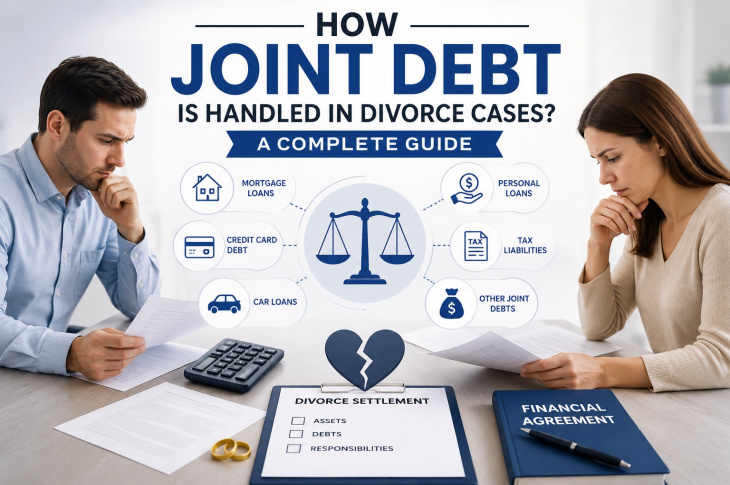


How Joint Debt Is Handled During Divorce: A Complete Guide to Dividing Financial Responsibilities


Divorce is more than the end of a marriage—it is also the separation of financial lives. While dividing assets often receives the most attention, joint debt can become one of the most challenging issues during the divorce process. Mortgages, car loans, personal loans, credit cards, and other shared financial obligations do not simply disappear because a marriage ends.
Understanding how joint debt is handled during divorce can help you avoid unexpected financial burdens, protect your credit score, and negotiate a fair settlement.
Also Read: Divorce Law in India
What Is Joint Debt?
Joint debt refers to any financial obligation for which both spouses are legally responsible. In most cases, both names appear on the loan agreement or credit account, making each person liable for repayment.
Common examples include:
-
Joint credit cards
-
Home mortgages
-
Car loans
-
Personal loans
-
Home equity loans
-
Business loans signed by both spouses
-
Lines of credit
Even if only one spouse regularly used the borrowed money, both parties may still be legally responsible if the debt was jointly incurred.
Also Read: Divorce Procedure In India
Does Divorce Automatically Remove Debt Responsibility?
No.
One of the biggest misconceptions is that a divorce decree changes your agreement with lenders. It generally does not.
A divorce settlement determines how spouses divide financial responsibilities between themselves, but creditors are usually not bound by that agreement unless they formally release one borrower.
For example:
-
A court may order your former spouse to pay a joint credit card.
-
If they stop making payments, the lender can still pursue you if your name remains on the account.
This is why handling debt properly during divorce is just as important as dividing property.
Also Read: Legal Grounds for Divorce in India
Types of Debt Considered During Divorce
1. Credit Card Debt
Credit card debt is often one of the largest areas of disagreement.
Courts may consider:
-
When the debt was incurred
-
Whether it benefited the household
-
Which spouse primarily used the card
-
Whether the account is jointly owned
In many cases, balances accumulated during the marriage are treated differently from debts incurred before marriage.
2. Mortgage Debt
If both spouses signed the mortgage:
-
Both remain legally responsible until the loan is refinanced, paid off, or the property is sold.
-
Simply moving out of the house does not remove liability.
Common solutions include:
-
Selling the property
-
Refinancing into one spouse's name
-
Buying out the other spouse's ownership interest
3. Car Loans
Vehicle loans are usually assigned to the spouse who keeps the vehicle.
However, if both spouses signed the loan, refinancing may be necessary to remove one person's legal responsibility.
4. Personal Loans
Personal loans taken jointly are generally divided according to the divorce settlement, but lenders may still hold both borrowers accountable.
5. Tax Debts
Outstanding tax liabilities may also become part of divorce negotiations.
Depending on the circumstances, both spouses may remain responsible for unpaid taxes arising during the marriage.
Also Read: How To File Mutual Divorce? Mutual Divorce Process
How Courts Divide Joint Debt
Debt division depends on the laws of the jurisdiction.
Generally, courts follow one of two approaches.
| System | How Debt Is Divided |
|---|---|
| Community Property | Debts acquired during marriage are generally considered jointly owned and are often divided equally. |
| Equitable Distribution | Courts divide debts fairly based on financial circumstances, income, contributions, and other relevant factors. Fair does not always mean equal. |
Judges may evaluate:
-
Each spouse's income
-
Future earning capacity
-
Existing assets
-
Child custody arrangements
-
Ability to repay debt
-
Purpose of the debt
Separate Debt vs Joint Debt
Not every liability is automatically shared.
Separate Debt
May include:
-
Student loans obtained before marriage
-
Credit cards opened individually before marriage
-
Personal debts unrelated to the marriage
-
Certain legal judgments
Joint Debt
Often includes:
-
Shared credit accounts
-
Home loans
-
Joint vehicle financing
-
Household-related loans
-
Family expenses incurred together
The classification depends on local laws and the specific facts of each case.
Also Read: Preparing for Divorce in 2026: 5 Crucial Things You Must Know Before Filing
Why Hidden Debt Can Become a Serious Problem
Sometimes one spouse discovers previously unknown financial obligations during divorce.
Examples include:
-
Secret credit cards
-
Undisclosed loans
-
Personal guarantees
-
Business liabilities
-
Tax obligations
-
Buy-now-pay-later accounts
Hidden debt can significantly affect settlement negotiations and future financial stability.
For this reason, it is important to conduct a thorough financial review before finalizing any agreement.
Also Read: Comprehensive Guide to Divorce Documents in India: A Step-by-Step Approach
Documents You Should Review
Gathering complete financial information is essential.
Review:
-
Credit reports
-
Bank statements
-
Credit card statements
-
Mortgage records
-
Vehicle loan documents
-
Tax returns
-
Investment accounts
-
Business financial records
-
Personal loan agreements
Having accurate documentation helps identify all outstanding liabilities.
Also Read: Divorce Simplified Types Of Divorce And Divorce Procedures In India
Protecting Your Credit During Divorce
Even while divorce proceedings are ongoing, your credit score can still be affected.
Consider these practical steps:
-
Continue monitoring your credit reports.
-
Close unnecessary joint credit accounts where possible.
-
Freeze additional borrowing if appropriate.
-
Remove authorized users from accounts when legally permissible.
-
Refinance loans assigned to one spouse.
-
Keep records of every payment.
-
Communicate with creditors if financial arrangements change.
Taking proactive measures can prevent long-term credit damage.
Can You Remove Your Name from Joint Debt?
Sometimes—but not automatically.
Possible options include:
Loan Refinancing
One spouse refinances the loan solely in their own name.
Paying Off the Debt
Using savings or proceeds from asset sales to eliminate the balance.
Selling the Asset
Common for homes and vehicles when neither spouse wishes to keep the property.
Creditor Approval
Some lenders may agree to remove one borrower, although this is relatively uncommon without refinancing.
Should You Consult a Lawyer?
Yes.
Dividing debt can involve legal, financial, and contractual issues that require professional guidance.
An experienced divorce lawyer can help:
-
Identify marital and separate debts
-
Negotiate fair settlements
-
Draft enforceable agreements
-
Protect your financial interests
-
Explain applicable state or country laws
-
Coordinate with financial experts when necessary
If complex assets or business interests are involved, consulting a financial advisor or forensic accountant may also be beneficial.
Practical Checklist Before Finalizing Your Divorce
-
Obtain updated credit reports.
-
List every outstanding debt.
-
Verify account balances.
-
Identify whose name appears on each account.
-
Discuss refinancing where necessary.
-
Close joint credit accounts if possible.
-
Keep copies of all settlement documents.
-
Monitor your credit after the divorce is finalized.
Conclusion
Joint debt is often one of the most overlooked yet financially significant aspects of divorce. While courts determine how responsibilities should be divided, lenders typically rely on the original loan agreements, meaning both spouses may remain liable unless formal changes are made.
Carefully reviewing your financial records, understanding the distinction between joint and separate debt, protecting your credit, and obtaining qualified legal advice can help you navigate the process with greater confidence. Taking these steps early not only supports a fair settlement but also lays a stronger financial foundation for life after divorce.
Need guidance with divorce-related legal matters? Consult a qualified family law professional to understand your rights, evaluate your financial obligations, and develop a strategy tailored to your circumstances.
Frequently asked questions
Who is responsible for joint debt after divorce?
Who is responsible for joint debt after divorce?
Responsibility depends on the divorce settlement and applicable law. However, creditors may still pursue either borrower if both names remain on the original loan agreement.
Can a divorce decree remove my name from a loan?
Can a divorce decree remove my name from a loan?
No. A divorce order does not automatically change your contract with the lender. Refinancing or lender approval is generally required.
Does moving out of the marital home remove mortgage responsibility?
Does moving out of the marital home remove mortgage responsibility?
No. If your name remains on the mortgage, you may still be legally liable for repayments regardless of where you live.
Can hidden debt affect a divorce settlement?
Can hidden debt affect a divorce settlement?
Yes. Undisclosed financial obligations can significantly alter negotiations and may require additional legal action if discovered later.
Should I check my credit report before divorce?
Should I check my credit report before divorce?
Absolutely. Reviewing your credit report helps identify all outstanding obligations and prevents unpleasant financial surprises.

Online Consultation


Online Consultations


Trending
Frequently asked questions
Who is responsible for joint debt after divorce?
Who is responsible for joint debt after divorce?
Responsibility depends on the divorce settlement and applicable law. However, creditors may still pursue either borrower if both names remain on the original loan agreement.
Can a divorce decree remove my name from a loan?
Can a divorce decree remove my name from a loan?
No. A divorce order does not automatically change your contract with the lender. Refinancing or lender approval is generally required.
Does moving out of the marital home remove mortgage responsibility?
Does moving out of the marital home remove mortgage responsibility?
No. If your name remains on the mortgage, you may still be legally liable for repayments regardless of where you live.
Can hidden debt affect a divorce settlement?
Can hidden debt affect a divorce settlement?
Yes. Undisclosed financial obligations can significantly alter negotiations and may require additional legal action if discovered later.
Should I check my credit report before divorce?
Should I check my credit report before divorce?
Absolutely. Reviewing your credit report helps identify all outstanding obligations and prevents unpleasant financial surprises.
Online Consultations


Ask a Lawyer