




Difference Between Possession Certificate and Occupation Certificate: Complete Guide


Buying a property is one of the most significant financial decisions a person makes. Whether you are purchasing a flat, independent house, villa, or plot, understanding the legal documents associated with the property is essential. Unfortunately, many homebuyers focus only on the sale deed and payment process while overlooking crucial documents such as the Possession Certificate and Occupation Certificate (OC).
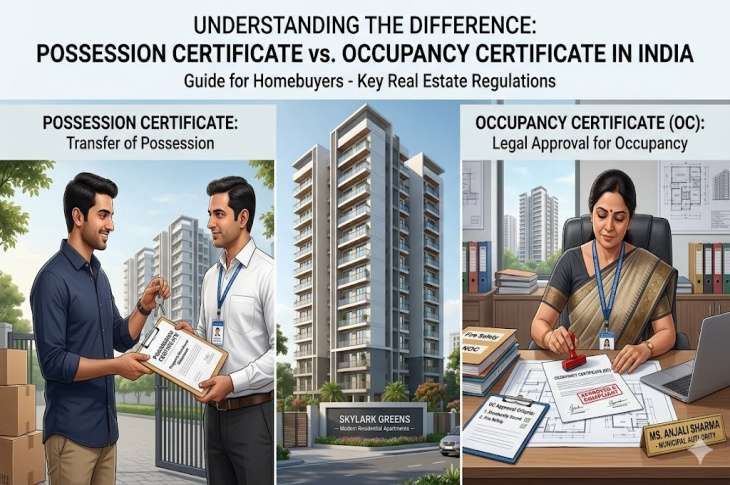
These two documents are often confused with each other because both are related to property ownership and possession. However, they serve completely different legal purposes. A Possession Certificate confirms that possession of a property has been handed over to the buyer, whereas an Occupation Certificate certifies that the building has been constructed according to approved plans and is fit for occupation.
Understanding the difference between Possession Certificate and Occupation Certificate can help buyers avoid legal disputes, regulatory issues, and future complications while buying or selling property.
Also Read: What is a Possession Certificate? Know all about it.
What Is a Possession Certificate?
A Possession Certificate is a document that confirms the transfer of possession of a property from one party to another.
In real estate transactions, it generally signifies that the builder, developer, seller, or previous owner has officially handed over possession of the property to the purchaser.
The document usually includes:
-
Name of the buyer
-
Property details
-
Date of possession
-
Details of the builder or seller
-
Confirmation of handover
-
Signatures of both parties
The Possession Certificate acts as evidence that the buyer has taken physical possession of the property.
Also Read: Understanding The Property Registration Process
Why Is a Possession Certificate Important?
The Possession Certificate serves several important purposes:
1. Proof of Physical Possession
It establishes that the buyer has taken possession of the property and can occupy or use it.
2. Evidence in Legal Disputes
If any dispute arises regarding possession, the certificate can serve as valuable evidence.
3. Useful for Utility Transfers
Authorities may request possession-related documents for:
-
Electricity connections
-
Water supply connections
-
Gas connections
-
Property tax records
4. Important for Home Loan Formalities
Banks may require possession-related documents before completing loan disbursement procedures.
5. Supports Ownership Documentation
Although ownership is primarily established through a registered sale deed, the Possession Certificate helps demonstrate that the buyer has actually received the property.
Also Read: What Is the 12-Year Rule for Land Ownership in India?
What Is an Occupation Certificate (OC)?
An Occupation Certificate, also known as an Occupancy Certificate, is a document issued by the local municipal authority or competent government body after verifying that a building has been constructed according to approved plans and applicable laws.
The certificate confirms that the building is:
-
Structurally safe
-
Legally constructed
-
Compliant with building regulations
-
Suitable for occupation
An Occupation Certificate is generally issued after the completion of construction and inspection by the concerned authority.
Also Read: Legal Checklist for Buying Property in Delhi NCR in 2025 – Your Complete Guide
Why Is an Occupation Certificate Important?
The Occupation Certificate is one of the most critical documents in a real estate transaction.
1. Confirms Legal Compliance
The authority verifies that:
-
Approved building plans were followed.
-
Building bylaws were complied with.
-
Safety norms were met.
-
Zoning regulations were respected.
2. Certifies Habitability
The certificate confirms that the property is safe and fit for people to occupy.
3. Necessary for Civic Services
In many jurisdictions, authorities require an OC before granting:
-
Water connections
-
Sewage facilities
-
Electricity connections
-
Property tax assessment
4. Protects Buyers
An OC protects purchasers from investing in unauthorized or illegally constructed properties.
5. Essential for Resale and Loans
Future buyers and financial institutions often insist on an Occupation Certificate before proceeding with transactions.
Also Read: Obtain Occupancy & Completion Certificates - Legalkart
Difference Between Possession Certificate and Occupation Certificate
Many homebuyers mistakenly believe these documents are interchangeable. In reality, they serve entirely different purposes.
Quick Comparison Table
| Basis | Possession Certificate | Occupation Certificate |
|---|---|---|
| Purpose | Confirms handover of possession | Confirms building is fit for occupation |
| Issued By | Builder, developer, seller, or revenue authority | Municipal authority or local government body |
| Legal Function | Evidence of possession transfer | Evidence of regulatory compliance |
| Focus | Ownership possession | Building legality and safety |
| Issuance Stage | At property handover | After construction completion and inspection |
| Mandatory for Occupancy | Not always | Usually essential |
| Construction Compliance | Does not certify compliance | Certifies compliance |
| Utility Connections | May assist in applications | Often required for approval |
| Proof of Habitability | No | Yes |
| Authority Verification | Generally limited | Thorough official inspection |
Understanding Through a Real-Life Example
Imagine that Rahul purchases a newly built apartment from a developer.
Scenario 1: Rahul Receives Only a Possession Certificate
The builder hands over the keys and issues a Possession Certificate.
This means:
-
Rahul can physically enter the apartment.
-
The builder has transferred possession.
-
Rahul has evidence of handover.
However, if the building lacks an Occupation Certificate:
-
The construction may still have regulatory issues.
-
Authorities may consider the occupancy unauthorized.
-
Utility approvals could become difficult.
-
Future resale may face challenges.
Scenario 2: Rahul Receives Both Documents
In this case:
-
The builder transfers possession.
-
Municipal authorities certify compliance.
-
The building is legally occupiable.
-
Future transactions become smoother.
This is the ideal situation for every homebuyer.
Also Read: Property Documents for Home Loan in India: An In-Depth Analysis
Who Issues a Possession Certificate?
The issuing authority depends on the nature of the property.
In Builder Projects
The builder or developer generally issues the possession letter or possession certificate during handover.
In Revenue Records
For land-related matters, possession certificates may be issued by revenue authorities such as:
-
Tahsildar
-
Revenue Divisional Officer (RDO)
-
Revenue Department
The specific authority varies across states.
Who Issues an Occupation Certificate?
The Occupation Certificate is issued by the competent local authority after inspection.
Depending on the location, this may include:
-
Municipal Corporation
-
Municipal Council
-
Development Authority
-
Urban Local Body
-
Panchayat Authority (in certain areas)
The authority conducts inspections before issuing the certificate.
When Is a Possession Certificate Issued?
A Possession Certificate is generally issued when:
-
Construction is substantially complete.
-
Payment obligations have been fulfilled.
-
Buyer is ready to take possession.
-
Builder formally hands over the property.
The exact timing depends on the agreement between the parties.
When Is an Occupation Certificate Issued?
The Occupation Certificate is issued only after:
Step 1: Construction Completion
The project reaches completion.
Step 2: Application by Builder
The developer applies to the local authority.
Step 3: Inspection
Authorities inspect the property.
Step 4: Compliance Verification
Officials verify:
-
Building plans
-
Height restrictions
-
Fire safety compliance
-
Structural safety
-
Environmental norms
-
Parking requirements
Step 5: Issuance of OC
The certificate is issued if all requirements are satisfied.
Can You Take Possession Without an Occupation Certificate?
Technically, some builders hand over possession before obtaining an Occupation Certificate.
However, doing so can create several risks.
Potential Risks
Legal Issues
Authorities may treat occupation as unauthorized.
Utility Problems
Obtaining permanent utility connections may become difficult.
Financial Risks
Banks and buyers may hesitate in future transactions.
Regulatory Penalties
In some cases, municipal authorities may impose penalties for unauthorized occupancy.
Resale Challenges
Future purchasers often insist on seeing an Occupation Certificate.
Therefore, buyers should exercise caution before taking possession without an OC.
Documents Commonly Checked Before Property Possession
Before accepting possession, buyers should carefully review important property documents.
Approved Building Plan
Verify whether the construction matches sanctioned plans.
Sale Agreement
Review all contractual obligations.
Completion Certificate
Check whether the project has been declared complete.
Occupation Certificate
Confirm that the building is approved for occupation.
Encumbrance Certificate
Verify that the property is free from legal and financial liabilities.
No Dues Certificate
Ensure there are no outstanding payments.
Property Tax Records
Review tax compliance.
Utility Approvals
Confirm electricity, water, and sewage arrangements.
What Is a Land Possession Certificate?
A Land Possession Certificate is a document showing that a person is in possession of a specific piece of land.
It is frequently used in:
-
Revenue matters
-
Land ownership disputes
-
Government schemes
-
Property verification procedures
The certificate helps establish possession but does not automatically create ownership rights.
Ownership generally requires additional legal documents such as:
-
Sale deed
-
Gift deed
-
Partition deed
-
Inheritance documents
Possession Certificate vs Sale Deed
Many people confuse these documents.
Possession Certificate
Shows that possession has been transferred.
Sale Deed
Legally transfers ownership rights.
The registered sale deed remains the primary ownership document.
A buyer should never rely solely on a Possession Certificate as proof of ownership.
Occupation Certificate vs Completion Certificate
These documents are also frequently misunderstood.
Completion Certificate
Confirms that construction has been completed according to approved plans.
Occupation Certificate
Confirms that the completed building is safe and fit for occupation.
In simple terms:
Completion Certificate = Building completed
Occupation Certificate = Building completed and approved for occupancy
Legal Importance of an Occupation Certificate
An Occupation Certificate has significant legal value.
It demonstrates that:
-
The project received required approvals.
-
Construction complied with applicable norms.
-
Occupancy is legally permitted.
-
Safety standards have been satisfied.
For buyers, this document provides confidence that the property does not suffer from major regulatory violations.
Legal Importance of a Possession Certificate
The Possession Certificate is equally important, but for different reasons.
It helps establish:
-
Date of possession
-
Transfer of physical control
-
Builder's handover obligations
-
Buyer's acceptance of possession
In property disputes involving possession, the document may become crucial evidence.
Common Mistakes Homebuyers Should Avoid
Accepting Possession Without Verifying OC
One of the most common mistakes is taking possession without checking whether the Occupation Certificate has been obtained.
Assuming Possession Means Legal Approval
Receiving keys does not automatically mean the building is legally approved for occupancy.
Not Reviewing Municipal Approvals
Buyers should independently verify approvals whenever possible.
Ignoring Deviations
Unauthorized deviations from approved plans may create future legal complications.
Relying Solely on Builder Assurances
Always request documentary proof rather than verbal assurances.
How to Verify an Occupation Certificate?
Depending on the state and local authority, buyers can verify an OC through:
Municipal Websites
Many authorities provide online verification services.
Builder Documentation
Request a copy directly from the developer.
Legal Verification
A property lawyer can conduct due diligence.
Authority Records
Buyers may inspect municipal records where permitted.
How to Obtain a Possession Certificate?
The process varies depending on the type of property.
For Builder Projects
The builder issues the certificate during handover.
For Land Records
Applications may be submitted through:
-
Revenue Department offices
-
State e-district portals
-
Online citizen service centres
Required documents may vary by state.
Final Thoughts
Understanding the difference between Possession Certificate and Occupation Certificate is crucial for every homebuyer, property investor, and landowner in India. Although both documents relate to property transactions, they address completely different legal aspects.
A Possession Certificate confirms that possession of the property has been handed over to the buyer. It records the transfer of physical control and serves as evidence of possession.
An Occupation Certificate, on the other hand, confirms that the building has been constructed in accordance with approved plans and applicable regulations and is fit for occupation. It protects buyers from investing in unauthorized or non-compliant constructions.
Before purchasing any property, buyers should ensure they receive not only possession but also all necessary legal approvals, including the Occupation Certificate, Completion Certificate, approved building plans, and registered ownership documents. Conducting proper due diligence at the time of purchase can prevent costly legal disputes and ensure a secure investment for years to come.
Disclaimer: This article is for general informational purposes only and should not be considered legal advice. Property laws, municipal regulations, and procedural requirements may differ across states and local authorities in India. For advice specific to your situation, consult a qualified property lawyer or legal professional.
Frequently asked questions
Is a Possession Certificate proof of ownership?
Is a Possession Certificate proof of ownership?
No. Ownership is primarily established through a registered sale deed or other legally recognized ownership documents.
Is an Occupation Certificate mandatory?
Is an Occupation Certificate mandatory?
In most urban development projects, obtaining an Occupation Certificate is an important legal requirement before lawful occupancy.
Can a property be sold without an Occupation Certificate?
Can a property be sold without an Occupation Certificate?
While transactions may occur, the absence of an OC can create legal, financial, and practical difficulties for buyers and sellers.
Can a bank approve a loan without an OC?
Can a bank approve a loan without an OC?
Policies vary among lenders, but many banks carefully evaluate the availability of an Occupation Certificate before approving certain property-related loans.
What happens if construction differs from approved plans?
What happens if construction differs from approved plans?
Authorities may refuse to issue an Occupation Certificate until violations are rectified or regularized according to applicable laws.

Online Consultation


Online Consultations


Trending
Frequently asked questions
Is a Possession Certificate proof of ownership?
Is a Possession Certificate proof of ownership?
No. Ownership is primarily established through a registered sale deed or other legally recognized ownership documents.
Is an Occupation Certificate mandatory?
Is an Occupation Certificate mandatory?
In most urban development projects, obtaining an Occupation Certificate is an important legal requirement before lawful occupancy.
Can a property be sold without an Occupation Certificate?
Can a property be sold without an Occupation Certificate?
While transactions may occur, the absence of an OC can create legal, financial, and practical difficulties for buyers and sellers.
Can a bank approve a loan without an OC?
Can a bank approve a loan without an OC?
Policies vary among lenders, but many banks carefully evaluate the availability of an Occupation Certificate before approving certain property-related loans.
What happens if construction differs from approved plans?
What happens if construction differs from approved plans?
Authorities may refuse to issue an Occupation Certificate until violations are rectified or regularized according to applicable laws.
Online Consultations


Ask a Lawyer