


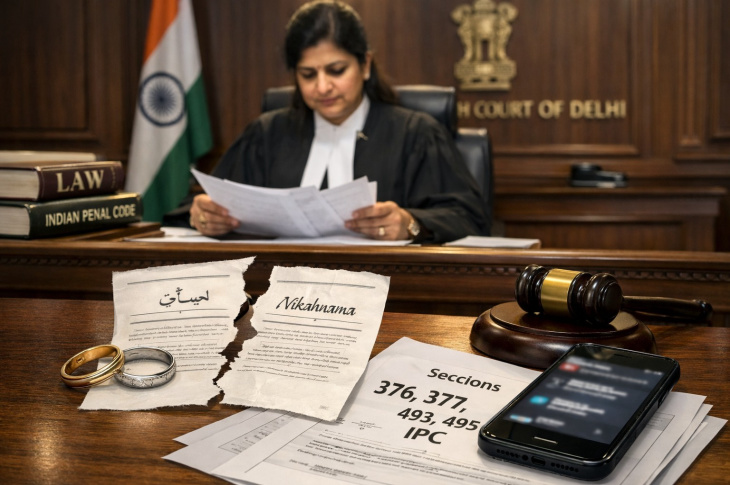


Delhi High Court Sets Boundaries for Criminal Cases in Consensual Relationships: A Detailed Analysis of MS A v. State & Ors. (Criminal Revision Petition 1008/2024)


The legal landscape surrounding intimate relationships and criminal liability in India has always been sensitive, particularly when allegations of sexual exploitation, deceitful marriage, and coercion arise. The recent judgment by the High Court of Delhi in MS A v. State & Ors. (Criminal Revision Petition 1008/2024), delivered by Justice Swarana Kanta Sharma on 16 February 2026, has set significant precedents on how criminal courts should approach cases involving consensual relationships. This detailed analysis explores the facts, legal issues, arguments, and implications of this landmark decision.
Background of the Case
The case arose from a complaint lodged by the petitioner, Ms. A, against Respondent No. 2, Guddu, and others, alleging sexual exploitation, deceitful marriage, and harassment. According to the petitioner, the respondent misrepresented his marital and religious status and coerced her into marriage and sexual relations. She further alleged that he subjected her to cruelty, physical assaults, confinement, and blackmail.
Ms. A contended that despite multiple attempts to approach authorities, Respondent No. 2, who was an advocate, used his influence to intimidate her into withdrawing complaints. Eventually, she lodged the present FIR while hiding from the respondents, asserting a pattern of continuous abuse.
The Sessions Court discharged the accused at the stage of trial, leading the petitioner to approach the Delhi High Court challenging the discharge order. The High Court had to assess whether the allegations amounted to prima facie offences under the Indian Penal Code (IPC), including Sections 376(2)(n) (rape), 377 (unnatural sex), 493 and 495 (deceitful marriage), 323, 325 (assault), 341, 342 (wrongful confinement), 354D (stalking), 506 (criminal intimidation), and 201 (destruction of evidence).
Key Legal Issues
The High Court identified several crucial legal issues in the case:
-
Consent vs. Non-Consent: Whether the allegations of sexual exploitation and rape were supported by evidence or whether the relationship appeared consensual.
-
Deceitful Marriage: Whether the petitioner’s claim that the marriage was fraudulent and coercive was supported by prima facie evidence under Sections 493 and 495 IPC.
-
Connected Offences: Whether charges of wrongful confinement, intimidation, stalking, and destruction of evidence could survive if the main allegations failed.
-
Discharge Stage Standards: Whether the Sessions Court was justified in relying on documentary evidence and concluding that no sufficient ground existed to proceed to trial.
Arguments Presented by the Parties
Petitioner’s Contentions
The petitioner’s counsel argued that:
-
The impugned discharge order was legally unsustainable and perverse.
-
The complaint, charge sheet, and petitioner’s statement indicated continuous sexual exploitation and coercion.
-
The Nikahnama (marriage certificate) relied upon by the respondents was forged, and the alleged Muslim marriage was not substantiated by evidence, such as the Qazi’s testimony.
-
The Sessions Court improperly relied on photocopies of documents presented by the respondents while ignoring medical and injury evidence.
-
Respondent No. 2 withheld mobile phones containing alleged obscene photographs.
-
The petitioner’s allegations showed a prima facie case under multiple IPC provisions.
Respondents’ Contentions
The respondents’ counsel countered that:
-
The relationship was long-standing, harmonious, and consensual.
-
Respondent No. 2 had solemnized a Nikah in 2012; physical relations were voluntary.
-
Petitioner’s allegations were motivated by personal disputes and arose only after disagreements.
-
Respondent No. 2 had provided support for the petitioner’s education and professional development.
-
Allegations of rape, blackmail, or intimidation were unsubstantiated, and charges against other respondents were vague.
-
The Sessions Court was correct in discharging the accused, as no prima facie case was made out.
Court’s Analysis
The Delhi High Court conducted a meticulous review of the material on record and emphasized several guiding principles:
1. Discharge Stage as a Safeguard
The Court reiterated that the power of discharge is a statutory safeguard to prevent an accused from being subjected to trial when no prima facie case exists. The mere consistency of allegations does not automatically justify framing charges, especially when evidence suggests a different narrative.
2. Importance of Documentary Evidence
The Court emphasized that documentary evidence, such as Aadhaar details, educational records, or documents purporting to establish a marriage, cannot be ignored at the discharge stage. These records must be assessed carefully before concluding whether the allegations can proceed to trial.
3. Consent in Intimate Relationships
The Court highlighted the principle that in cases involving intimate relationships, criminal law must be applied with circumspection. Allegations of sexual exploitation must be supported by credible material evidence. A long-standing relationship where both parties participated voluntarily cannot automatically be equated with coercion.
4. Delay in Lodging Complaints
The Court noted the eleven-year delay in lodging the FIR, which undermined the credibility of the allegations. Unexplained delays in reporting are relevant when assessing the prima facie case, especially in matters of sexual offences.
5. Lack of Evidence for Coercion or Threats
The Court observed that there was no prima facie evidence of:
-
Continuous sexual assault or blackmail.
-
Deceitful marriage under Sections 493 or 495 IPC.
-
Wrongful confinement or intimidation.
-
Existence of obscene photographs or videos.
The Sessions Court had relied on documentary verification and found insufficient grounds to proceed with the trial.
Judgment
After careful consideration, the Delhi High Court dismissed the Criminal Revision Petition 1008/2024. The Court upheld the Sessions Court’s order of discharge, holding that:
-
No prima facie case of rape, sexual exploitation, or deceitful marriage existed.
-
Allegations of coercion, intimidation, or unlawful confinement were unsubstantiated.
-
Criminal law must be applied with restraint in cases involving consensual intimate relationships to prevent unwarranted litigation.
Justice Swarana Kanta Sharma noted that the Sessions Court had examined the material diligently, and there was no infirmity or illegality in the order.
Legal Principles Established
This judgment is significant because it clarifies several critical aspects of criminal law in the context of intimate relationships:
1. Prima Facie Evidence Requirement
Courts cannot proceed to trial solely on the basis of allegations; there must be credible prima facie evidence establishing all ingredients of the alleged offences.
2. Consent Matters
Even in cases involving serious offences like sexual assault, the overall conduct of parties and the voluntary nature of the relationship are central to determining whether a prima facie case exists.
3. Criminal Law Must Be Applied with Circumspection
Cases involving intimate relationships are prone to emotional disputes and potential misuse. The Court highlighted the need for careful assessment to prevent harassment through unwarranted criminal proceedings.
4. Documentary Evidence Is Crucial
Documents such as identity proofs, marriage certificates, and official records are vital at the discharge stage and can be decisive in determining whether allegations are credible.
5. Delay in Filing Complaints Can Undermine Credibility
Courts consider unexplained delays in lodging FIRs as a factor in assessing the reliability and gravity of allegations, particularly when related to historical intimate relationships.
Implications for Legal Practice
The MS A v. State & Ors. judgment has far-reaching implications for both legal practitioners and society at large:
-
Protection Against False Allegations:
The judgment reaffirms that criminal trials should not be initiated in the absence of credible evidence, protecting individuals from false or exaggerated allegations. -
Guidance for Courts:
Lower courts now have clear guidance on how to evaluate complaints arising from intimate relationships, particularly at the discharge stage. -
Emphasis on Verification of Evidence:
Lawyers representing either party must ensure thorough verification of documents and records before presenting cases to the court. -
Balanced Approach to Consent:
Legal practitioners are reminded that the law recognizes consensual adult relationships, even when disputes arise later, emphasizing the need for balance and restraint in criminal prosecution. -
Deterrence Against Misuse:
By highlighting the need for credible evidence and examining the context of relationships, the Court discourages the misuse of criminal law to settle personal disputes.
Comparative Legal Perspective
The Delhi High Court’s approach aligns with principles recognized globally:
-
UK and US Law: Courts often examine consent, delay, and corroborative evidence before allowing sexual exploitation cases to proceed.
-
International Human Rights Standards: The judgment upholds the principle that criminal law must not be arbitrary or oppressive and that procedural safeguards are essential.
This case reinforces the principle that allegations must be supported by verifiable evidence rather than relying solely on the complainant’s narrative.
Key Takeaways
-
Prima Facie Case: Allegations must be corroborated by credible material evidence to proceed to trial.
-
Consent is Central: Courts will evaluate voluntary participation and relationship history when considering sexual offence allegations.
-
Document Verification: Official records are essential in establishing or disproving claims such as fraudulent marriages.
-
Unexplained Delays Matter: Long delays in lodging complaints can weaken the credibility of allegations.
-
Criminal Law Restraint: Intimate relationship disputes require careful application of criminal law to prevent harassment or misuse.
Conclusion
The High Court of Delhi’s decision in MS A v. State & Ors. represents a nuanced approach to criminal law in the context of consensual relationships. It underscores the importance of evidence, consent, and careful judicial scrutiny at the discharge stage. While the law protects victims of genuine exploitation, it equally safeguards individuals against frivolous or malicious litigation.
This landmark ruling will serve as a guiding precedent for courts, advocates, and policymakers in ensuring that criminal justice in India remains fair, balanced, and grounded in credible evidence. By emphasizing restraint and verification, the judgment strengthens the integrity of the criminal justice system and ensures that the law is not misused in matters arising from personal relationships.
Frequently asked questions
What is the significance of the Delhi High Court ruling in MS A v. State & Ors.?
What is the significance of the Delhi High Court ruling in MS A v. State & Ors.?
The ruling clarifies that criminal prosecution in cases arising from intimate relationships must be based on credible, prima facie evidence. It emphasizes that consent, delay in filing complaints, and documentary proof are crucial at the discharge stage to prevent misuse of criminal law.
What is the role of documentary evidence in such cases?
What is the role of documentary evidence in such cases?
Documents such as marriage certificates, identity proofs, and official records (like Aadhaar cards) are vital at the discharge stage. Courts rely on these documents to verify claims of deceit, coercion, or fraudulent marriage before proceeding to trial.
Can a long-term intimate relationship be considered evidence of consent?
Can a long-term intimate relationship be considered evidence of consent?
Yes. The Court noted that the overall conduct of parties, voluntary participation, and the history of the relationship are important factors. A long-standing relationship may indicate consent, making allegations of sexual exploitation less likely to survive the discharge stage if unsupported by evidence.
How does delay in lodging a complaint affect a case?
How does delay in lodging a complaint affect a case?
Unexplained delays in filing an FIR, especially for several years, can weaken the credibility of allegations. The Delhi High Court highlighted that an eleven-year delay in this case undermined the prima facie strength of the claims.
Are allegations of harassment or blackmail automatically valid in intimate relationship disputes?
Are allegations of harassment or blackmail automatically valid in intimate relationship disputes?
No. The Court stressed that claims of harassment, blackmail, or wrongful confinement must be supported by credible material evidence. Mere allegations without proof cannot justify framing criminal charges, particularly when the relationship appears consensual.

Online Consultation


Online Consultations


Trending
Frequently asked questions
What is the significance of the Delhi High Court ruling in MS A v. State & Ors.?
What is the significance of the Delhi High Court ruling in MS A v. State & Ors.?
The ruling clarifies that criminal prosecution in cases arising from intimate relationships must be based on credible, prima facie evidence. It emphasizes that consent, delay in filing complaints, and documentary proof are crucial at the discharge stage to prevent misuse of criminal law.
What is the role of documentary evidence in such cases?
What is the role of documentary evidence in such cases?
Documents such as marriage certificates, identity proofs, and official records (like Aadhaar cards) are vital at the discharge stage. Courts rely on these documents to verify claims of deceit, coercion, or fraudulent marriage before proceeding to trial.
Can a long-term intimate relationship be considered evidence of consent?
Can a long-term intimate relationship be considered evidence of consent?
Yes. The Court noted that the overall conduct of parties, voluntary participation, and the history of the relationship are important factors. A long-standing relationship may indicate consent, making allegations of sexual exploitation less likely to survive the discharge stage if unsupported by evidence.
How does delay in lodging a complaint affect a case?
How does delay in lodging a complaint affect a case?
Unexplained delays in filing an FIR, especially for several years, can weaken the credibility of allegations. The Delhi High Court highlighted that an eleven-year delay in this case undermined the prima facie strength of the claims.
Are allegations of harassment or blackmail automatically valid in intimate relationship disputes?
Are allegations of harassment or blackmail automatically valid in intimate relationship disputes?
No. The Court stressed that claims of harassment, blackmail, or wrongful confinement must be supported by credible material evidence. Mere allegations without proof cannot justify framing criminal charges, particularly when the relationship appears consensual.
Online Consultations


Ask a Lawyer