


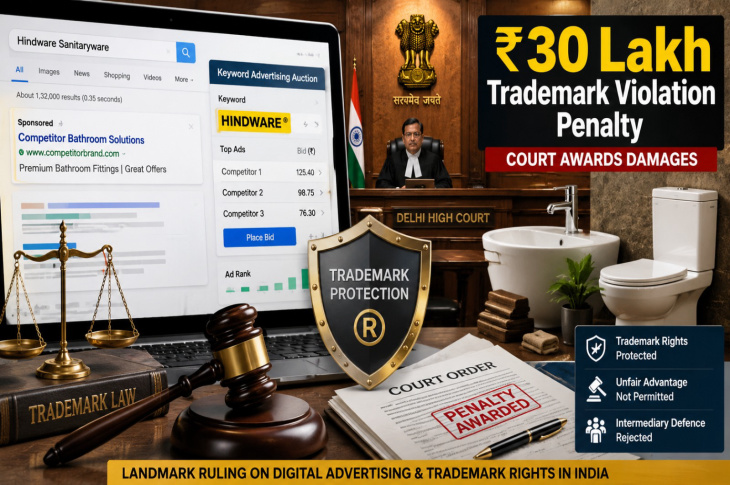


Delhi High Court Orders Google to Pay ₹30 Lakh for Hindware AdWords Trademark Violation: What the Landmark Judgment Means for Businesses


Introduction
In a significant judgment that could reshape the relationship between trademarks and digital advertising in India, the Delhi High Court has directed Google to pay ₹30 lakh in damages to Hindware for permitting the use of its registered trademark as advertising keywords under the Google Ads (formerly AdWords) program.
The ruling goes beyond a simple trademark dispute. It addresses an important question that businesses, advertisers, and digital platforms have debated for years:
Can a company's registered trademark be used by competitors as a keyword to attract customers online without permission?
The Delhi High Court answered this question in favor of trademark owners, holding that such practices may amount to trademark infringement and unfair exploitation of a brand's reputation.
The decision is likely to have far-reaching implications for digital marketing strategies, search engine advertising, brand protection, and intermediary liability in India.
Also Read: The Trademark Registration Process In India A Comprehensive Guide
Understanding the Dispute Between Hindware and Google
Hindware is one of India's most recognized sanitaryware and bathroom solutions brands. Over the years, it has built substantial goodwill and consumer recognition in the market.
The dispute arose when Hindware discovered that its registered trademarks were allegedly being used as keywords within Google's advertising ecosystem.
When internet users searched for terms associated with the Hindware brand, advertisements from competing businesses could appear alongside or above the organic search results.
According to Hindware, this practice allowed competitors to capitalize on the goodwill and reputation attached to its trademark without obtaining authorization.
The company approached the Delhi High Court seeking protection of its trademark rights and compensation for the alleged misuse.
Also Read: Assignment of Trademarks
What Are Google Ads Keywords?
To understand the judgment, it is important to understand how keyword advertising works.
Google's advertising platform allows businesses to bid on specific words and phrases.
For example:
-
A shoe company may bid on "running shoes."
-
A travel agency may bid on "holiday packages."
-
A mobile phone seller may bid on "best smartphones."
When users search for those terms, sponsored advertisements may appear.
The controversy begins when advertisers bid on another company's registered trademark.
For instance:
-
Company A owns a famous trademark.
-
Company B bids on Company A's trademark as a keyword.
-
Users searching for Company A may see Company B's advertisements.
The legal issue is whether such use amounts to infringement or unfair competition.
Also Read: How to Copyright and Trademark a Logo in India: A Comprehensive Guide
Delhi High Court's Key Findings
The Court carefully examined Google's advertising model and the manner in which trademarks were being used.
The judgment concluded that Google could not escape liability merely by claiming to be a neutral technology platform.
According to the Court:
1. Trademark Keywords Can Constitute Infringement
The Court observed that allowing competitors to use Hindware's trademark as advertising keywords provided them with an unfair commercial advantage.
When consumers search for a particular brand, they often demonstrate a clear intention to locate that brand's products or services.
Permitting competitors to intercept that consumer interest can divert potential customers and exploit the trademark owner's reputation.
The Court therefore held that such use falls within the scope of trademark infringement and unfair advantage under trademark law.
2. Google's Ad Program Was a Commercial Activity
A crucial aspect of the ruling was the Court's analysis of Google's business model.
The Court noted that the advertising program is not merely a passive technological function.
Instead, it is a revenue-generating commercial activity through which Google monetizes user searches.
The Court observed that Google:
-
Suggested keywords,
-
Offered trademarked terms for advertising,
-
Conducted keyword auctions,
-
Earned revenue from such transactions.
Because Google actively benefited financially from the use of trademarks as keywords, the Court found that it could not be treated as a completely neutral intermediary.
3. No Permission Was Obtained from Hindware
The Court emphasized that Google's platform enabled the use of Hindware's trademark without obtaining prior authorization from the trademark owner.
This factor played an important role in determining liability.
A registered trademark grants its owner exclusive rights over the mark and protection against unauthorized commercial exploitation.
The Court held that Google's conduct effectively allowed third parties to benefit from Hindware's brand recognition without consent.
Also Read: Protecting Your Brand Identity A Comprehensive Guide To E Filing Trademarks In India
Why the Intermediary Defence Failed
One of the most important aspects of the judgment relates to intermediary liability under the Information Technology Act, 2000.
Google argued that it functioned as an intermediary and should therefore receive protection under the "safe harbour" provisions of the IT Act.
What Is Safe Harbour Protection?
Section 79 of the Information Technology Act provides limited protection to intermediaries such as online platforms.
Generally speaking, intermediaries are not liable for third-party information hosted on their systems if they satisfy certain legal conditions.
Examples include:
-
Social media platforms,
-
Online marketplaces,
-
Hosting services,
-
Search engines.
The purpose of safe harbour is to encourage innovation while protecting platforms from excessive legal liability.
Court's View on Google's Defence
The Delhi High Court rejected Google's argument.
The Court held that Google's actions went beyond passive hosting.
Several factors influenced this conclusion:
-
Google actively sold advertising space.
-
It auctioned keywords.
-
It earned revenue from trademark-based advertising.
-
It encouraged keyword selection.
-
It commercially benefited from the use of trademarks.
As a result, the Court held that Google could not claim blanket immunity under Section 79.
This finding is particularly significant because it narrows the scope of intermediary protection when a platform is actively involved in monetizing trademark use.
Also Read: Copyright vs. Trademark: Understanding the Differences
Why the Court Considered the Practice Unfair
Trademark law exists primarily to protect consumers and brand owners.
A trademark serves several important functions:
-
Identifies the source of goods or services.
-
Prevents consumer confusion.
-
Protects brand reputation.
-
Encourages fair competition.
The Court observed that consumers searching specifically for Hindware were expressing an intention to locate that particular brand.
By enabling competitors to target those searches, Google facilitated a practice that could:
-
Divert customer traffic,
-
Dilute brand value,
-
Exploit established goodwill,
-
Create marketplace confusion.
The Court therefore characterized the conduct as an unfair commercial practice.
Also Read: How Section 34 of the Trade Marks Act Secured Victory for Pune’s Burger King After a 13‑Year Fight
Damages Awarded by the Court
The Delhi High Court awarded:
₹30 Lakh in Total Damages
The Court granted:
-
₹15 lakh in one suit, and
-
₹15 lakh in another suit,
bringing the total compensation to ₹30 lakh.
Although the Court described the damages as nominal, the award carries considerable symbolic significance.
It sends a clear message that trademark rights must be respected in digital advertising environments.
Litigation Costs Also Awarded
Apart from damages, the Court held that Hindware was entitled to recover litigation costs.
The company was directed to submit a detailed bill of costs for consideration.
This means the financial consequences for infringement may extend beyond damages alone.
Injunction Issued Against Google
The Court did not merely award compensation.
It also restrained Google from using or allowing the use of several Hindware-related terms as advertising keywords.
This injunctive relief is often more valuable than monetary compensation because it prevents future violations.
For trademark owners, injunctions provide ongoing protection against unauthorized commercial exploitation.
The Significance of Google's Policy Change
An interesting aspect noted by the Court was Google's historical policy regarding trademarks.
According to the findings:
-
Google previously restricted the use of trademarks as keywords.
-
Around 2009, its policy changed.
-
The revised policy allowed advertisers to bid on trademarked terms under certain circumstances.
The Court viewed this shift as evidence that Google consciously adopted a commercial model that enabled monetization of trademark value.
This observation strengthened the Court's conclusion that the company was actively involved in the advertising process rather than acting as a passive intermediary.
Impact on Trademark Law in India
This judgment could become one of the most influential decisions involving online trademark protection.
Strengthening Trademark Owners' Rights
The ruling reinforces the principle that trademarks are valuable intellectual property assets.
Businesses invest heavily in:
-
Brand development,
-
Advertising,
-
Customer trust,
-
Market recognition.
Allowing competitors to freely leverage those investments undermines trademark protection.
The judgment strengthens legal safeguards for brand owners operating in digital markets.
Recognition of Modern Digital Infringement
Traditional trademark infringement often involved:
-
Counterfeit products,
-
Similar logos,
-
Copycat packaging.
Today's disputes increasingly arise in digital environments.
Examples include:
-
Search engine advertising,
-
Domain names,
-
Social media promotions,
-
Online marketplaces.
The judgment demonstrates the judiciary's willingness to adapt trademark law to modern business realities.
Implications for Advertisers
Businesses that rely heavily on search engine marketing should pay close attention to this ruling.
Review Keyword Strategies
Advertisers should evaluate whether they are using competitors' trademarks as keywords.
Potential risks include:
-
Trademark infringement claims,
-
Injunctions,
-
Damages,
-
Litigation expenses,
-
Reputational harm.
Focus on Generic Keywords
Instead of targeting competitor trademarks, businesses should consider:
-
Product-related keywords,
-
Category-based searches,
-
Industry-specific terms,
-
Location-focused phrases.
These strategies reduce legal risk while still attracting relevant traffic.
Conduct Regular Legal Audits
Marketing teams and legal departments should work together to review advertising campaigns.
Questions businesses should ask include:
-
Are we bidding on competitor trademarks?
-
Do we have authorization?
-
Could our advertisements create confusion?
-
Are we exposing ourselves to litigation?
Regular audits can prevent costly disputes.
Implications for Digital Platforms
The judgment also carries important lessons for online platforms.
Increased Responsibility
Platforms that actively participate in advertising transactions may face greater legal scrutiny.
Courts may examine:
-
Revenue models,
-
Advertising mechanisms,
-
Keyword suggestions,
-
Platform involvement,
-
Commercial benefits received.
The more active a platform's role, the harder it may be to rely on intermediary protection.
Need for Strong Compliance Systems
Digital advertising platforms may need:
-
Enhanced trademark review systems,
-
Better complaint mechanisms,
-
Automated infringement detection,
-
Faster takedown procedures.
Such measures can reduce legal exposure while protecting intellectual property rights.
What Businesses Can Learn from the Case
The Hindware-Google dispute offers several practical lessons.
Register Your Trademarks
Businesses should ensure that:
-
Brand names are registered,
-
Logos are protected,
-
Key product names receive legal protection.
Registration significantly strengthens enforcement rights.
Monitor Online Usage
Brand owners should regularly monitor:
-
Search engine advertisements,
-
Social media campaigns,
-
Online marketplaces,
-
Competitor marketing activities.
Early detection often prevents larger problems.
Take Prompt Legal Action
Delays in enforcement can weaken a company's position.
If unauthorized trademark use is detected:
-
Gather evidence.
-
Send legal notices.
-
Engage with the platform.
-
Seek judicial remedies when necessary.
Prompt action often results in better outcomes.
Conclusion
The Delhi High Court's decision directing Google to pay ₹30 lakh to Hindware marks a significant development in Indian trademark jurisprudence. The ruling sends a strong signal that trademark rights cannot be diluted simply because commercial activity occurs in a digital environment.
By rejecting Google's intermediary defence and recognizing the commercial exploitation involved in keyword advertising, the Court has strengthened protections available to brand owners while placing greater responsibility on digital advertising platforms.
For businesses, the message is clear: trademarks are valuable assets that deserve protection both offline and online. Companies should proactively register, monitor, and enforce their trademark rights, while advertisers must ensure that their digital marketing strategies comply with intellectual property laws.
Frequently asked questions
Can a competitor use my trademark as a Google Ads keyword?
Can a competitor use my trademark as a Google Ads keyword?
Following this Delhi High Court judgment, such use may expose advertisers and platforms to trademark infringement claims, particularly where it exploits brand reputation or creates unfair advantage.
Does this judgment apply to all trademarks?
Does this judgment apply to all trademarks?
The principles can apply broadly, especially where registered trademarks are involved and there is evidence of unauthorized commercial use.
Can Google still claim intermediary protection?
Can Google still claim intermediary protection?
The Court held that safe harbour protection may not apply where Google actively participates in selling and monetizing trademark-based advertising.
Why is this case important?
Why is this case important?
The judgment addresses the growing conflict between intellectual property rights and digital advertising practices, making it highly relevant for businesses operating online.
Can trademark owners seek damages?
Can trademark owners seek damages?
Yes. Trademark owners may seek injunctions, damages, costs, and other remedies depending on the facts of each case.

Online Consultation


Online Consultations


Trending
Frequently asked questions
Can a competitor use my trademark as a Google Ads keyword?
Can a competitor use my trademark as a Google Ads keyword?
Following this Delhi High Court judgment, such use may expose advertisers and platforms to trademark infringement claims, particularly where it exploits brand reputation or creates unfair advantage.
Does this judgment apply to all trademarks?
Does this judgment apply to all trademarks?
The principles can apply broadly, especially where registered trademarks are involved and there is evidence of unauthorized commercial use.
Can Google still claim intermediary protection?
Can Google still claim intermediary protection?
The Court held that safe harbour protection may not apply where Google actively participates in selling and monetizing trademark-based advertising.
Why is this case important?
Why is this case important?
The judgment addresses the growing conflict between intellectual property rights and digital advertising practices, making it highly relevant for businesses operating online.
Can trademark owners seek damages?
Can trademark owners seek damages?
Yes. Trademark owners may seek injunctions, damages, costs, and other remedies depending on the facts of each case.
Online Consultations


Ask a Lawyer