


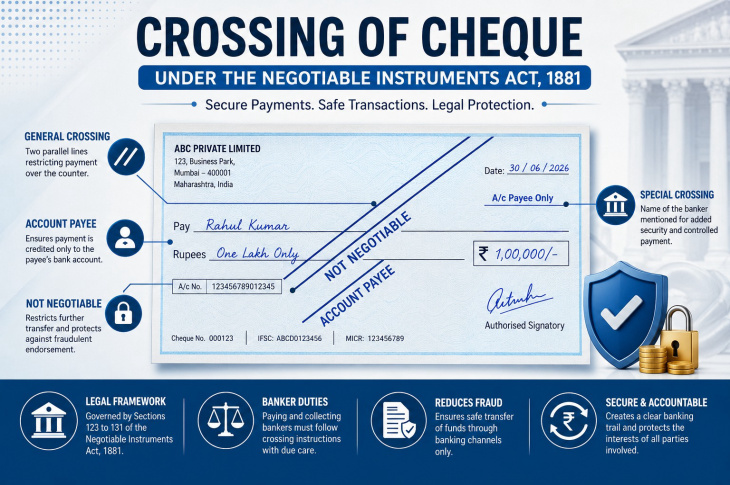


Crossing of Cheques Under the Negotiable Instruments Act, 1881: Complete Guide


Cheques continue to play an important role in business, banking, and commercial transactions despite the rise of digital payment methods. Since cheques represent negotiable instruments capable of transferring money, they are vulnerable to theft, unauthorized encashment, forgery, and fraudulent misuse.
To minimize these risks, the law recognizes the concept of crossing a cheque, a banking safeguard that directs how payment should be made. Instead of allowing immediate cash withdrawal, a crossed cheque ensures that funds move through banking channels, creating a verifiable record of the transaction.
The provisions governing crossed cheques are contained in Sections 123 to 131 of the Negotiable Instruments Act, 1881. These provisions establish the legal framework for different forms of crossing, the responsibilities of banks, and the protection available to parties involved in cheque transactions.
What Is Crossing of a Cheque?
Crossing a cheque means placing specific markings or instructions on its face to regulate how the payment should be collected.
Typically, this is done by drawing two parallel transverse lines across the cheque, with or without additional words such as:
-
Account Payee
-
Not Negotiable
-
A/C Payee Only
-
& Co.
The primary objective is straightforward: the cheque should not be paid in cash directly over the bank counter but should be routed through a bank account.
This simple banking practice significantly improves transaction security and reduces the possibility of fraudulent encashment.
Why Is Crossing a Cheque Important?
Cheque crossing serves several legal and practical purposes.
1. Prevents Fraud
If a cheque is lost or stolen, crossing makes it difficult for unauthorized persons to receive payment because banks must process it according to the crossing instructions.
2. Creates a Banking Trail
Funds move through bank accounts rather than cash payments, creating documentary evidence of the transaction.
3. Ensures Proper Identification
Banks can verify the identity of the person receiving the payment.
4. Protects Commercial Transactions
Businesses frequently issue crossed cheques for vendor payments, salaries, insurance settlements, and contractual obligations because they provide greater financial security.
5. Reduces Disputes
Since payments are recorded electronically through banking channels, disputes regarding receipt of funds become easier to resolve.
Legal Provisions Governing Crossed Cheques
The Negotiable Instruments Act contains specific provisions relating to cheque crossing.
| Section | Subject Matter |
|---|---|
| Section 123 | General Crossing |
| Section 124 | Special Crossing |
| Section 125 | Who May Cross a Cheque |
| Section 126 | Payment of Crossed Cheques |
| Section 127 | Double Crossing |
| Section 129 | Liability for Improper Payment |
| Section 130 | Not Negotiable Crossing |
| Section 131 | Protection to Collecting Banker |
Together, these provisions regulate the entire lifecycle of crossed cheque transactions.
Who Can Cross a Cheque?
The law permits different persons to cross a cheque depending upon the stage of the transaction.
1. The Drawer
The person issuing the cheque may cross it before handing it over to the payee.
Example:
A company issues salary cheques with an "Account Payee Only" crossing to ensure employees alone receive payment.
2. The Holder
A person who lawfully possesses an uncrossed cheque may add a crossing before presenting it for collection.
The holder may also convert:
-
an uncrossed cheque into a crossed cheque
-
a generally crossed cheque into a specially crossed cheque
-
add the words "Not Negotiable"
3. The Banker
In specific situations, a banker receiving a specially crossed cheque may further cross it to another banker acting as its collection agent.
Types of Crossing of Cheques
Different types of crossing provide different levels of protection.
1. General Crossing
General crossing is the most common form.
Features
-
Two parallel lines appear across the cheque.
-
The cheque cannot be paid in cash over the counter.
-
Payment must be made through any bank.
Suitable For
-
Everyday banking
-
Business payments
-
Routine commercial transactions
2. Special Crossing
Special crossing contains the name of a specific bank.
Example:
State Bank of India
In this case:
-
only the named bank can collect payment;
-
unauthorized banks cannot receive payment unless acting as an agent.
Benefits
-
Higher security
-
Better control
-
Reduced chances of wrongful collection
3. Account Payee Crossing
Although widely recognized in banking practice, this type of crossing is based on established banking usage rather than an express statutory provision.
Typical wording includes:
-
Account Payee
-
A/C Payee Only
Effect
The collecting bank should credit the proceeds only to the account of the named payee.
This is among the safest forms of cheque crossing for individual and corporate payments.
4. Not Negotiable Crossing
The words "Not Negotiable" restrict the transferability of rights.
The cheque can still be transferred, but the transferee cannot obtain a better legal title than the transferor.
This provision discourages fraudulent transfers and protects genuine owners.
5. Double Crossing
Double crossing occurs when a specially crossed cheque is further crossed to another banker acting as a collection agent.
This usually happens where:
-
the original collecting bank lacks a branch at the place of payment;
-
another bank is appointed solely for collection purposes.
Multiple special crossings without an agency relationship are generally not permissible.
6. Non-Negotiable Account Payee Crossing
Banks frequently encounter cheques bearing both:
-
Account Payee
-
Not Negotiable
This combination offers enhanced protection by restricting collection while also limiting transfer rights.
General Crossing vs Special Crossing
| Basis | General Crossing | Special Crossing |
| Banker Name | Not required | Mandatory |
| Payment | Through any banker | Through specified banker only |
| Security Level | Moderate | Higher |
| Flexibility | More | Less |
| Risk of Misuse | Lower than open cheque | Lowest among statutory crossings |
Duties of the Paying Banker
Banks must carefully examine every crossed cheque before releasing payment.
Verify the Nature of Crossing
The bank should determine whether the cheque is:
-
generally crossed
-
specially crossed
-
account payee
-
not negotiable
Follow Crossing Instructions
Ignoring crossing instructions may expose the bank to legal liability.
Avoid Cash Payment
Crossed cheques should generally not be paid directly across the counter.
Exercise Due Care
Bank officials must inspect:
-
alterations
-
endorsements
-
authenticity
-
banking instructions
Reasonable diligence reduces the risk of wrongful payment.
Duties of the Collecting Banker
The collecting banker also owes legal responsibilities.
These include:
-
verifying endorsements;
-
collecting cheques only for authorized customers;
-
following account payee instructions;
-
exercising reasonable care;
-
promptly informing customers if a cheque is dishonoured.
Failure to exercise due care may result in negligence.
Liability of Banks
Banks may become legally liable if they fail to comply with statutory requirements.
Examples include:
-
paying a specially crossed cheque through the wrong bank;
-
ignoring account payee instructions;
-
making payment contrary to the crossing;
-
collecting a cheque negligently.
The law balances customer protection with banking efficiency by imposing duties on both paying and collecting bankers.
Practical Examples
Example 1
Rahul issues a cheque crossed "Account Payee Only" to his landlord.
The collecting bank credits the amount directly into the landlord's account instead of making cash payment.
Example 2
A company issues a specially crossed cheque naming a particular bank.
Another bank presents it without authorization.
The paying bank must refuse payment.
Example 3
A cheque marked "Not Negotiable" is transferred by someone who has no valid title.
The recipient cannot acquire better ownership rights than the transferor.
Advantages of Crossing a Cheque
-
Improves financial security
-
Prevents unauthorized encashment
-
Creates an audit trail
-
Reduces banking disputes
-
Protects businesses against fraud
-
Encourages transparent financial transactions
-
Supports legal compliance
Limitations
Despite its benefits, cheque crossing has certain practical limitations.
-
Payment processing may take longer than cash withdrawal.
-
Crossing does not completely eliminate cheque forgery.
-
Banks must still verify signatures and other cheque particulars.
-
Improper banking procedures can still result in litigation.
Best Practices While Issuing Crossed Cheques
For greater financial security:
-
Prefer "Account Payee Only" for personal payments.
-
Use special crossing for high-value commercial transactions.
-
Avoid leaving blank spaces on cheques.
-
Never sign incomplete cheques.
-
Verify beneficiary details before issuance.
-
Keep cheque books secure.
-
Report lost cheques immediately to your bank.
Conclusion
Crossing of cheques remains one of the most effective safeguards in traditional banking. By directing payments through regulated banking channels, it minimizes fraud, protects the interests of genuine parties, and strengthens confidence in commercial transactions.
Whether it is a simple general crossing, a specially crossed cheque, or an account payee instruction, understanding the legal effect of each form helps individuals, businesses, and banking professionals avoid costly mistakes.
Although electronic payments have become increasingly popular, crossed cheques continue to be widely used in property transactions, corporate payments, government dealings, insurance settlements, and various commercial activities. Knowing how cheque crossing works is therefore essential for anyone dealing with negotiable instruments.
Need more easy-to-understand legal guides? Explore our collection of practical articles covering banking law, consumer rights, traffic laws, and other important legal topics to stay informed and legally aware.
Frequently asked questions
Can a holder add a crossing after receiving a cheque?
Can a holder add a crossing after receiving a cheque?
Yes. Subject to the provisions of the Negotiable Instruments Act, the lawful holder may add certain types of crossing before presenting the cheque.
What is the purpose of crossing a cheque?
What is the purpose of crossing a cheque?
The purpose is to ensure that payment is made through banking channels rather than directly in cash, thereby improving security and reducing fraud.
Can a crossed cheque be encashed over the counter?
Can a crossed cheque be encashed over the counter?
Generally, no. A crossed cheque is intended to be collected through a bank account in accordance with the crossing instructions.
Which type of crossing offers the highest level of protection?
Which type of crossing offers the highest level of protection?
An "Account Payee Only" cheque combined with a "Not Negotiable" crossing provides one of the strongest practical safeguards.
Is "Account Payee" mentioned in the Negotiable Instruments Act?
Is "Account Payee" mentioned in the Negotiable Instruments Act?
The expression is not expressly provided in the Act. However, it is widely recognized in banking practice and routinely followed by banks.

Online Consultation


Online Consultations


Trending
Frequently asked questions
Can a holder add a crossing after receiving a cheque?
Can a holder add a crossing after receiving a cheque?
Yes. Subject to the provisions of the Negotiable Instruments Act, the lawful holder may add certain types of crossing before presenting the cheque.
What is the purpose of crossing a cheque?
What is the purpose of crossing a cheque?
The purpose is to ensure that payment is made through banking channels rather than directly in cash, thereby improving security and reducing fraud.
Can a crossed cheque be encashed over the counter?
Can a crossed cheque be encashed over the counter?
Generally, no. A crossed cheque is intended to be collected through a bank account in accordance with the crossing instructions.
Which type of crossing offers the highest level of protection?
Which type of crossing offers the highest level of protection?
An "Account Payee Only" cheque combined with a "Not Negotiable" crossing provides one of the strongest practical safeguards.
Is "Account Payee" mentioned in the Negotiable Instruments Act?
Is "Account Payee" mentioned in the Negotiable Instruments Act?
The expression is not expressly provided in the Act. However, it is widely recognized in banking practice and routinely followed by banks.
Online Consultations


Ask a Lawyer