


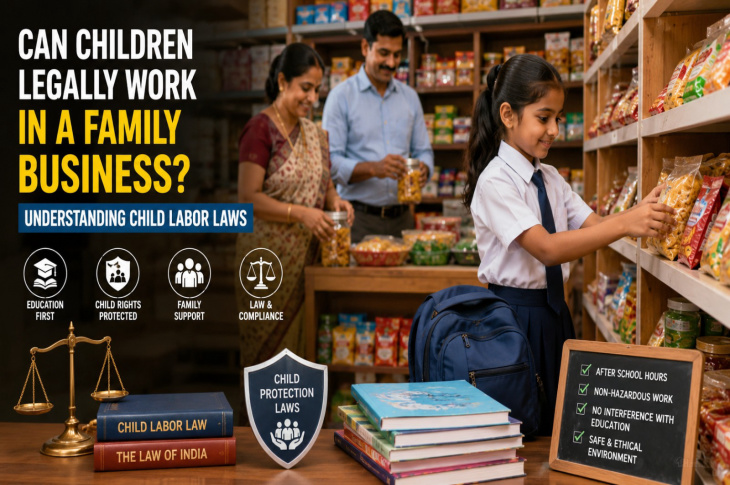


Can Children Legally Work in a Family Business? Understanding Child Labor Laws in India


Introduction
India has a long tradition of family-run businesses. From small grocery stores and handicraft units to agricultural activities and home-based enterprises, family members often work together to support their livelihoods. In many households, children are seen helping parents after school, during vacations, or while learning traditional skills passed down through generations.
However, an important legal question often arises: Can children legally work in a family business in India?
The answer is not a simple yes or no.
Indian child labor laws generally prohibit the employment of children, but they also provide a limited exception allowing children to assist in family enterprises under specific conditions. This exception has generated significant discussion among lawmakers, child rights activists, employers, parents, and courts.
The law seeks to strike a careful balance between protecting children from exploitation and recognizing the realities of family-owned occupations. At the same time, it prioritizes education, health, safety, and overall development.
What Is Child Labour?
Child labour refers to work performed by children that negatively affects their education, physical health, mental well-being, safety, or overall development.
Not every activity performed by a child is considered illegal child labour. For example:
-
Helping parents with household chores
-
Assisting in a family shop for a short period after school
-
Learning traditional family skills
-
Participating in educational or vocational activities
may not necessarily qualify as child labour.
The real concern arises when work:
-
Prevents school attendance
-
Causes physical or psychological harm
-
Involves dangerous conditions
-
Becomes a child's primary occupation
-
Results in exploitation
The objective of child labour laws is not merely to prevent children from working but to ensure that childhood, education, and development are protected.
Why Child Labour Laws Exist
Children are among the most vulnerable members of society. Without legal safeguards, they may be exposed to:
-
Long working hours
-
Unsafe workplaces
-
Physical abuse
-
Economic exploitation
-
Loss of educational opportunities
-
Health risks
Child labour laws exist to ensure that children receive:
-
Education
-
Proper nutrition
-
Recreation
-
Healthcare
-
Emotional development
-
Protection from exploitation
These protections form the foundation of India's child welfare framework.
Constitutional Protection Against Child Labour
The Constitution of India provides strong safeguards for children.
Article 21A – Right to Education
Article 21A guarantees free and compulsory education for children between 6 and 14 years of age.
This means every child has a fundamental right to attend school and receive basic education.
Article 24 – Prohibition of Child Employment in Hazardous Work
Article 24 prohibits the employment of children below the age of 14 years in:
-
Factories
-
Mines
-
Hazardous occupations
-
Dangerous industries
This provision directly protects children from harmful working environments.
Article 39(e) and 39(f)
These Directive Principles require the State to ensure that:
-
Children are not forced into unsuitable work due to economic necessity.
-
Childhood is protected against exploitation.
-
Young persons develop in conditions of freedom and dignity.
Article 45
This provision encourages early childhood care and educational opportunities.
Together, these constitutional safeguards establish that child welfare is a national priority.
Main Law Governing Child Labour in India
The primary legislation governing child labour is:
Child and Adolescent Labour (Prohibition and Regulation) Act, 1986
This law was significantly amended in 2016 to strengthen child protection measures.
The amendment introduced stricter prohibitions while creating certain limited exceptions.
Who Is Considered a Child Under the Law?
The Act classifies young persons into two categories:
Child
A child is a person below 14 years of age.
Adolescent
An adolescent is a person between 14 and 18 years of age.
Different legal rules apply to these two groups.
General Rule: Employment of Children Is Prohibited
The 2016 amendment brought a major change.
Today, children below 14 years are generally prohibited from being employed in any occupation or process.
Earlier laws prohibited child labour only in selected hazardous industries. The current framework adopts a much broader prohibition.
This means that as a general rule, hiring a child for work is illegal.
However, there are specific exceptions.
Can Children Legally Work in a Family Business?
Yes, but only under limited circumstances.
The law allows children to assist in family enterprises subject to strict conditions and safeguards.
This is known as the family enterprise exception.
The exception recognizes that in India:
-
Family businesses are common.
-
Traditional occupations are often passed through generations.
-
Children may naturally assist parents in non-hazardous activities.
-
Economic realities sometimes require family participation.
However, this permission is not unlimited.
What Is a Family Enterprise?
A family enterprise generally refers to any business, profession, occupation, trade, manufacture, or work carried on by family members.
The law recognizes assistance provided within the family setup.
Family members may include:
-
Mother
-
Father
-
Brother
-
Sister
-
Maternal relatives
-
Paternal relatives
The business may be:
-
A grocery shop
-
A tailoring unit
-
A handicraft business
-
Agriculture-related work
-
A home-based enterprise
-
A traditional occupation
However, simply calling a business a "family business" does not automatically make child involvement legal.
Several legal conditions must still be satisfied.
Conditions Under Which Children May Assist in Family Businesses
1. Education Must Come First
The most important condition is that a child's education cannot suffer.
A child cannot skip school to work in the family enterprise.
Parents must ensure:
-
Regular attendance
-
Participation in school activities
-
Completion of homework
-
Continued educational progress
If work interferes with education, the activity may become illegal.
Example
A 12-year-old child helps at a family-owned stationery store for one hour after school.
This may be permissible.
However, if the child stops attending school and spends the entire day at the shop, it could amount to child labour.
2. Work Must Be Performed After School Hours
Children may assist only:
-
After school
-
During holidays
-
During vacations
Work cannot replace classroom education.
The purpose is to ensure that learning remains the child's primary responsibility.
3. Hazardous Activities Are Completely Prohibited
Even within a family business, children cannot participate in hazardous occupations.
This prohibition is absolute.
Examples include work involving:
-
Explosives
-
Mining operations
-
Toxic chemicals
-
Dangerous machinery
-
Highly inflammable substances
-
Hazardous manufacturing processes
Family ownership does not create an exception to these restrictions.
Example
A family may own a workshop involving dangerous chemical processing.
A child cannot legally participate in those activities even if the enterprise belongs to parents.
4. Work Must Be Light and Appropriate
The work assigned should be suitable for the child's age and capacity.
Children should not be required to:
-
Lift heavy loads
-
Operate dangerous equipment
-
Work under extreme temperatures
-
Perform physically exhausting tasks
The activity should remain limited and non-exploitative.
5. The Child's Health Must Be Protected
The work should not:
-
Cause physical injury
-
Affect mental health
-
Result in stress or fatigue
-
Endanger safety
Child welfare remains the overriding consideration.
Child Labour Rules, 2017: Additional Safeguards
The Child Labour Rules introduced further protections to prevent misuse of the family business exception.
No Night Work
Children cannot work between:
7:00 PM and 8:00 AM
This rule protects children from excessive working hours and unsafe conditions.
Limited Working Hours
Continuous work for long periods is not permitted.
Children should receive:
-
Adequate breaks
-
Time for studies
-
Time for rest
-
Time for recreation
No Replacement for Adult Workers
A child cannot be used as a substitute for adult labour.
Parents cannot rely on children to perform the duties that should ordinarily be carried out by adult employees.
Education Cannot Be Interrupted
Authorities may intervene if a child's schooling is being affected.
School attendance remains a critical compliance requirement.
Difference Between Helping and Child Labour
One of the most challenging legal questions is determining where assistance ends and exploitation begins.
Helping in a Family Business
Generally permissible when:
-
The child attends school regularly
-
Work is occasional and limited
-
Tasks are light and safe
-
There is no coercion
-
Health and education remain unaffected
-
Illegal Child Labour
Likely exists when:
-
The child works long hours
-
School attendance declines
-
Work becomes full-time
-
Hazardous activities are involved
-
Physical or mental harm occurs
-
The child is effectively treated as a worker
Courts and authorities typically examine the actual circumstances rather than merely accepting a family's description of the arrangement.
Why Was the Family Business Exception Introduced?
India's economy includes millions of small family-run enterprises.
Many households depend on:
-
Agriculture
-
Traditional crafts
-
Street vending
-
Small retail shops
-
Home-based production units
Lawmakers recognized that occasional participation by children in these settings may differ from commercial exploitation.
Supporters argue that children may:
-
Learn family skills
-
Understand traditional occupations
-
Develop responsibility
-
Gain practical exposure
while continuing their education.
The exception was therefore introduced to accommodate social realities while maintaining safeguards.
Criticism of the Family Business Exception
Despite its objectives, the exception has attracted criticism.
Child rights advocates argue that it can be misused.
Common Concerns
Hidden Child Labour
Employers may disguise commercial work as family assistance.
School Dropouts
Children may gradually spend more time working and less time studying.
Lack of Monitoring
Family enterprises often operate in the informal sector where inspections are limited.
Economic Pressure
Children may feel compelled to work because of family poverty.
Critics believe these factors can make enforcement difficult.
International Perspective on Children Working in Family Businesses
Globally, child labour laws focus on the impact of work rather than merely the existence of work.
The principles followed by international organizations generally consider:
-
Nature of the work
-
Duration
-
Safety conditions
-
Educational impact
-
Child welfare
The goal is to eliminate harmful and exploitative labour while recognizing that some limited family participation may occur in cultural and economic contexts.
India is also a signatory to international child rights commitments that emphasize protection from economic exploitation.
Important Court Decisions on Child Labour
Indian courts have repeatedly emphasized child welfare while acknowledging socio-economic realities.
M.C. Mehta v. State of Tamil Nadu
This landmark Supreme Court case highlighted the connection between poverty and child labour.
The Court recognized that many families rely on children's earnings due to financial hardship.
The judgment stressed the importance of:
-
Rehabilitation
-
Educational opportunities
-
Alternative employment for adults
The Court sought solutions that protect children without pushing families into deeper poverty.
Court on Its Own Motion v. Government of NCT Delhi
The Court observed that merely removing children from work is often insufficient.
Authorities must also address:
-
Poverty
-
Family welfare
-
Access to government support schemes
The judgment reinforced the idea that child protection requires broader social intervention.
Judicial Approach to Family Participation
Various courts have generally adopted a balanced approach.
They examine:
-
The child's age
-
Educational status
-
Nature of work
-
Working hours
-
Family circumstances
The focus remains on determining whether the child's welfare is being protected.
Penalties for Violating Child Labour Laws
The law imposes strict penalties on those who illegally employ children.
Depending on the nature of the violation, consequences may include:
-
Imprisonment
-
Monetary fines
-
Criminal prosecution
Authorities may also initiate rescue and rehabilitation measures for affected children.
Businesses attempting to misuse the family enterprise exception may face legal action if investigations reveal exploitation.
Practical Compliance Tips for Families Running Businesses
Families should take proactive steps to remain legally compliant.
Ensure School Attendance
Keep records demonstrating regular attendance and educational participation.
Restrict Work Hours
Allow only limited assistance after school or during vacations.
Avoid Hazardous Activities
Never involve children in dangerous processes, machinery, chemicals, or risky environments.
Maintain Child Welfare
Ensure adequate:
-
Rest
-
Recreation
-
Nutrition
-
Study time
Do Not Use Children as Workers
Children should not perform duties equivalent to full-time employees.
Document Family Relationship
Where necessary, maintain records showing that the enterprise is genuinely family-owned.
Conclusion
The question of whether children can legally work in a family business does not have a simple answer. Indian law generally prohibits child labour but permits limited assistance in family enterprises under carefully regulated conditions. The objective is to accommodate India's social and economic realities without compromising a child's education, safety, health, or overall development.
The key principle is that helping is not the same as working. A child occasionally assisting parents after school in a safe environment is very different from a child performing long hours of labour, missing classes, or being exposed to hazardous conditions.
Parents, business owners, and guardians must remember that the family business exception is not a loophole for employing children. It is a narrowly tailored provision designed to allow limited participation while preserving the child's right to education, dignity, and childhood.
As India continues to strengthen child protection measures, the ultimate legal and moral responsibility remains clear: every child deserves an opportunity to learn, grow, and enjoy a safe childhood free from exploitation.
Frequently asked questions
Can a child work during school hours in a family business?
Can a child work during school hours in a family business?
No. Education must remain the priority.
Can a child below 14 years help in a family shop?
Can a child below 14 years help in a family shop?
Yes, provided the assistance occurs after school hours, does not affect education, and involves non-hazardous work.
Is agricultural work by children always legal?
Is agricultural work by children always legal?
Not necessarily. The legality depends on the nature of the work, safety conditions, working hours, and educational impact.
Can adolescents between 14 and 18 years work?
Can adolescents between 14 and 18 years work?
Adolescents may work in certain occupations but cannot be employed in hazardous occupations or processes prohibited by law.
Can parents be punished for violating child labour laws?
Can parents be punished for violating child labour laws?
Yes. Violations may attract legal penalties, including fines and imprisonment under applicable laws.

Online Consultation


Online Consultations


Trending
Frequently asked questions
Can a child work during school hours in a family business?
Can a child work during school hours in a family business?
No. Education must remain the priority.
Can a child below 14 years help in a family shop?
Can a child below 14 years help in a family shop?
Yes, provided the assistance occurs after school hours, does not affect education, and involves non-hazardous work.
Is agricultural work by children always legal?
Is agricultural work by children always legal?
Not necessarily. The legality depends on the nature of the work, safety conditions, working hours, and educational impact.
Can adolescents between 14 and 18 years work?
Can adolescents between 14 and 18 years work?
Adolescents may work in certain occupations but cannot be employed in hazardous occupations or processes prohibited by law.
Can parents be punished for violating child labour laws?
Can parents be punished for violating child labour laws?
Yes. Violations may attract legal penalties, including fines and imprisonment under applicable laws.
Online Consultations


Ask a Lawyer