


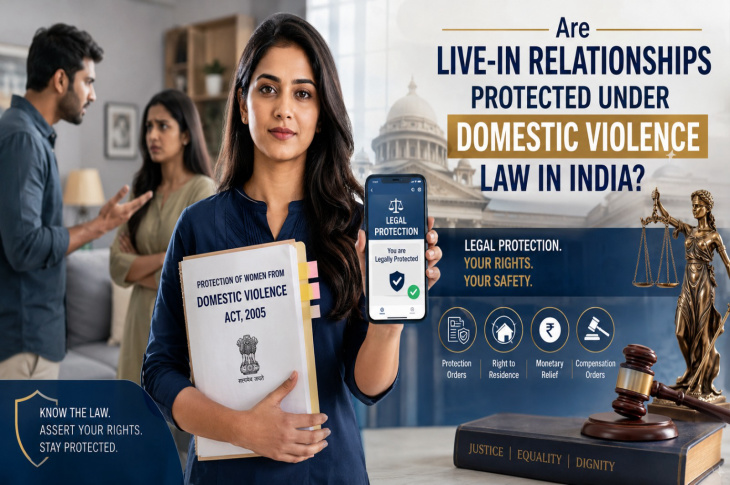


Are Live-In Relationships Protected Under Domestic Violence Law in India?


Introduction
Indian society has witnessed significant changes in the way personal relationships are viewed and accepted. While marriage continues to be the most recognized form of relationship, an increasing number of couples are choosing to live together without formally marrying. These arrangements, commonly known as live-in relationships, have raised several legal questions regarding the rights and protections available to partners, particularly women.
One of the most important concerns is whether a woman living in a live-in relationship can seek legal protection if she faces abuse, harassment, or violence from her partner. The answer lies in India's domestic violence laws, which have evolved to recognize that abuse is not confined to legally married relationships alone.
The Protection of Women from Domestic Violence Act, 2005 (PWDVA) provides legal remedies to women facing domestic abuse. Importantly, under certain circumstances, this protection extends to women who are in relationships that resemble marriage, even if no formal wedding has taken place.
Understanding Live-In Relationships in India
A live-in relationship generally refers to an arrangement where two consenting adults live together in a shared household without entering into a legally recognized marriage.
Unlike marriage, a live-in relationship:
-
Does not require religious ceremonies.
-
Does not require registration.
-
Does not create marital status automatically.
-
Is based on mutual consent and companionship.
India does not currently have a separate law governing live-in relationships. However, courts have repeatedly addressed issues arising from such relationships in cases involving maintenance, domestic violence, inheritance, child legitimacy, and property disputes.
Over time, Indian courts have recognized that social realities are changing and that legal protection cannot be denied merely because a couple chose not to marry.
What Is Domestic Violence Under Indian Law?
Domestic violence is much broader than physical assault. The Protection of Women from Domestic Violence Act, 2005 recognizes multiple forms of abuse that can occur within a domestic relationship.
The law identifies the following forms of domestic violence:
Physical Abuse
Physical violence includes:
-
Hitting
-
Slapping
-
Kicking
-
Beating
-
Causing bodily injury
-
Wrongful confinement
Example
If a woman is repeatedly assaulted by her live-in partner during arguments, such conduct may amount to physical abuse under the Act.
Emotional and Psychological Abuse
Mental cruelty can be equally harmful.
Examples include:
-
Constant humiliation
-
Threats of abandonment
-
Character assassination
-
Public embarrassment
-
Isolation from family and friends
Example
A partner repeatedly insulting a woman, calling her degrading names, or threatening to throw her out of the house may constitute emotional abuse.
Verbal Abuse
Verbal abuse includes:
-
Insults
-
Abusive language
-
Threats
-
Repeated derogatory comments
Sexual Abuse
Sexual abuse may include:
-
Forced sexual acts
-
Non-consensual sexual conduct
-
Sexual humiliation
-
Coercive behavior
Economic Abuse
Economic abuse often goes unnoticed but can severely impact a woman's independence.
Examples include:
-
Denying access to money
-
Controlling finances
-
Preventing employment
-
Refusing basic household expenses
-
Disposing of shared assets without consent
Does the Domestic Violence Act Protect Women in Live-In Relationships?
Yes. The Protection of Women from Domestic Violence Act, 2005 extends protection beyond legally married women.
The law recognizes a "domestic relationship," which includes certain relationships that are "in the nature of marriage."
This means that if a live-in relationship closely resembles a marital relationship, the woman may seek remedies under the Act.
However, every live-in relationship does not automatically qualify for protection. Courts examine the facts and circumstances of each case before granting relief.
What Does “Relationship in the Nature of Marriage” Mean?
This phrase forms the foundation of legal protection for women in live-in relationships.
The law does not provide a rigid definition. Therefore, Indian courts have developed guidelines to determine whether a particular relationship resembles marriage.
A relationship in the nature of marriage generally involves:
-
Long-term commitment
-
Shared household
-
Emotional bonding
-
Financial interdependence
-
Public recognition as a couple
-
Stability and continuity
The objective is to distinguish genuine domestic partnerships from casual, temporary, or purely physical relationships.
How Courts Determine Whether a Live-In Relationship Qualifies for Protection
No single factor is decisive. Courts evaluate the overall nature of the relationship.
1. Duration of Cohabitation
A long-term relationship generally carries greater legal significance than a brief association.
Courts often look at:
-
Number of years spent together
-
Continuity of cohabitation
-
Stability of the relationship
Example
A couple living together continuously for ten years is more likely to receive legal recognition than partners who cohabited for a few weeks.
2. Shared Household
Living together under one roof is a key indicator.
Courts may consider:
-
Rental agreements
-
Utility bills
-
Residential records
-
Neighbour testimony
The shared household should reflect a domestic arrangement rather than occasional visits.
3. Public Recognition as a Couple
Courts examine whether the couple presented themselves socially as partners.
Relevant evidence may include:
-
Invitations to family functions
-
Social media posts
-
Joint photographs
-
Statements of relatives and friends
Example
If neighbours, relatives, and friends consistently viewed the couple as husband and wife, it strengthens the claim.
4. Legal Capacity to Marry
Courts generally expect both individuals to be legally capable of marriage.
This means:
-
Both must be adults.
-
Neither should be prohibited by law from marrying.
-
The relationship should not violate legal restrictions.
This factor becomes particularly important in complex situations involving existing marriages.
5. Emotional and Personal Commitment
A genuine domestic relationship usually involves:
-
Emotional support
-
Mutual care
-
Long-term planning
-
Shared responsibilities
Courts often look beyond physical intimacy and examine whether the relationship reflected a family-like structure.
6. Financial Interdependence
Financial arrangements frequently reveal the seriousness of a relationship.
Indicators include:
-
Joint bank accounts
-
Shared investments
-
Joint property ownership
-
Shared household expenses
Example
A couple contributing jointly to rent, groceries, and utilities demonstrates financial integration similar to marriage.
7. Domestic Responsibilities
The performance of household responsibilities often indicates a stable domestic partnership.
Courts may consider whether the partners:
-
Managed household expenses together
-
Shared domestic duties
-
Took care of each other's needs
8. Presence of Children
Having children together may strongly support the existence of a relationship resembling marriage.
Children often demonstrate:
-
Long-term commitment
-
Shared responsibilities
-
Family structure
Courts generally view such relationships more seriously.
Landmark Judicial Decisions on Live-In Relationships
Indian courts have played a crucial role in shaping legal protection for women in live-in relationships.
Badri Prasad v. Director of Consolidation
This case involved a couple who had lived together for several decades.
The Supreme Court observed that prolonged cohabitation creates a strong presumption in favor of marriage unless proven otherwise.
Significance
The judgment acknowledged that long-term cohabitation deserves legal recognition and respect.
Revanasiddappa v. Mallikarjun
The Supreme Court adopted a progressive approach while addressing issues arising from non-traditional family structures.
The Court emphasized that changing social realities require laws to be interpreted in a manner that protects vulnerable individuals, particularly women and children.
Significance
The judgment reinforced the need to ensure justice for people living outside conventional marital arrangements.
Indra Sarma v. V.K.V. Sarma
This is one of the most important decisions regarding live-in relationships under domestic violence law.
The Supreme Court clarified:
-
Not every live-in relationship qualifies for protection.
-
Only relationships resembling marriage are covered.
-
Courts must evaluate various factors before granting relief.
The judgment laid down practical indicators for identifying a relationship in the nature of marriage.
Significance
It remains one of the leading authorities on the subject and continues to guide courts across India.
Rights Available to Women in Qualifying Live-In Relationships
When a live-in relationship satisfies legal requirements, a woman may seek several remedies under the Domestic Violence Act.
Right to Protection Orders
Courts may issue orders preventing the abusive partner from:
-
Committing further violence
-
Contacting the victim
-
Threatening or harassing her
-
Entering specific locations
These orders are designed to provide immediate safety.
Right to Residence
A woman cannot simply be thrown out of the shared household because the relationship was not legally registered as a marriage.
Courts may pass residence orders that:
-
Allow continued residence
-
Prevent unlawful eviction
-
Ensure housing security
Example
If a woman has lived with her partner for several years and faces domestic violence, she may seek protection against forced eviction.
Monetary Relief
Financial assistance may be granted for:
-
Household expenses
-
Medical treatment
-
Loss of earnings
-
Maintenance requirements
The court determines relief based on the facts of each case.
Compensation for Mental Trauma
Victims may seek compensation for:
-
Emotional suffering
-
Psychological trauma
-
Mental harassment
-
Physical injuries
This remedy recognizes that abuse often causes damage beyond visible injuries.
Child Custody Orders
Where children are involved, courts may pass temporary custody orders to protect their welfare and interests.
When Protection May Not Be Available
Legal protection is not available in every situation.
Courts generally refuse to treat the following as relationships in the nature of marriage:
Casual Relationships
Short-term relationships lacking stability usually do not qualify.
Example
A brief romantic association without shared domestic life may not receive protection.
One-Time or Sporadic Relationships
Occasional meetings or temporary arrangements typically fall outside the scope of the Act.
Purely Sexual Relationships
A relationship based solely on physical intimacy without domestic commitment may not qualify.
Commercial Arrangements
Transactional relationships are generally excluded from protection under this category.
Relationships Without Evidence
Claims unsupported by evidence often face difficulties.
Courts may require proof such as:
-
Address records
-
Joint documents
-
Witness testimony
-
Financial records
-
Photographs
Practical Challenges Faced by Women in Live-In Relationships
Although legal recognition exists, women often face significant obstacles in seeking justice.
Social Stigma
Many parts of India continue to view live-in relationships negatively.
Women may face:
-
Family pressure
-
Social criticism
-
Community isolation
-
Emotional stress
Fear of judgment often prevents victims from seeking legal help.
Difficulty in Proving the Relationship
Unlike marriage, live-in relationships often lack formal documentation.
Women may struggle to establish:
-
Duration of cohabitation
-
Shared residence
-
Financial dependence
-
Public recognition
As a result, evidence gathering becomes critical.
Economic Dependence
Many women become financially dependent on their partners.
When abuse occurs, they may fear:
-
Homelessness
-
Financial instability
-
Loss of support
This dependence can make leaving an abusive relationship extremely difficult.
Lack of Legal Awareness
Many women are unaware that domestic violence law may protect them even without marriage.
As a result:
-
Complaints are delayed.
-
Evidence gets lost.
-
Abuse continues unchecked.
Awareness remains one of the most important tools for protection.
Live-In Relationship vs Marriage: Key Legal Differences
Although courts recognize certain live-in relationships, important differences remain.
| Aspect | Marriage | Live-In Relationship |
|---|---|---|
| Legal Recognition | Direct statutory recognition | Limited recognition through judicial interpretation |
| Formal Ceremony | Usually required | Not required |
| Registration | Possible and often encouraged | Not mandatory |
| Divorce Process | Legal dissolution required | Usually no formal dissolution |
| Inheritance Rights | Generally clearer | Often dependent on facts and separate legal claims |
| Proof of Relationship | Marriage certificate available | Evidence must be produced |
Understanding these distinctions is important before entering any long-term relationship.
What Should Women Do If They Face Domestic Violence in a Live-In Relationship?
Women experiencing abuse should take immediate steps to protect themselves.
Preserve Evidence
Keep records such as:
-
Messages
-
Emails
-
Photographs
-
Medical reports
-
Audio or video recordings (where legally permissible)
Seek Medical Assistance
If physical violence occurs:
-
Obtain treatment immediately.
-
Request medical documentation.
Medical records often become crucial evidence.
Approach Protection Officers
Protection Officers appointed under the Domestic Violence Act can assist victims in filing complaints and obtaining relief.
Contact a Lawyer
Professional legal advice helps determine:
-
Eligibility under the Act
-
Available remedies
-
Documentation requirements
-
Court procedures
File an Application Before the Magistrate
The Domestic Violence Act allows women to seek urgent legal protection through the courts.
Relief can often be sought without waiting for lengthy litigation.
How Indian Courts Are Adapting to Social Change
Indian courts have increasingly recognized that family structures are evolving.
The judiciary has repeatedly emphasized that:
-
Women's dignity must be protected.
-
Abuse cannot be ignored merely because a relationship lacks formal marriage.
-
Legal remedies should reflect social realities.
At the same time, courts have attempted to prevent misuse by carefully distinguishing genuine domestic partnerships from casual associations.
This balanced approach seeks to protect vulnerable women while preserving the integrity of the law.
Conclusion
Live-in relationships are no longer viewed entirely outside the scope of legal protection in India. The Protection of Women from Domestic Violence Act, 2005 recognizes that domestic abuse can occur even when a couple has not formally married. As a result, women in relationships that resemble marriage may seek protection against physical, emotional, sexual, verbal, and economic abuse.
However, protection is not automatic. Courts carefully examine whether the relationship demonstrates the characteristics of a genuine domestic partnership, including long-term cohabitation, shared household arrangements, emotional commitment, financial interdependence, and public recognition as a couple.
Through progressive judicial decisions, India has gradually adapted its legal framework to address modern relationship realities while ensuring that vulnerable women are not left without remedies. For women facing abuse in a live-in relationship, understanding these rights can be the first step toward safety, dignity, and justice.
Frequently asked questions
Is a live-in relationship legal in India?
Is a live-in relationship legal in India?
Yes. Consenting adults are generally free to live together without marriage, and courts have repeatedly recognized the legality of such arrangements.
Can a woman in a live-in relationship file a domestic violence case?
Can a woman in a live-in relationship file a domestic violence case?
Yes, if the relationship qualifies as a relationship in the nature of marriage under the Protection of Women from Domestic Violence Act, 2005.
Does every live-in relationship get legal protection?
Does every live-in relationship get legal protection?
No. Courts evaluate factors such as duration, shared household, financial arrangements, commitment, and public recognition.
Can a woman claim residence rights in a live-in relationship?
Can a woman claim residence rights in a live-in relationship?
In qualifying cases, courts may grant residence-related protection under the Domestic Violence Act.
Can children born from live-in relationships receive legal recognition?
Can children born from live-in relationships receive legal recognition?
Indian courts have generally adopted a protective approach toward children born from such relationships, ensuring their welfare and legal rights.

Online Consultation


Online Consultations


Trending
Frequently asked questions
Is a live-in relationship legal in India?
Is a live-in relationship legal in India?
Yes. Consenting adults are generally free to live together without marriage, and courts have repeatedly recognized the legality of such arrangements.
Can a woman in a live-in relationship file a domestic violence case?
Can a woman in a live-in relationship file a domestic violence case?
Yes, if the relationship qualifies as a relationship in the nature of marriage under the Protection of Women from Domestic Violence Act, 2005.
Does every live-in relationship get legal protection?
Does every live-in relationship get legal protection?
No. Courts evaluate factors such as duration, shared household, financial arrangements, commitment, and public recognition.
Can a woman claim residence rights in a live-in relationship?
Can a woman claim residence rights in a live-in relationship?
In qualifying cases, courts may grant residence-related protection under the Domestic Violence Act.
Can children born from live-in relationships receive legal recognition?
Can children born from live-in relationships receive legal recognition?
Indian courts have generally adopted a protective approach toward children born from such relationships, ensuring their welfare and legal rights.
Online Consultations


Ask a Lawyer