
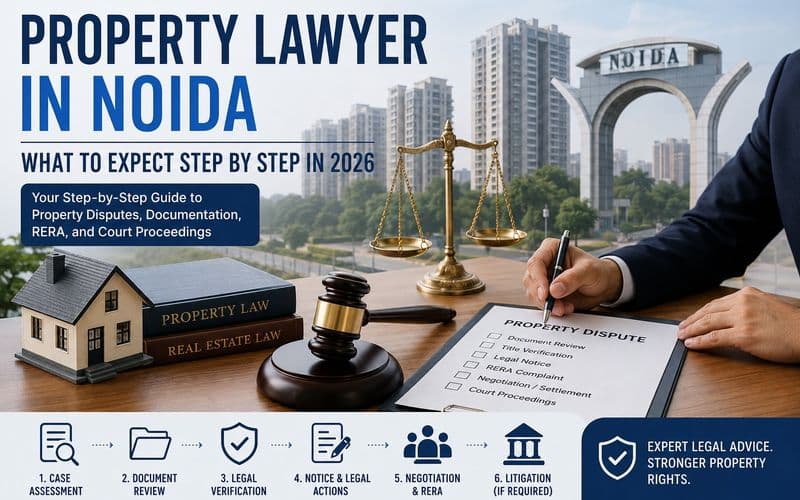
Buying, selling, inheriting, or defending property in Noida can involve far more than signing a sale deed. Problems may arise over ownership, possession, builder delays, family rights, unpaid dues, illegal construction, boundaries, mortgages, or defective property documents.
When a dispute appears, the first question many property owners ask is: What will a property lawyer in Noida actually do for me?
The answer depends on the nature of the property and the legal problem. A lawyer may begin by examining your documents, tracing the ownership history, checking registration and encumbrance records, identifying the appropriate legal remedy, negotiating with the other party, issuing a legal notice, filing a complaint before the appropriate authority, or representing you in court.
This guide explains the process step by step so you know what to prepare, what questions to ask, and what to expect before hiring a property lawyer in Noida in 2026.
> Important: Property disputes are highly fact-specific. The appropriate forum, limitation period, documents, and remedy can differ from one case to another. This article provides general legal information and should not be treated as case-specific legal advice.
What Does a Property Lawyer in Noida Handle?
A property lawyer may advise on both transactions and disputes involving residential, commercial, and land-related property.
Common matters include:
- Property title verification
- Sale and purchase due diligence
- Sale deed and agreement review
- Property registration issues
- Builder-buyer disputes
- Delayed possession
- Defective or incomplete construction
- Property possession disputes
- Illegal occupation or encroachment
- Boundary disputes
- Partition of jointly owned property
- Ancestral property disputes
- Inheritance-related property claims
- Property mutation and revenue-record issues
- Mortgage and charge-related problems
- Cancellation or rectification of property documents
- Lease and tenancy-related property disputes
- Injunction proceedings
- Declaration and title disputes
- RERA complaints involving eligible real-estate projects
The lawyer's role is not simply to "fight the case." A competent property lawyer first determines what legal right has been affected and what remedy can realistically protect it.
Property Lawyer in Noida: The Step-by-Step Process
Although every matter is different, a typical property-law engagement can move through the following stages:
| Stage | What Usually Happens | | Initial consultation | Lawyer understands the property and identifies the legal issue | | Document assessment | Ownership, agreements, receipts, notices and other records are examined | | Title and legal verification | Relevant registration, encumbrance and other records may be checked | | Legal strategy | Lawyer identifies possible remedies and the appropriate forum | | Notice or negotiation | A legal notice or settlement communication may be used where appropriate | | RERA/authority/court action | Complaint, application or civil proceedings may be initiated if necessary | | Evidence and hearings | Documents, witnesses and legal arguments are presented | | Resolution or appeal | Matter concludes through settlement, order, judgment or further legal remedy |
Stage What Usually Happens Initial consultation Lawyer understands the property and identifies the legal issue Document assessment Ownership, agreements, receipts, notices and other records are examined Title and legal verification Relevant registration, encumbrance and other records may be checked Legal strategy Lawyer identifies possible remedies and the appropriate forum Notice or negotiation A legal notice or settlement communication may be used where appropriate RERA/authority/court action Complaint, application or civil proceedings may be initiated if necessary Evidence and hearings Documents, witnesses and legal arguments are presented Resolution or appeal Matter concludes through settlement, order, judgment or further legal remedy
The stages do not always occur in exactly this order. For example, an urgent injunction issue may require immediate court action rather than a prolonged pre-litigation exchange.
Step 1: Identify Exactly What Property Problem You Have
The first consultation should not begin with "I have a property dispute."
Your lawyer needs to know what is actually being disputed.
For example, these situations may look similar but require very different legal strategies.
Title dispute Someone claims ownership over your property, or there is a problem in the chain of title.
Possible issues include:
- Missing previous sale documents
- Conflicting sale deeds
- Unauthorized transfers
- Questions about the seller's title
- Fraudulent or disputed documents
- Multiple claims over the same property
Possession Dispute You may have ownership documents but someone else is occupying the property, or a buyer is unable to obtain possession.
Builder Dispute A builder may have:
- Delayed possession
- Failed to provide promised facilities
- Delivered a property with defects
- Demanded amounts contrary to the agreement or applicable law
- Failed to execute required documentation
- Failed to comply with applicable RERA obligations
For eligible real-estate matters, the Uttar Pradesh Real Estate Regulatory Authority (UP-RERA) provides a dedicated mechanism for complaints and dispute resolution. UP-RERA states that the RERA framework is intended to protect real-estate consumers and provide an adjudicatory mechanism for grievance redressal.
Partition dispute A family may disagree about shares in jointly held or inherited property.
These cases can require examination of:
- Family relationships
- Previous partitions
- Wills
- Succession documents
- Earlier transfers
- Revenue records
- Existing title documents
Boundary or encroachment dispute A disagreement may concern the exact extent of land, construction across a boundary, or alleged encroachment.
The appropriate evidence can include the registered documents, site plans, approved plans, survey or measurement records, and relevant authority records.
Why classification matters: You should not choose a legal remedy merely because someone else had a similar property problem. The correct remedy depends on the documents, facts, property type, and relief required.
Step 2: Your Property Lawyer Will Review the Documents
The strength of a property case often depends heavily on the documentary trail.
Before your first consultation, collect as much relevant material as possible.
Property documents you may need
Depending on the matter, these can include:
- Current sale deed
- Previous sale deeds
- Agreement to sell
- Builder-buyer agreement
- Allotment letter
- Conveyance deed
- Gift deed
- Will
- Probate or succession-related documents, where applicable
- Partition deed
- Relinquishment deed
- Power of attorney
- Possession letter
- Property tax records
- Mutation records
- Revenue records
- Encumbrance-related records
- Mortgage or loan documents
- Bank correspondence
- No-dues certificates
- Approved building plans
- Property/site plans
- Completion or occupancy-related documents, where applicable
- Receipts for payments
- Notices received from authorities or private parties
- Emails, letters and relevant messages
- Photographs or videos documenting the property condition
- Previous court or authority orders
Do not discard documents simply because they appear old or irrelevant.
A document that seems insignificant to you may establish an important part of the ownership history.
Step 3: The Lawyer Builds the Property's Legal History
One of the most important parts of property due diligence is understanding how the property reached its present owner.
Suppose a person purchased a plot from B.
B acquired it from C.
C received it through an earlier transfer from D.
If one of those transactions is legally defective, the current buyer may face a problem even though their own sale deed appears properly executed.
This is why a property lawyer may examine the chain of title rather than looking only at the latest document.
What may be checked?
Depending on the property, the lawyer may investigate:
- Registration records
- Earlier conveyances
- Encumbrances
- Existing mortgages or charges
- Court disputes
- Revenue records
- Mutation status
- Authority records
- Development or layout approvals
- Builder/project documentation
- RERA registration and project information, where relevant
The Uttar Pradesh registration system contains provisions concerning inspection and searches of registration records, including searches connected with encumbrances in specified circumstances.
Why an encumbrance check matters
A property may appear clean because the seller has possession and a registered document. That does not automatically establish that there are no competing interests or charges.
A lawyer can help determine what searches and records are appropriate for the particular property.
Step 4: The Lawyer Explains Your Legal Options
After reviewing the documents, a good consultation should end with options, not just a diagnosis.
For example, depending on the facts, your lawyer may recommend:
- Negotiation with the other party
- A formal legal notice
- Mediation or settlement
- Complaint before a regulatory authority
- RERA proceedings
- Civil litigation
- Injunctive relief
- Declaration of rights
- Possession-related proceedings
- Cancellation or rectification-related remedies
- Appeal or other challenge to an existing order
Not every property dispute needs a lawsuit.
In fact, if the dispute can be resolved safely and effectively through negotiation, litigation may not be the most practical first step.
However, settlement should not mean giving up important legal rights without understanding the consequences.
Step 5: A Legal Notice May Be Sent
A legal notice is often used before formal proceedings, although it is not legally mandatory in every private property dispute.
The notice may explain:
- The relevant facts
- Your legal rights
- The documents supporting your position
- The other party's alleged breach or unlawful conduct
- The action demanded
- A deadline for responding
- Consequences of non-compliance
For example, a notice to a builder concerning delayed possession may be very different from a notice concerning encroachment by a neighboring landowner.
A professionally drafted notice should therefore be based on the actual documents rather than a generic template downloaded from the internet.
What should you do after receiving a property legal notice?
Do not ignore it.
Instead:
- Check who issued it.
- Note the date.
- Identify any response deadline.
- Preserve the envelope/email and attachments.
- Gather the documents mentioned in the notice.
- Avoid making admissions in writing before taking legal advice.
- Ask a property lawyer to review the allegations and supporting documents.
An aggressive response is not necessarily a strong response. The objective should be to protect your legal position.
Step 6: Builder Disputes May Involve UP-RERA
If your issue concerns a real-estate project covered by RERA, the appropriate remedy may involve UP-RERA.
UP-RERA provides an online complaint mechanism and currently maintains systems for complaint filing, status tracking, cause lists and related proceedings.
The official UP-RERA material also explains that complaints may be filed by eligible aggrieved persons for violations of the RERA Act, rules or regulations.
Examples of builder-related issues
A lawyer may assess whether the matter concerns:
- Delay in possession
- Refund
- Interest
- Compensation
- Defects
- Non-compliance with contractual or statutory obligations
- Project-related representations
- Other violations covered by applicable RERA provisions
UP-RERA also operates a conciliation mechanism intended to facilitate amicable settlement between allottees and promoters and reduce the need for prolonged litigation.
Important: RERA is not automatically the answer to every property dispute
A dispute involving family ownership, a traditional title conflict, inheritance, or certain land-right questions may require a different legal route.
Your lawyer should determine the appropriate forum rather than filing a complaint simply because the property is located in Noida.
Step 7: Civil Court Proceedings May Become Necessary
If negotiation, settlement or an appropriate regulatory remedy does not resolve the dispute, civil litigation may be considered.
The relief sought determines the nature of the proceeding.
Depending on the facts, a case may involve claims relating to:
- Declaration of rights
- Possession
- Permanent or temporary injunction
- Partition
- Specific performance
- Cancellation of instruments
- Recovery of property
- Other civil remedies
The Specific Relief Act, 1963, for example, contains provisions concerning recovery of immovable property, dispossession, specific performance, cancellation, declarations and injunctions.
For suits involving rights in immovable property, the Code of Civil Procedure generally contains territorial-jurisdiction rules connected with the location of the property, subject to applicable exceptions and other jurisdictional requirements.
A Noida property lawyer should therefore assess jurisdiction before filing a case.
Step 8: Evidence Becomes Critical Once Litigation Starts
Once a dispute reaches court, simply saying "the property belongs to me" is not enough.
Your lawyer must establish the relevant facts through admissible evidence.
Depending on the dispute, evidence may include:
- Registered documents
- Official records
- Payment records
- Correspondence
- Expert reports
- Site plans
- Photographs
- Witness testimony
- Authority records
- Previous judgments or orders
- Other legally relevant documents
Keep the original documents safely stored.
Do not write on originals, alter them, or hand them over permanently without understanding why they are required and obtaining appropriate acknowledgements.
How Long Does a Property Case in Noida Take?
There is no reliable universal timeline for property litigation.
A matter may conclude relatively quickly if the parties reach an agreement. A contested title or partition dispute can take substantially longer.
The duration may depend on:
- Number of parties
- Complexity of title
- Quality of documentary evidence
- Interim applications
- Opposing party's defence
- Court workload
- Evidence requirements
- Adjournments
- Appeals
- Compliance with court orders
Therefore, be cautious if someone guarantees that a complicated property dispute will definitely be resolved within a few weeks or months.
A responsible lawyer should explain what can be controlled and what depends on the other party, authority, or court.
Do Not Ignore Limitation Periods
One of the biggest mistakes property owners make is waiting too long before obtaining legal advice.
Different causes of action have different limitation rules. The Limitation Act, 1963 provides specific periods for different categories of suits. For example, Article 65 of the Schedule provides a 12-year period for a suit for possession of immovable property or an interest in it based on title, subject to the statutory rules and facts of the case.
This does not mean every property dispute has a 12-year limitation period.
Other claims may have different limitation periods, and the starting point can vary according to the nature of the claim and applicable law.
The safest approach is to have the limitation issue assessed as soon as the dispute becomes apparent.
How Much Does a Property Lawyer in Noida Charge?
There is no single standard fee for all property matters.
The cost may depend on:
- Type of legal issue
- Complexity of the title
- Number of documents
- Due-diligence requirements
- Whether a legal notice is required
- Whether a RERA complaint is involved
- Whether court representation is required
- Number of hearings
- Number of parties
- Seniority and experience of the lawyer
- Location and nature of the proceedings
Before engaging a lawyer, ask for a written explanation of the fee structure.
Questions worth asking
- Is the consultation charged separately?
- Is document review included?
- Is title verification included?
- Is drafting a legal notice included?
- What is the fee for filing a complaint?
- What is the representation fee?
- Are court fees separate?
- Are documentation or search expenses separate?
- Are appearance charges billed separately?
- What happens if the matter goes to appeal?
A low initial quote may not necessarily be cheaper if important services are charged separately later.
How to Choose the Right Property Lawyer in Noida
Choosing the right lawyer is about more than searching for "best property lawyer near me."
Look for relevant experience
A lawyer who primarily handles criminal matters may not be the best choice for a complex property title dispute.
Ask whether the lawyer regularly handles matters involving:
- Property title
- Real estate transactions
- Builder disputes
- RERA
- Partition
- Possession
- Injunctions
- Property documentation
- Local authority matters
Ask what the lawyer thinks your strongest evidence is
This is an excellent test during an initial consultation.
A lawyer who has actually reviewed your documents should be able to explain which documents help your case and which create risk.
Ask about weaknesses
Do not only ask:
> "Can I win?"
Ask:
> "What is the biggest legal weakness in my case?"
A trustworthy professional should be willing to discuss risks rather than promise a guaranteed outcome.
Verify who will handle the matter
If you hire a law firm or legal platform, clarify:
- Who will advise you?
- Who will draft documents?
- Who will appear before the authority or court?
- Who will communicate updates?
- Will another lawyer take over later?
Continuity can be particularly useful in complicated property matters because the lawyer needs to understand the documentary history and previous legal decisions.
Property Lawyer in Noida: Documents Checklist for Your First Consultation
Use this checklist before your appointment.
Ownership documents
- Current sale deed
- Previous title documents
- Agreement to sell
- Conveyance deed
- Gift/partition/relinquishment deed, if applicable
- Will or succession documents, if relevant
Property records
- Mutation documents
- Property tax receipts
- Encumbrance/search-related documents
- Site plan
- Approved plan, where relevant
- Authority correspondence
Builder documents
- Booking form
- Allotment letter
- Builder-buyer agreement/agreement for sale
- Payment receipts
- Demand letters
- Possession correspondence
- Emails with the builder
- Previous complaints
Dispute records
- Legal notices
- Replies
- Court documents
- RERA documents
- Police/authority complaints, where relevant
- Photographs/videos
- Relevant communications
Tip: Arrange the documents chronologically. This can make it much easier for the lawyer to understand what happened.
Common Mistakes to Avoid in a Noida Property Dispute
1. Waiting until the dispute becomes serious
Early legal advice can help you understand your position before irreversible steps are taken.
2. Relying only on mutation
Mutation or revenue entries can be important evidence, but they should not automatically be treated as conclusive proof of ownership in every property dispute.
The underlying title documents and applicable law must be examined.
3. Signing a settlement without legal review
A settlement can affect future ownership, possession, claims and rights.
Have the document reviewed before signing.
4. Destroying or deleting communications
Emails, letters, payment records and relevant messages may become important evidence.
Preserve them.
5. Assuming RERA solves every builder-related issue
RERA may be highly relevant, but the precise facts, project status, relief sought and legal issues must be assessed.
6. Assuming a legal notice means you have already lost
A notice is an allegation or legal demand. Its contents should be examined against the documents and applicable law.
7. Choosing a lawyer solely on price
Property disputes can involve substantial financial interests. Relevant expertise and communication may be more important than selecting the cheapest quote.
Property Transaction vs Property Dispute: When Should You Hire a Lawyer?
You do not have to wait for a dispute before consulting a property lawyer.
In many cases, preventive legal review is considerably more useful than trying to repair a defective transaction later.
Consider legal advice before:
- Buying a plot
- Buying a resale flat
- Purchasing inherited property
- Buying property from a company or trust
- Entering into a joint development arrangement
- Signing a builder agreement
- Executing a power of attorney
- Purchasing property with multiple owners
- Accepting property as a gift
- Dividing family property
- Selling disputed or inherited property
A pre-purchase legal review can help identify ownership, documentation and encumbrance concerns before money changes hands.
What to Expect From Your First Meeting With a Property Lawyer
A productive first consultation should ideally give you clarity on five things:
1. What is the actual legal issue?
You should understand whether you are facing a title, possession, contractual, inheritance, boundary, builder, RERA or another type of issue.
2. What documents matter?
The lawyer should identify missing or important documents.
3. What are your possible remedies?
You should understand the realistic legal routes available.
4. What are the risks?
Every dispute has risks. Ask about weaknesses as well as strengths.
5. What should happen next?
You should leave knowing the immediate next step, whether that means obtaining records, sending a notice, negotiating, filing a complaint, or commencing litigation.
Final Checklist Before Hiring a Property Lawyer in Noida
Before engaging a lawyer, make sure you can answer:
- What exactly is my property problem?
- Who currently claims the property or disputed right?
- What documents prove my position?
- Are any documents missing?
- Is there an existing court, RERA or authority proceeding?
- Could limitation be an issue?
- What remedy am I seeking?
- Which forum is appropriate?
- Can the matter realistically be settled?
- What will the legal work cost?
- Who will handle the case?
- What are the major risks?
The more clearly these questions are answered, the easier it becomes to make an informed decision.
Conclusion: Getting Legal Advice Early Can Protect Your Property Rights
A property dispute in Noida is rarely solved by simply producing one document or sending one angry message. Property rights are often built on a chain of documents, transactions, records and legal events.
A good property lawyer in Noida should therefore do more than tell you whether your case "looks strong." The lawyer should examine the documentary history, identify weaknesses, explain available remedies, assess the appropriate forum, discuss costs and risks, and help you decide whether negotiation, RERA proceedings, or litigation makes sense.
If you are currently dealing with a property dispute, do not wait until documents disappear, deadlines expire, or the opposing party takes an irreversible step. Organise your records and obtain professional legal advice at the earliest practical stage.
Looking for legal help with a property matter in Noida? Connect with an experienced property lawyer, share your documents and facts, and understand your legal options before taking the next step.
Frequently Asked Questions
When should I hire a property lawyer in Noida?
You should consider consulting a property lawyer when buying or selling high-value property, reviewing title documents, dealing with a builder dispute, facing an ownership conflict, handling inherited property, or receiving a legal notice concerning property.
Early advice can be particularly important where limitation, possession or transfer issues may arise.
What documents should I take to a property lawyer?
Take the sale deed and previous title documents, agreements, payment receipts, mutation and property records, tax documents, notices, correspondence, court or RERA documents, and any other material connected with the dispute.
If you do not have every document, do not postpone the consultation. Tell the lawyer what is missing.
Can a property lawyer help with a builder dispute in Noida?
Yes. Depending on the facts and the project's legal status, a lawyer may assess remedies involving UP-RERA, contractual claims, consumer or civil remedies, negotiation, or other appropriate proceedings.
The correct route depends on the nature of the dispute and relief sought.
Is a legal notice compulsory before filing a property case?
Not in every private property dispute. Whether notice is required or strategically advisable depends on the nature of the claim, the parties involved, applicable law and the remedy being pursued.
Can I settle a property dispute without going to court?
Yes, many disputes can potentially be resolved through negotiation, mediation, conciliation or a properly documented settlement.
However, settlement terms should be reviewed carefully before signing.
How long does a property dispute take in Noida?
There is no fixed timeline. Negotiated matters may conclude relatively quickly, while complicated civil litigation can take much longer. Court workload, evidence, number of parties, interim applications and appeals can all affect the duration.
Is mutation proof of property ownership?
Mutation is an important property record, but it should not automatically be treated as conclusive proof of title. Ownership must be assessed through the relevant title documents and applicable legal principles.
Can I handle a property dispute without a lawyer?
You may technically be able to take certain steps yourself, particularly where online filing or administrative procedures are available. However, complex title, possession, partition, RERA and court matters involve legal and procedural issues where professional advice can reduce avoidable mistakes.
What should I ask a property lawyer before hiring them?
Ask about their experience with your type of property matter, proposed legal strategy, documents required, likely stages, risks, expected expenses, fee structure, who will handle the matter and how updates will be communicated.
Comments
Commenting as Guest